We Do Windows (Home Server)
Scheduled to launch this fall, Windows Home Server connects multiple PCs in the same household and stores, manages, backs up and protects digital audio, video and photos.
In addition to centralized storage and backup, Windows Home Server also lets users access their digital content remotely and is built on the secure platform of Windows Server 2003, said Joel Sider, senior product manager in the Windows Home Server group at Microsoft, Redmond, Wash.
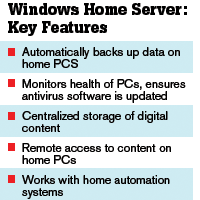
Although Windows Home Server is designed to be easy to install and use, the software fits well into the toolbox of home integrators, who can wrap it into a smart home solution along with home automation and networking technologies, Sider noted.
In addition to backup and remote access, Windows Home Server also works well in environments with high-end home automation and entertainment systems, said Mark Crall, president of Charlotte Tech Care Team, a Microsoft partner in Charlotte, N.C.
"It's the first time you've ever been able to have the words 'server' and 'home entertainment' combined in a single product. It's really a platform for the home," Crall said.
But the home market has proven difficult for Microsoft to crack, due in large part to the inability of Windows XP Media Center Edition to generate enough interest with the channel, said Todd Swank, vice president of marketing at Nor-Tech, Burnsville, Minn.
"There has always been this promise of the digital home, but the challenges are that it's a single sale and there isn't a lot of ongoing support. Partners tend to like multiple PC sales and services opportunities, and so far, the home market hasn't quite been there," Swank said.
Home automation has been a growing market for years, but from a pure networking and infrastructure point of view, Windows XP Media Center Edition didn't operate well with existing home products, said Amy Luby, CEO of Mobitech, an Omaha, Neb.-based solution provider.
"The home automation market has been looking for stable, standardized products to build that infrastructure upon, but until now the market has been mainly proprietary products that haven't been very scalable," Luby said.
"Media Center didn't play well with anything else that was out there, and home automation vendors had to build their own tools to work with it," Luby said.
However, given that home users' storage requirements have shot up dramatically in recent years, the market has reached the point where end customers are ready to buy a server to manage their home PCs, according to Nor-Tech's Swank.
"I think Windows Home Server could be the product that generates the interest that Media Center was unable to do," Swank said. "Given the amount of people who have multiple PCs in the home, it looks like a significant opportunity."
The home market has matured to the point where centralized storage is a necessity, and Windows Home Server stands to benefit from the upswing in services going into the home, Luby said.
To capitalize on the home automation opportunities, Microsoft has been working with companies in that space, including Embedded Automation and Lagotek. OEM products based on Windows Home Server will be led by Hewlett-Packard's Media Smart Server, which is scheduled for release later this year, followed by other offerings from vendors Fujitsu-Siemens, Gateway, Iomega, LaCie and Medion.
"You'll see a number of price points, design aesthetics and capabilities, and Microsoft will also be delivering Windows Home Server through the system builder channel," Microsoft's Sider said.
Next: Business Interest David Stinner, president of US itek Group, a system builder in Buffalo, N.Y., expects Windows Home Server to attract more interest from business users than from consumers, at least initially.
"I don't think it will have mass market appeal because it's somewhat difficult to educate consumers on a product like this, just as it has been difficult to educate customers on Windows Media Center PCs," Stinner said.
However, he added, "It's something I'd like to market to the business clients I serve because they can easily appreciate the value and they can afford the hardware that's needed to run it."
Said Swank: "Many partners are excited about selling Windows Home Server to business because they can get services revenue. The typical reseller is going to go after that business instead of home users."
Chris Rue, CEO of Black Warrior Technology, a Northport, Ala.-based solution provider, says that most of the interest he's seen in Windows Home Server has been from people who run home-based businesses.
"Rather than going with a full-blown Small Business Server with Exchange and management, people see this as a simpler and better-integrated alternative," he said.
Windows Home Server's remote access capabilities allow users to set up a page through Windows Live and access Home Server content that's protected with strong authentication, according to Sider.
"The ability to stream the media remotely is a fantastic feature. Many people have a lot of digital media in the home that's not adequately backed up or centralized, and this gives them a framework for utilizing that," Rue said.
Remote storage and backup would work well as an in-the-cloud service, to allow for disaster recovery if a home were to suffer a catastrophic data-loss scenario such as a fire, Rue added.
Given the priceless nature of the digital content that many families create, and the need for home businesses to safeguard their data, the best practices that are used in business are beginning to have a place in the home, said Neil Pearlstein, executive vice president of sales and marketing at Oakland, Calif.-based solution provider PC Professional.
That's one of the main reasons why Pearlstein said he expects Windows Home Server to quickly gain traction in the market.
"If you're doing business in the home, or even if you're not, you still have to consider best practices. As storage and backup technologies become more affordable, more individual users are going to have to start considering having fall-back and fail-safe positions," Pearlstein said.
But despite its potential, Windows Home Server could eventually face a threat from network-attached storage and wireless router vendors, according to Patrick DeRosier, CTO of Hanson, Mass.-based solution provider CPU Guys.
"Linksys is making routers with USB ports right now that would allow you to add on a hard drive. If they came up with advanced streaming capability through the routers, that's a product that could easily derail some of the value of Windows Home Server," DeRosier said.
It's not clear at this point where Windows Home Server would fit into Microsoft's software plus services strategy, the vendor's response to the threat posed by Software-as-a-Service vendors.
But last month at Microsoft's annual financial analyst meeting, the normally effusive Microsoft CEO Steve Ballmer described Windows Home Server in lukewarm terms, calling it "an interesting product" with "a reasonable amount of potential."
Ballmer also said he expects there will be an equal number of users seeking to store their data locally and "in the cloud" as a service.
"I have a pretty positive outlook—a very positive outlook for Home Server—and yet I think it's too early to give any kind of wild-eyed projections," Ballmer said.