Indirect From Dell
Well, it's not your father's Dell.
The company that was born into this world as PC's Unlimited with a promise to cut out the "middleman" has undergone an agonizing reappraisal.
The market has changed, the channel has gotten stronger and Michael Dell has made up his mind. He is now ready to work publicly and unabashedly with resellers, compete against other vendors for the channel's business, and allow his salespeople to stop fighting against the likes of Hewlett-Packard, IBM, Lenovo and Acer with one hand behind their backs. It's a new day in the PC industry—at least on paper—and that means the old playbook gets tossed on the scrap heap.
"In the last several years, we have been growing fairly significant business working with channel partners and solution providers," said Chairman and CEO Michael Dell in an exclusive interview earlier this month with CRN. "And I think, first of all, that's a real business. But more than that, it's just a really important growth opportunity for us to work with partners as we expand the ways that we're going to go to market."
Channel reaction has run the gamut from surprised to skeptical. "Just imagine, they have been a competitor since the beginning," said Babar Yasin, president of Arshco, a Berkeley, Calif., solution provider. "And today they are saying they now want to be an ally. This is a 180-degree turn."
But Michael Dell and other executives say the company has already quietly built its sales through solution providers in North America into a $4 billion annual revenue stream. And, since it is now among Dell's fastest-growing businesses, and around 10 percent to 15 percent of its business in North America, the company won't be so quiet about it anymore.
Dell already has operated a program, Solution Provider Direct, which enlisted a small number of solution providers that could buy direct from Dell at deep discounts and then sell to end users. It is now preparing to roll out the Dell Authorized Partner Program, with many of the traditional benefits—such as deal registration—that Solution Provider Direct did not have.
The company said it has learned from some of its baby steps with the channel. For example, executives say its program to provide unbranded "white-box" systems to solution providers failed not because it was a bad program, but because customers preferred Dell-branded systems to unbranded systems. Dell introduced the white-box program in 2002 but pulled the plug on it in 2005.
So after a year in which the Round Rock, Texas-based PC maker saw its sales, earnings and market share begin to decline, Michael Dell is eager to reverse the trend. He told CRN that the channel has shown itself flexible enough and resilient enough to make it the kind of player with which he wants to do business when customers decide they do not want to buy from his company direct.
However, Yasin knows full well how Dell spent years fighting against solution providers in competitive engagements and how Dell's aggressive pricing played havoc with margins. "I have been in this industry for almost 19 years," Yasin said. "My challenge is to turn around and kiss the enemy, that's the challenge I have. Obviously, we are all in this to make money. If [Dell is] bringing in accounts for us where we can sell our services, this is something to definitely be considered."
Yasin said he also has only begun considering implications for other vendors. If Dell can offer Yasin better margins or incentives, HP, Lenovo, Acer and others will suddenly have to compete.
Next: Market Impact Of Dell's Channel Plan
Dell's primary competitive threat, HP, the world's No. 1 PC maker, isn't showing signs that it is taking Dell's new strategy as a threat. During his conference call with financial analysts earlier this month to talk about Palo Alto, Calif.-based HP's recent quarterly earnings, one analyst asked HP Chairman and CEO Mark Hurd directly about Dell's new channel engagement strategy. Hurd shrugged it off.
"They need to do what is best for their business and what is best for their customers and decide," Hurd said. "We need to do what is best for ours and best for our customers, and that is what we're focused on, doing the best we can for HP and HP's customers. That is what we will continue to focus on."
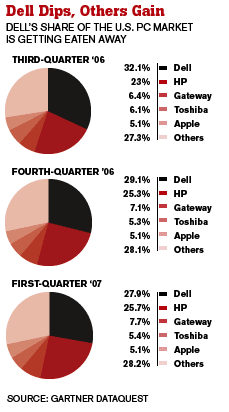
But HP's cost of winning business through the channel, in all probability, just went up. As did Lenovo's.
"Clearly, any businessperson in this business has to pay attention to what their competitors are doing," said Steve Mungall, vice president of worldwide and Americas channels at Lenovo, Research Triangle Park, N.C. "But to be successful in the channel, you have to pay attention to the channel, what they need to be successful and provide that to them. Regardless of what one of our competitors comes up and does, it's not going to impact that."
Said Roger Kay, a market analyst at Endpoint Technologies: "As you take any supply chain and build the number of players, at some part of the supply chain you create leverage for other players in the supply chain. By creating additional choice for any of the channel players, Dell gives the players some leverage over existing suppliers."
Dell executives say sales representatives will be calling more on solution providers. To keep up, other vendors may have to do the same. And not only PC makers and server vendors: Michael Dell told CRN Dell remains committed to the printer business, for example, and will soon launch new color laser printers.
It is difficult for many to view Dell's new strategy as one created out of strength. This week, Dell is slated to report its second-quarter earnings. Not only are analysts expecting a decline, but many observers are still awaiting details of two federal investigations into Dell's accounting that began last year, as well as details of an investigation conducted by members of Dell's board of directors.
Meanwhile, most tier-one PC makers are undergoing changes. Lenovo has begun revamping its North American sales organization as U.S. sales have lagged. Gateway is seeking to expand its solution provider sales from government accounts to more commercial. Acer, where a top executive said earlier this month it would overtake Dell in U.S. market share, has designs on small and midsize business. And HP has continued to slash costs internally.
Over at Dell, where almost all of senior management has been replaced since last year, group executives overseeing federal sales, large integrators, local government and education, and speciality OEMs are eager for their new mission. They have become a de facto channel working group.
"We're a very flat organization, hierarchically," said Rick Froehlich, a vice president with Dell's ISG OEM Solutions Group. "I probably talk to the other guys three or four times a week. We have the degrees of freedom across all of Dell to get things done in short order and make sure that we're sending one message to our customer bases. Sometimes, when you have a senior vice president over channels, you tend to create a separate empire. We want this to be integrated into the fabric of Dell and stay that way."
"They've got to do something," said Kevin Dvorak, manager of American Digital, an Arlington Heights, Ill.-based solution provider and HP partner. "Their market share is being clobbered. Obviously, they are trying to get more feet on the street."
Next: Timeline Of Dell And The Channel
DellThe Channel: A Timeline
1984: Michael Dell starts doing business while a student at the University of Texas, building and selling PCs directly.
1987: Michael Dell takes his company public, with the express business strategy of 'cutting out the middleman.'
1993: Dell begins selling some laptops to consumers through CompUSA and other retail outlets, but Michael Dell pulls the plug on the operation after determining his company is seeing only limited profitability.
1997: Like direct PC rival Gateway, Dell begins quietly selling more PCs and service through resellers— although without going through distributors, offering price protection or stocking inventory.
2002: Dell launches a new program, Solution Provider Direct, that begins offering unbranded PCs to the channel.
2004: Michael Dell, while keeping his post as chairman of the company, turns over the CEO reins to Kevin Rollins.
2005: Dell pulls the plug on its white-box program, saying it would focus on providing its branded systems to the market and solution providers.
2006: Dell ends the year with sluggish sales and earnings and declining market share as HP surpasses it as the No. 1 PC maker in the world.
2007: Kevin Rollins resigns as CEO as Michael Dell reassumes that post. Dell tells CRN the company has decided to fully engage solution providers, as sales through the North American channel have become one of the fastest-growing segments of business at the company.