Is Best Buy For Real?
With a partner program in the works and a dogged determination to make it fly, Best Buy appears ready to shake things up.
The Minneapolis-based company has designs on becoming a major player in the channel. Its new partner program passes services leads on to solution providers and also—and perhaps more importantly—it's trying to convince vendors to allow it to sell products currently procured through distribution to solution providers.
It's a heady two-pronged strategy for Best Buy aimed at creating a national network of solution provider partners that can use their value-added services to complement its own Geek Squad, while also becoming a product supplier to the channel. All the while, gingerly side-stepping the broken promises left behind from retailers' previous attempts to woo solution providers.
"At a gut level, based on anecdotal feedback, it feels like there is opportunity for us in the channel," said Dave Hemler, president of Best Buy for Business, the business unit crafting the program. "There are holes in execution out there. We said let's do something that's really value-added for the channel vs. another 'me too' program."
To date, no big-box retailer or direct marketer has enjoyed wide success engaging with solution providers on services. Many companies, including CDW, CompUSA, Circuit City and even Best Buy itself, have tried before. Jaded solution providers have learned to be wary of such programs. Been there, done that. No thanks.
But Best Buy believes it has a unique approach this time. It's actually listening to solution providers and designing a program around that information, executives said. How successful it will be remains to be seen.
"Someone could be very successful, especially someone with the girth of Best Buy," said Bob Venero, president and CEO of Future Tech Enterprise, a $70 million VAR based in Holbrook, N.Y. "I don't see it as a channel upset, but channel augmentation. If they have the ability to pass a relationship on to the VAR and get something out of it, it really becomes a lead-generation solution for VARs. It's more feet on the street for the [solution providers]."
Alex Zaltsman, managing partner at Exigent Technologies, a Morristown, N.J.-based solution provider, said Best Buy won't be successful unless it limits the number of partners. "I told them they better not open it up to just anybody. Qualify the solution providers and limit the number of partners in the territories. Otherwise, they're going to have an issue," Zaltsman said. "Is it good for the channel? The VARs are getting more business ultimately. Best Buy is like their outside sales force. There's no downside as long as quality control is maintained. That's the key."
Passing services leads on to VARs is one thing, but Best Buy also has its eyes on another prize—capturing more product revenue from VARs that traditionally has gone through two-tier distribution, which, if successful, could dramatically change the current landscape of the channel. It's a tall order. Right now, the language in many of Best Buy's vendor contracts prohibits it from selling wholesale to other solution providers. But the company is talking with some of its largest vendors—such as Hewlett-Packard and Microsoft—to get it done, Hemler said.
The objective, said Hemler, is to give end users a single purchase order, rather than one for products from Best Buy and one for services from the VAR. In one scenario, the VAR may resell its services to Best Buy, which then bills the end user for everything. In another possibility, Best Buy may take on the characteristics of distributors Ingram Micro, Synnex or Tech Data and sell products to resellers, which package the total solution for the end user.
Best Buy won't rule out anything, Hemler said.
"I don't think the world needs another distributor right now, but [VARs] do need in many cases better pricing or more local access [to products]," he said. "I wish I could say we're further along with [that]. Right now, there is some stuff we can sell to other resellers. We are in the process of working with larger resellers where it makes sense, so we can take care of the end customer."
For example, an end user may want a specific VAR as its single point of contact for billing but want to receive the products from Best Buy. "Right now, we can't provide that with HP products," Hemler said. "Those are the minutia details—the big minutia details—that we are trying to work out. It's hard to say what will happen. Some vendors want to push us that way. At heart, we are a retailer. How can we use that expertise to help those partners to get product at better prices today?"
Solution providers said a single point of contact would be a key ingredient to a partnership.
"At the end of the day, the value of a single PO and the relationship is important to the customer. I expressed that to [Best Buy] early on," said Venero, who has had numerous conversations with Best Buy to help architect the program. He is unsure how Best Buy would serve as a product fulfillment vehicle. "Best Buy is not a warehousing, 80 percent drop-ship [entity] like a distributor is," he said. "They're really going to have to change their model internally to support that."
Zaltsman said he cannot envision sourcing products through Best Buy for his own customers. "I would do it, but only for their customers if there was greater efficiency. I wouldn't change my preferred distributor partner."
Best Buy also faces a marketing challenge with business customers, Zaltsman said. "I don't know if businesses think of Best Buy as an IT provider. I didn't even know they sold business-class stuff until [recently]."
Next: Best Buy's Rapid Expansion
Best Buy's Rapid Expansion
Best Buy opened more than 200 Best Buy for Business locations in its retail stores in the past couple of years, including more than 100 in just the past year. Revenue through that unit has increased "a high double-digit percentage" during that time and is expected to have similar growth this year, Hemler said. But solution providers said it became clear to Best Buy that it needs partners to more effectively reach SMB customers.
Best Buy for Business has already ruffled channel feathers with its rapid expansion and low-price model. Last year, reseller organizations such as The ASCII Group decried Lenovo Group's decision to sell business-class notebooks at Best Buy as well as Microsoft's move to certify Best Buy as a Gold partner.
"We wish them well, but the resellers in ASCII felt Best Buy was not qualified [to be certified by Microsoft]. The quality of service is not up to that of independent resellers," said Alan Weinberger, chairman and CEO of ASCII, Bethesda, Md. "We have been approached by other large retail chains and are negotiating with them at this point. But not with Best Buy."
Thus far, Best Buy's new partner strategy is light on details, but the company is saying all the right things politically while garnering feedback from dozens of solution providers.
"One thing I will give them credit for is they're reaching out. I've had literally hours of conversation about what I would like to see as a solution provider," said Zach Schuler, president and CEO of Cal Net Technology Group, a 40-person Northridge, Calif.-based solution provider. "They made it clear they want to work with the channel extensively and they've been receptive to a lot of ideas," Schuler said. "What they are trying to do is not live in a bubble. They've done that in the past, and it's not served them well."
Cal Net first pitched a local Circuit City store in1996 about a services partnership, so Schuler believes in the model. "This is a completely different approach. They're saying, 'Let's reach out to strong solution providers across the country, figure out what they want and craft our model based on that.' They've made that much clear," he said.
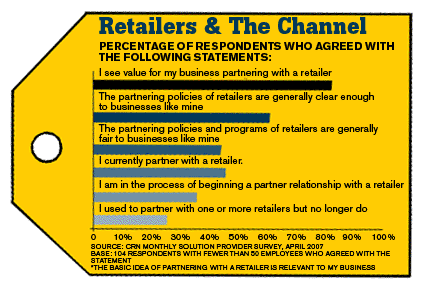
It's also clear that there is opportunity for Best Buy within the small-business market. Almost 50 percent of solution providers with fewer than 50 employees said they see value in partnering with a retailer, according to an April 2007 CRN survey of solution providers. In addition, half of the respondents with a discontinued retailer relationship say they are in at least one other retailer partnership or are in the process of establishing a new one.
Greg Spierkel, CEO of Ingram Micro, said Best Buy faces an uphill climb to gain traction with solution providers. "The big-box retailers over the last four or five years have gotten more into SOHO products. The next logical step is services," Spierkel said. "These [initiatives] come and go, there's no question. A lot of people envy what we have. Others have tried to chip away at that. We've built this up over the last 15 to 20 years. We have a highly extensive network of resellers that understand each other. They know they relate to us and we won't sell around them. There's a lot of goodwill that we've developed over the years."
Next: The Services Question
The Services Question
Schuler says it is likely that any services leads through Best Buy would be at lower margins than he now gets for performing the same functions, but that would be offset by lower costs from his own sales force acting as high-tech hunters and gatherers.
"If they have the ability of floating me deals that have a minimal impact on my sales force, that would be awesome. Am I expecting to do that work for less? Yes I am. But my sales commission can change because the guy didn't have to hunt that deal. The cost per lead is very expensive now. Basically, we would get free business. I expect slightly deteriorated margins, but I don't think they'll bring it into a commodity-type play because they want to differentiate themselves above what any other competitor can do."
Venero is not sure services margins would deteriorate, however. "We'll have to see what the market bears," he said. "Let's not forget that individuals that go into Best Buy can buy a computer online [that is] less expensive. They chose to spend more because of the convenience. Who's to say it's not the same thing for services."
Best Buy for Business has started a pilot partner program with OnForce, the New York-based service provider network of more than 10,000 members. The pilot has led to several successful engagements, Hemler said.
"It gets Best Buy comfortable with a third-party organization. We use third parties for appliance installs, but not on the IT side. Our sales teams use OnForce for services where we don't have Geek Squad capabilities from a geography or skills standpoint," Hemler said.
Best Buy hasn't broached the sourcing subject with solution providers, but Schuler said he would not rule out using Best Buy for more product procurement.
"I love Ingram Micro, don't get me wrong. It would have to be a huge compelling reason for me to move," said Schuler. "But if they give me a [services] lead, I would expect them to want the product sale back for that customer. I have no problem doing that. If they want me to take all my other [product revenue], they will have to have one great compelling argument for that. If they send me 500 leads and they've grown my company, in that case, I have a compelling reason to do a business. I don't anticipate that happening. [Best Buy] might be a piece of our business, but I don't think it will be close to a majority of our business."
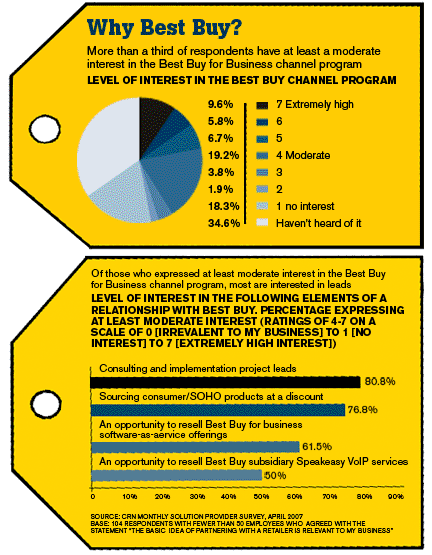
Best Buy wouldn't provide a time line for general availability of the program. "It's more important to get it right. We don't want to waste our time or the partners' time," Hemler said. "The things coming through loud and clear are they want opportunities and leads through [Best Buy] stores that are very centered on the services side of the world. Partners are happy to get out of commoditized hardware and software in exchange for being the service provider."
Many of the leads will be passed on by Best Buy's inside sales team calling on small businesses, Hemler said. The company recently passed six leads on to partners in Montana, the only state in which it doesn't have a retail location, Hemler said.
From its research, Best Buy found that small-business customers were already shopping at its stores—as consumers.
"They'd walk in and pick up six laptops, paying the same price as a consumer, getting the same level of service and the same financing options," Hemler said. "We recognized the opportunity in that market to expand and offer a more tailored set of services for that customer set. A lot of it is driven by customer demand. We see, increasingly, customers approaching us wanting us to provide end-to-end consulting, product sourcing, maintenance and support. There are some areas we are able to do that, some we are not.
"There are some sticky issues [with the partner program], like who owns the customer. It's one thing to say I'm the HP reseller, I own the customer. It's another thing to say I buy from Best Buy, who found the customer. That's the sticky stuff we're working through right now."