Microsoft Jockeying For Position In Virtualization Race
Microsoft arrived late to the virtualization market and still has some holes in its product portfolio. As it fights for market share, partners say the company's traditional strategy of pricing competitors out of the market may not be as effective in the virtualization arena as it has been in other markets.
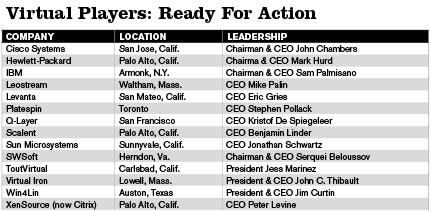
What's clear is that Microsoft sees the rapid acceleration of the virtualization market and wants a piece of the action. The health of the market was underscored by VMware's strong $1.1 billion initial public offering and Citrix Systems' pending $500 million acquisition of open-source virtualization vendor XenSource, which is expected to close in the fourth quarter. In the wake of the latter, industry analysts have speculated that Microsoft may be considering acquiring Citrix, with which it already partners.
Microsoft currently offers a line of virtualization products that its partners say are seeing steady growth: Virtual PC and Virtual Server 2005 for desktop and entry-level server virtualization; SoftGrid for application virtualization; and terminal services for the presentation level. What Microsoft doesn't have right now is a server virtualization product to compete with popular offerings such as VMware's ESX Server. That will come with the Viridian hypervisor, which is slated to arrive in the second half of next year, six months after the release of Windows Sever 2008.
The problem is, Microsoft has already delayed the beta release of Viridian, and the longer the delay runs, the more Microsoft risks losing further ground in the virtualization market, leaving its partners with no choice but to sell competitors' solutions, several sources told Solutions Inc. on condition of anonymity.
And given that VMware holds a commanding lead in server virtualization—with a 55 percent share of the market, followed by Microsoft's Windows Virtual Server with 29 percent, according to the Yankee Group—Microsoft has quite a bit of catching up to do.
Next: Microsoft's Advantages
Microsoft's Advantages
Still, Microsoft partners believe that once Viridian is released, it's likely to quickly level the playing field in the virtualization market.
Rand Morimoto, president of Convergent Computing, an Oakland, Calif.-based solution provider, says that while Microsoft may lack some of the features and functions of certain VMware offerings, he has several customers who are handling their virtualization needs exclusively with Virtual Server 2005 and are finding it's a good fit for their environments.
"With Viridian, the expectation is that Microsoft is going to leapfrog VMware and never look back," said Morimoto. "Customers today can use Microsoft Virtual Server 2005 R2, build up their images, and then when Viridian becomes available, easily transition over."
Microsoft also holds a trump card of sorts with its System Center portfolio, which provides management for both physical and virtual assets, and monitors the health of virtual machines and applications, said Larry Orecklin, general manager of Microsoft's System Center and Virtualization Group. "The more you virtualize, the more that management of the environment becomes important," he said.
System Center Virtual Machine Manager includes several features that organizations really care about when it comes to virtualization, such as the ease of creating images and the ability to clone images, said Morimoto. "Once you create one image, you can take that and clone it, and then change it to repurpose it for a new system. The ability to create one standard template and blow it out for multiple images is huge," he said.
Until recently, VMware held an advantage over Microsoft in the management of virtual machines. VMware's VirtualCenter management tool provides the type of enterprise-level performance that Microsoft lacked until it came out with System Center Virtual Machine Manager, according to Morimoto.
Microsoft's Challenges
But despite these advantages, some solution providers believe Microsoft is behind because it is missing key features found in competitors' offerings. For example, VMware's VMotion offering, which makes it possible to move running virtual machines from one physical server to another, has no equivalent in the Microsoft virtualization portfolio, said Cor Knijnenburg, CEO of Core Consulting, Plano, Texas. "If you have a mission-critical application in a virtual environment, that's a useful tool," he said.
Another feature that VMware has that Microsoft does not is support for 64-bit client sessions, according to Morimoto. "But right now, that's not a big issue because Exchange 2007, which is 64-bit, is just ramping up. Organizations can build on physical hardware today and then move to Viridian [which is 64-bit] later on," said Morimoto.
Solution providers say one of VMware's major advantages over Microsoft today is its ability to effectively "snapshot"—a function called VMotion. This feature comes into play when one virtual server fails and another comes up and switches sessions, providing disaster-recovery-type failover to another system.
Another looming challenge Microsoft faces is that nearly every other virtualization engine on the market is based on Linux in some shape or form, said Chris Ward, senior solutions architect at Greenpages, a solution provider in Kittery, Maine. "And you can be pretty sure that there's no way that Microsoft will have any Linux embedded in Viridian when it comes out," he said.
The bare metal footprint and the ability to customize the kernel are the primary reasons why many organizations prefer Linux-based virtualization, said Ward. With so-called hosted virtualization, the virtual layer runs on top of an operating system, but with bare metal virtualization, the hypervisor runs on the hardware itself.
Next: Microsoft's Plan Of Attack
Microsoft's Plan Of Attack
Microsoft plans to spark widespread adoption of its virtualization products through competitive pricing, said Orecklin. "Virtualization is an important feature of the operating system and shouldn't be a technology that organizations have to pay more in order to utilize," he said.
To make this happen more quickly, Microsoft is making strategic maneuvers behind the scenes, from desktop licensing scenarios down to server licensing scenarios, that are aimed at commoditizing virtualization technology, said Jaymes Davis, virtualization practice manager at Entisys, a Concord, Calif., solution provider.
Support is one of the most important factors that play into pricing for virtualization, said Davis. "The way the virtualization market runs is based on the level of command and support, and whether you have an Enterprise Agreement with Microsoft," said Davis.
"I have people who have Microsoft agreements that because Systems Management Server comes as part of their agreement, and if they perceive it to be free, they'll use it," said Davis. "If Microsoft allows for free virtualization as part of their agreement, companies are going to use it as well. And that's when the commoditization of virtualization will become a foregone conclusion," added Davis.
Microsoft made a play two years ago to standardize on the Virtual Hard Disk (VHD) Image Format Specification, which refers to a virtual machine hard disk that can reside on a native host file system encapsulated within a single file, noted Davis. "The idea behind this was that you'd have interoperability of virtual environments as well as platform independence," he said.
"When Microsoft got into Xen's community, they saw that Xen is now being integrated into many platforms, including Solaris and Red Hat, which shows that the format is now interchangeable between multiple different virtual platforms," Davis added.
This is proof positive of a play that highlights Microsoft's plans to push for the commoditization of virtualization, said Davis.
"Viridian will take advantage of the same format that everyone using now and apply it so that everyone can manage using multiple different management platforms. For Microsoft, if they can control the container, it's all about the OS that's inside," said Davis.
Other solution providers believe that cost isn't necessarily a primary motivator for companies looking to add virtualization.
While some VMware competitors market products similar to ESX Server at a lower price, VMware is perceived as the most mature product on the market, and customers are willing to pay a significant amount more to go this route, said Greenpages' Ward.
"Customers don't necessarily take price into consideration when it comes to virtualization, probably because they're not as concerned due to ROI of virtualization and the amount of money they save from not having to buy new hardware," said Ward.
However, Morimoto insists that pricing is, in fact, one of the main benefits of going with Microsoft virtualization.
"The point where licensing costs come into play is that Microsoft Virtual Server is a free download, whereas VMware ESX Server is not free," said Morimoto. "And if an organization plans to cluster their servers, which is pretty common these days for high-availability environments, Windows clustering services comes with Windows Server R2 Enterprise and data center at no additional charge."
When Viridian does arrive, Microsoft may find that organizations that have already chosen a virtualization vendor aren't willing to switch just because Microsoft has a cheaper product, according to one East Coast Microsoft Gold partner.
"Microsoft's opportunity will be with those that haven't yet made substantial virtualization investments. They're not going to go into organizations with VMware and convince them to change at this point," said the source, who requested anonymity.
NEXT: The Channel's Role In Virtualization
The Channel's Role In Virtualization
Meanwhile, as the hype around virtualization builds, solution providers say it's crucial to explain to customers what the technology can and can't do.
"We've seen customers try and take a dedicated SQL Server and make it into a virtual server, and then add terminal services as one of the virtual servers," said Steven Mulka, a partner with SIS, a Duluth, Ga., solution provider. "But do you want terminal services running on a virtual server environment? No, because that's not the best utilization of the virtual server application."
However, when properly designed, virtual server technology will become key to a company's network infrastructure in the future, noted Mulka. "Utilizing larger, properly designed servers—much like the old mainframe scenarios where the large servers were doing the bulk of the work—can be a beautiful concept," he said .
Orecklin says the fact that Microsoft's virtualization portfolio will extend from the desktop all the way to the data center means there will be opportunities for the vendor and its partners to build applications in between. Other important factors that come into play and determine the value that partners provide in virtualization are the strong customer relationships they have, according to Orecklin.
Solution providers with skin in the virtualization game say they're making money from the integration and configuration services for virtual servers that are necessary for optimal performance, said Knijnenburg. "We also make money on integrating Virtual Server into a SAN environment, which is one area where the product works very well. The physical host doesn't have to have a lot of disc space, just memory and processing power tied back to a SAN," he said.
Rick Opal, vice president at PetersAssociates, a Gold partner in Oakbrook Terrace, Ill., says demand for higher-end virtualization features is relative to the customer size and the problems they're attempting to solve.
"Virtualization in general is hot, and frankly, we have a lot of customers who are anxious for Windows Server 2008 [and Viridian]. I think after it launches, we're going to see serious momentum for services and consulting around virtualization," Opal said.
"Sure, Microsoft will have some ground to make up, but when they ship Windows Server 2008 and Viridian, what customers will have to look at is what they natively get with the Microsoft stack, as opposed to the value proposition outside the stack," said Opal.
While VMware once had a head start on the strength of higher-end virtualization features, that advantage is quickly fading, said Morimoto. "A year ago, I'd have said that Microsoft was three years behind VMware. But in the past year, they've made up a lot of ground, and for a lot of the things people care about, it's pretty close now," he said.