Making The VoIP Call
Two years ago, Barry Goldstein found himself at the foot of a path he could not refuse to take. It was time for Goldstein, the president and CEO of CT Networks, a Hauppauge, N.Y., solution provider, to move into the VoIP market.
The 23-year-old company had its roots in traditional telephony, but Goldstein began to see that the road CT Networks was traveling was coming to an end. "We come from the legacy PBX world: It's a dead model. It's gone. It's history," Goldstein said. "I started to see opportunities falling away to hosted service providers. That was my first clue that this game was going to be about bandwidth."
That's when Goldstein made the decision to invest in the VoIP and data integration expertise his company would need to take the new path toward IP communications. That's also when a new set of decisions presented themselves: Once a solution provider like CT Networks decides to move toward VoIP, it sees quickly that the path actually diverges into three, with an array of potential vendor partners representing each one.
An IP-PBX can be a dedicated piece of equipment from vendors such as Avaya or Cisco Systems. Solution providers can also integrate their own system using software such as the Asterisk open-source IP-PBX platform. Or they can take the hosted approach, offering services from companies such as 8x8, Covad Communications Group or M5 Networks.
Each path has its own benefits and detriments, which means solution providers need to choose based on their business models, the level of investment they wish to make and the types of customers they want to go after. Goldstein took a blended approach: He built an IP telephony practice on partnerships with Cisco, Inter-Tel and NEC and added newer players in the hosted VoIP space such as Covad and M5 to target smaller customers.
The journey, while necessary, wasn't easy. "It's been incredibly painful for us," Goldstein said. "To become authorized by Cisco to get IP telephony reseller status—we're Premier-certified in IP communications—you have to have many Microsoft engineers, many Cisco engineers, many sales experts, parts experts and IP voice experts."
The investment in new salaries alone in the first year of CT Networks' transformation totaled $400,000 to $500,000, part of a year-one investment Goldstein puts at close to $1 million. It's a move that seems to be paying off. CT Networks' IP communications practice has reached about $20 million in product and services sales. "We're just beginning to reap the benefits now," he said. "It's just starting now that we are winning the big deals."
Like CT Networks, D&D Consulting, a 15-year-old networking and security integrator in Albany, N.Y., also saw the move toward VoIP as a matter of survival. "To stay competitive in the networking space, you have to get into VoIP. Otherwise, you're going to go out of business," said Chris Labatt-Simon, president and CEO of D&D. "The choice was either do it or get left behind in networking, which is a major piece of our business."
It took three months of soul-searching to determine what path and what vendors were best for D&D, a process that included looking at the solution provider's current capabilities to determine what holes needed to be filled and whether potential vendor partners would be able to fill them, Labatt-Simon said.
D&D's path to VoIP now lies with a single partner—Avaya—largely because of its service and support capabilities, Labatt-Simon said. The company expects to begin selling IP communications solutions within the next few months.
What solution providers like Goldstein and Labatt-Simon illustrate is the importance of up-front research and planning. The investment in both money and personnel can be substantial, profits are not likely to come immediately and the right vendor partner can help make or break a difficult transition.
Next: Keeping It In-House
Keeping It In-House
By far, the majority of solution providers building IP communications solutions today are doing so with vendors whose product lines include dedicated IP-PBX boxes. In many cases these vendors carry recognizable names, offer full-bodied channel programs and have broad product lines that include routers, switches, security, applications and other building blocks of IP communications solutions.
The use of VoIP can, in some cases, reduce long-distance charges for companies, particularly if they are connecting multiple sites. But solution providers say the real benefits of premise-based solutions come from productivity gains achieved by deploying unified messaging, mobility and video applications.
"One of the key lessons we learned is that IP telephony is not necessarily going to save money for the customer," Labatt-Simon said. "Most organizations that implement it spend more on it, so cost-savings is not an end result of implementing VoIP. What it can do, however, is increase the quality of customer service and increase productivity throughout the organization."
In-house IP-PBXes can be found to target a wide range of customers, from SMB specialist Allworx's 6x platform, which supports up to 30 users, to high-end systems from players such as 3Com that support tens of thousands of users. A modern IP phone system installation for a business of 50 users typically costs upward of $40,000 for the IP-PBX and the phones and $450 a month for a T1 line.
Premise-based solutions also offer flexibility. Solution providers can choose pure VoIP offerings from players such as 3Com or Cisco or they can opt for a hybrid system from the likes of Avaya, Nortel Networks or Allworx.
Allworx's 6x hybrid system lets users migrate at their own pace, said Allworx CEO George Daddis. While analog lines support fax machines and legacy phones, the system also delivers VoIP functionality and can be used with any Session Initiation Protocol (SIP) 2.0 phone at the same price point as an old analog key system. "The 6x is our key system killer," Daddis said.
In addition to deciding whether to go with a pure-play or hybrid system, solution providers need to consider other factors. SIP represents the future of VoIP. It is built on top of the standard IP stack using the UDP/IP standard, and most IP-PBXes and the phones that go with them support SIP. These systems typically use an Open Architecture Interface, making it easy for software developers to write applications.
Simple SIP phones typically have simple text display and navigation buttons. But proprietary IP-PBX systems offer much greater functionality. Cisco offers advanced IP phones that use XML to call Web pages from the IP-PBX to the phone screen for configuration, customization and added functionality.
Such phones with color LCD screens can be programmed to display things such as stock quotes, company logos and an array of services. In hotels, a phone's display can be customized for returning customers, and maids can access a menu to set a room's status to ready. In the education market, teachers can check attendance records. And in hospitals, doctors can check patient records without having to carry any other devices.
Using advanced IP phones is like having a PC in every room. The phones can also be programmed for use as database connections, to set up conferences from lists of users, bring up pictures and business cards of different employees and more. Customizing these systems is far too complicated for the average user, which creates opportunities for solution providers.
Next: Doors Open To Open Source
Doors Open To Open Source
Solution providers that want to integrate their own PC-based systems can turn to open-source VoIP software such as Pingtel SIPxchange and Asterisk. Asterisk solutions offer high-end features at a lower cost than offerings from rival vendors, said Chad Agate, co-founder and CEO of NeoPhonetics, a solution provider in Tinley Park, Ill., that integrates a VoIP solution based on the Asterisk platform.
Asterisk may be the most popular option. Digium, the Huntsville, Ala.-based creator and primary developer of Asterisk, claims the software has an installed base of more than a half-million users. More than 500 people have contributed to the current version, and there are plenty of online resources and books that cover it in detail. It is most commonly deployed on Linux but can be installed on Microsoft Windows.
"Open source is advanced enough to be accepted in Fortune 500 companies, and you don't have to be a Linux guru to get it going," said Jim Webster, Digium director of software technologies.
Most any standard PC makes a fine Asterisk platform for just a couple of calls. For a system that will support 100 users, a typical server running at 2GHz or 3GHz with 1 Gbyte of RAM is sufficient. Other pieces may be required, such as interface cards for analog phones and T1 lines and transcoding cards to offload and increase the number of calls the IP-PBX will support.
Digium sells all the hardware a solution provider will need to build a fully functional PBX. Digium also sells the Asterisk Business Version, which costs $995 and includes warranty, support, maintenance upgrades, help with bug resolution and access to custom development support. The package supports 40 simultaneous calls, which should be enough for 160 users. Upgrade licenses for an additional 40 simultaneous calls cost $695. A single Asterisk server can support a maximum of 240 simultaneous calls, and software is available that allows multiple Asterisk servers to be clustered together.
Digium also offers a developer kit consisting of a small appliance with an embedded processor and flash-based memory. There are no hard drives or fans, so the appliance is completely quiet. It supports up to eight analog lines or it can be set up as IP only. The kit costs $2,195 to $3,995 depending on the level of training a partner requires. The appliance is intended to encourage VARs to build applications for Asterisk.
But the company is also planning to launch an appliance for end users that should help ease deployments. "There is a whole group of resellers who love to add value through their Linux expertise and integration expertise and who are willing to do that level of integration. That market is growing," said Steve Harvey, vice president of worldwide sales at Digium. "But most customers don't want to mess around to get their hands that dirty to make a phone system work."
Some solution providers, like CT Networks, still have their doubts about whether open-source telephony solutions are stout enough for enterprise deployments. "The problem is there's so much legacy programming and the PBX gets so complicated with T1 circuitry and functionality that goes to five-nines reliability," Goldstein said. "Open-source has a long way to come before it's a candidate for enterprise environments."
Next: Hosted VoIP Solutions
Hosted VoIP Solutions
The easiest option is to go with a hosted service. And for some customers, solution providers find it just makes more sense to use a hosted service from vendors such as 8x8, Covad or M5 rather than installing premise-based systems, particularly for small clients. Like Centrex services in the legacy phone world, hosted IP voice systems are ones in which the routing equipment is located remotely. In the case of newer services, the connections in and out of a building are IP-based.
"Once they look at the benefits and the costs annually, in most cases, it's a no-brainer," said Adam Eiseman, CEO of Lloyd Group, a New York-based solution provider that partners with M5.
Hosted VoIP services are useful when parts of a company are situated in dispersed locations with each one having only four or five phones. It would be impractical to install an expensive phone system in every location. Instead, a cable modem or DSL connection, along with a bunch of IP phones, are all that's needed. The hosted service then provides all the functionality such as voice mail, call forwarding and transfers, and even when lines are located in different parts of the country, it is completely transparent to callers.
Customer benefits from a hosted system include easier mobility and survivability in the event of disaster because none of the important phone equipment, save for the phones themselves, is located on premises. It also makes it more economical to set up temporary phone systems. Another benefit is that there are little or no startup costs.
Solution providers stand to gain a similar benefit. Since there is little on-site equipment and the service provider is responsible for quality, some VARs have found that offering hosted VoIP services is the fastest way to build a profitable IP telephony practice. Such partnerships typically require little up-front training and offer recurring revenue streams.
"It allows you to get into it and almost profit from day one," Eiseman said. "We also sell Cisco phones and infrastructure [to support the service] at a comfortable margin."
Another key benefit to both partners and their customers is that they often get more attention from the smaller hosted VoIP providers. "You're getting rid of Verizon. You no longer have to deal with them,"said Benjamin Irvine, CEO of Octopus Networking, another M5 partner in New York. "You can now have a smaller customer-focused group that's focused just on you."
According to David Immethun, senior director of sales at 8x8, more than 6,000 businesses are now using the Packet8 Virtual Office service, and hundreds of new customers are joining each month. "Hosted is better for SMBs because the TCO is easiest to calculate, compare and substantiate," Immethun said. "You don't have to purchase any expensive equipment. All you need is broadband."
The Packet8 Virtual Office service, for example, costs $40 per user, per month for unlimited calls throughout the U.S. and Canada. Another package costs $20 per user, per month for 250 minutes with unlimited inbound calls. The phones cost $100 each, or they can be rented for $10 each per month, thus eliminating any up-front costs. Solution providers that want to set customers up with the Packet8 Virtual Office service get an inside sales rep, single payouts and residuals. According to Immethun, they can earn up to $10,000 for signing up a 100-user site.
A hosted service breaks geography limitations, as virtual lines can be set up anywhere. Each extension gets its own number, and additions, moves and services are all included. New features are added for free as they become available as customers have no IP-PBX to upgrade.
Getting the Packet8 phones set up is easy. Existing Ethernet wiring and routers can usually be used. A QoS router is recommended, but 95 percent of 8x8's customers don't have a QoS router. Old hubs often have to go, as they are known to cause packet collisions. The Packet8 phones plug into an Ethernet port, and PCs and other equipment can plug into the two Ethernet extension ports on the back of the phones.
While some partners said they have customers with up to 350 users happily existing with hosted VoIP services, others say they prefer to limit rollouts to much smaller firms. "If you've got 12 phones in three buildings throughout a metropolitan area, hosted may work for you," Goldstein said. But once users get above 25 phones, he said, it makes sense to own an IP-PBX.
Some solution providers shun the hosted VoIP path entirely because they don't like the loss of control. "We have a philosophy here that we like to put the success of D&D in the hands of D&D," Labatt-Simon said.
All Paths Lead To IP Telephony
Regardless of the path they take, many solution providers are in agreement that IP communications is the way of the future, and that building a VoIP practice is essential to their survival.
"You won't exist in three to five years if you don't build your focus on routers, switches and IP telephony," Goldstein said. "Your business will be declining, declining. I see it with my peers. They're moving into smaller offices."
For Goldstein and solution providers like him, it's the path toward IP communications that has made all the difference.
Next: Research
The Facts Of Business
Service Revenue
Solution providers on average report receiving 60/40 split on service-to-
product revenue from IP telephony engagements.
Average Deal Size
The median deal size on IP telephony deployments is about $20,000, but the average is $187,000, bolstered by large deal sizes ranging up to $3 million.
Sales Cycle
Nearly half of the respondents report that the typical sales cycle for IP telephony solutions is less than three months.
Recurring Revenue
Most IT telephony solution providers receive some recurring revenue, but nearly one-third get less than one-fourth the value of initial engagement in the fist year. Another two-thirds get from 25 cents to $50 of recurring revenue for every dollar of deployment revenue.
BASE: 56 SOLUTION PROVIDERS OFFERING IP TELEPHONY
SOURCE: CRN MONTHLY SOLUTION PROVIDER SURVEY, JANUARY 2007
IP Telephony Adoption Curve
\
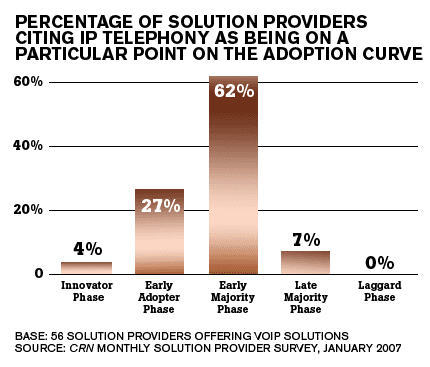
Solution providers are of like mind when it comes to forecasting a steep adoption curve for IP telephony. A sizable 62 percent place it in the "early majority" phase, when a mass market should open up, while only 7 percent put it in a "late majority" phase.
Making Plans
\
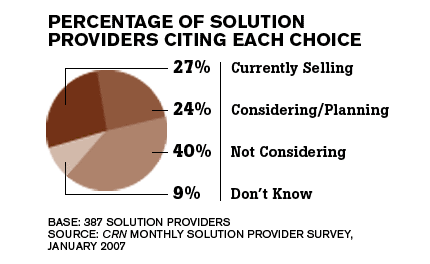
The number of solution providers delivering IP telephony solutions should grow strongly. Nearly 27 percent of respondents currently sell IP telephony solutions and services, while another 24 percent are planning or considering doing so. Another 40 percent have no interest.