Crabtree Maps Out New Document Imaging Solution
That is one reason why over the past five years geological information systems (GIS) have become a standard software application for many city and county governments.
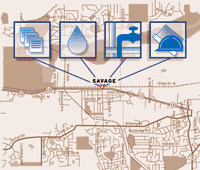
GIS solutions overlay plot lines, underground utilities and other data on aerial photos. It was probably inevitable, then, that someone would come up with the idea of integrating a GIS system with a document imaging solution so that users could click a button on a GIS map and bring up a screen with a link to all the various city documents related to a particular piece of property.
\
Geological information systems now a standard software application for city, county governments.
The inevitable occurred about four months ago in the city of Savage, Minn., a small but growing suburb in the Twin Cities area. That's when The Crabtree Companies, a solution provider in Eagan, Minn., integrated a document imaging system from LaserFiche, Long Beach, Calif., with GIS software from ESRI, Redlands, Calif., for one of its government customers.
Rich Crabtree, owner and president of the 12-employee solution provider, said since that time, Crabtree Companies has been asked by five other cities and a county government to do the same thing for them, at about $5,000 a pop.
"A lot of companies talk about doing this stuff, but when push comes to shove, they don't know how to do it," Crabtree said.
The integration project spearheaded by Crabtree Companies also helped lead to a joint-marketing agreement two months ago between LaserFiche and ESRI, he said. The alliance is a natural one because both software companies have accounts in government markets, said Chris Wacker, senior vice president of sales and marketing at LaserFiche.
"The cities and counties are really dependent on GIS," Wacker said. "Public safety officers would like to know when they are going to a location what the history of that location is."
LaserFiche has also honored Blake Crandall, the GIS technician in Eagan who worked with Crabtree Companies on the integration project, with an award for innovation. While Crabtree said Crandall came up with the idea, Crandall said the notion arose out of a conversation he had with the solution provider, who installed the initial LaserFiche system for the city more than a year ago.
"We were just sitting around and said wouldn't it be nice if we could just click on a parcel and get, not just attribute information, but get all the information that's on LaserFiche," Crandall said.
Crandall first met Crabtree two years ago at one of the monthly seminars that Crabtree Companies hosts on document imaging. The Eagan city manager had asked him to look at a document imaging system, initially for disaster-recovery and records-retention purposes.
Now the city, which manages about 120,000 documents in the system, is extending beyond archival uses to applications where more people access information on a daily basis, Crandall said. At some point, he expects the city to make documents available to the public over the Internet and deploy a wireless solution to give police and fire workers access to information in the field.
That's just the kind of thing Crabtree likes to hear. Crabtree Companies, which started in 1979 in the copier business and then migrated to digital copiers, multifunction machines and computer services, invested about $20,000 to become a LaserFiche partner three and a half years ago, and Crabtree is happy with that decision.
LaserFiche business accounted for about half of Crabtree Companies' $2 million in sales this year. Revenue grew 20 percent, while profits were up 30 percent. "We don't sell as many HP printers as we used to," Crabtree said. "That was affecting our profit margins."
Crabtree said document imaging sales are being driven by the declining cost of hardware and a greater awareness among his clients in the legal, financial and municipal government markets that document imaging is replacing paper. "And since 9/11, the disaster-recovery factor is becoming a big factor in this business," he said.
While Crabtree said some city governments are beginning to freeze purchasing, he doesn't expect that to slow him down. "We can't sit on our laurels; we have to keep growing," he said. "We'd like to see growth of 30 percent or more."