Q&A: Oracle' s Hurd On Public Cloud, Salesforce.com, And Sales Strategies
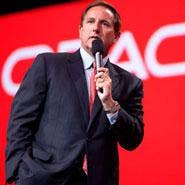
Oracle President Mark Hurd, who has revamped the company's direct/indirect sales strategy, spoke with CRN's Editorial Board about the integrated hardware -software maker's public cloud, the drive to build a long term sustainable business with channel partners and other issues. Below are excerpts from the interview.
How tough is it going to be to go forward with a public cloud model with monthly recurring revenue and the on premise capital-expenditure solutions model?
The car industry has rent a cars and buy a car and the customer can decide what makes sense. It is only a question of where the cap-ex (capital expenditure) sits. And in the end you are still (getting renumerated) for everything that you have got in the ecosystem. I think we'll leverage both.
More Of CRN's Oracle Coverage:
Mark Hurd: The Oracle Of The Channel
Q&A: Oracle Channel Chief Althoff On Recruiting Partners From HP, EMC, And More
Review: Thumbs-Up On Oracle Database Appliance
| AD | |
|---|---|
| id | unit-1659132512259 |
| type | Sponsored post |
The economic models work for us. I would argue to you that the way our strategy works is to give the customer choice. Allow the customer to leverage the cloud or on site and to mix or match. The way our strategy works you can use CRM from the Oracle Public Cloud for a division in Asia Pacific or a division in the Southwest United States. You can have another division that is on site. The same code base.
By the way you can change your mind. And the ability for us to hybrid these environments, we think is a competitive advantage. Because if you go into Salesforce.com's cloud you are not coming out.
By the way our cloud you can go take our stuff and go to Amazon and then you can come back to our cloud. Our cloud is open. So if you want to say let's take my CRM data but I want some infrastructure as a service and I want to get that from Amazon. I want to leverage that (Amazon cloud) down from peak time and then I want to come back to the Oracle public cloud, that is your choice.
Open Cloud. Elastic Cloud. Scalable. Opportunity to go leverage technology. And have the same code base that you would on site.
With cloud do you expect IT decision making is going to move away from IT and more toward line of business?
I think there will be a lot of push-pull between a siloed orphaned, sort of segmented process in a company and the ability to get an enterprise view of the company are contradictory in some way. Now, do I think there are plays that people can make that play to weaknesses in prioritization that exist in an IT organization and can have some level of success. Sure.
That has been going on for years. Call them ASPs (Application Service Providers). Call them whatever you want. They have had some degree of success. But eventually when somebody tries to get an enterprise view of IT people don't want silohs. People want to get an integrated view of the company.
So I think even with the cloud offerings you are going to have to say - How does that fit in to my overall enterprise architecture.And if the answer is: it doesn't. It is cheap. It is sort of easy. There is no cap-ex. And it is sort of cool. Sounds good. Then somebody says - How does this work? I mean how do I get a view of this performance management system and how does it integrate with my core HR system.
Don't you think there are a lot of line of business people who have to hit a number and can now do IT quickly?
Sure. I think you have a lot of line of business people who think that way. I think you have other people in the same account who think about security. I think you have a lot of people in the same account that think about governance. I think you have a lot of people in the same account that think about risk. I think you have a lot of people in the same account that say: 'How do I get an integrated view of the company.'
Aren't you thinking more about the enterprise (market) and not a mid-tier company?
It depends who it is. Let's say I'm a bank with $5 billion of assets instead of $1 trillion worth of assets? Do I have the regulatory problems? Sure I do. Do I report to the same guy? Sure I do. Do I have the same risk governance issues? Sure I do. So there is no free lunch here. It is not like there are some bunch of guys that are going to run around saying - I have a model for you .'
By the time you are done - How many applications do you think a small bank has with less than $1 billion in assets? Could they have 200? I have 200 separate ASP providers. Does anybody have a data model? Can anybody tell me anything about one customer? Can anybody tell me one thing about an employee? And I am not trying to completely dismiss your point either. I think you are going to see some. And I get where there is pent up demand.
I will tell you the other way (too). I am the HR guy and by the time the CIO gets to me I am so far down the totem pole nobody talks to me. Because that same line of business guy you've got - the guy running the business unit- he gets all the stuff because he has got the P&L and he has got the ear of the CEO or the Chairman or whatever the model is, so I think you can make some of that work.
But at some level it runs into a wall. At some level it runs up against all the principles of running an organization. And these silohs. Listen people are working really hard to cut them out. So I think you have got that battle that will go on. It has gone on for a while.
NEXT: Mark Hurd On Oracle's Direct/Indirect Sales Strategy
Historically Oracle really has been kind of a direct sales company. Even today it still has that hard driving direct salesforce and it has come and gone with the channel. What has changed inside of Oracle?
I think that's the right question. I think for us, we have a great product portfolio. If somebody has a better portfolio I don't know who it is. So for us the big issue is making sure we get full distribution. I think apart from other (channel) programs, we don't need a lot of help getting to big accounts.
We are clever enough to know where if you insert some of the biggest customers we can find out where they are located, where their headquarters is, who the CIO is and who the CEO is. And they will generally take sales calls from us.
So our ability then to get to all of the dispersed buying points, small medium business, to all the places that our products are applicable, is hard. Trying to do that in the context of getting smart capable representatives of the company that can then distribute our portfolio to all of the potential buyers that is where the channel comes in.
You can go to the top 200 accounts and find 40 percent of the enterprise market. You can go to the top 500 accounts and find 50 percent of the market. You have got to go to the top 2,000 accounts to get even close to 60 percent. And from there it gets really hard to start getting incremental total available market coverage to cover more accounts. At some point you get to the law of very diminishing returns.
Are our products applicable to a hospital in Tuscon just as it is applicable to Stanford? Sure. Do we have the ability to get to all those buying points? No. I'll give you the flip side of it: we don't need a redundant channel following our existing channel into the accounts we already cover. And that is where many channel programs fall apart.
I am sure I have used this example before when you have covered other companies I have run. I look at demand as the soccer ball in a soccer game: when you get to immature distribution models they behave like five year old soccer games. And all the kids if you watch them they all run to the ball.
When you get to more mature soccer games, people stay in their position and they strategically align to go try to make a grander thing happen. It is the same way with distribution models. We need people playing their positions. Our job is to instrument how we market and distribute that model in a way that everybody is participating and covering the market.
So again if we have partners that all want to run to the ball. Not helpful. Not helpful. So it is really about creating and sort of instrumenting a bigger distribution model that becomes strategic. You said it the right way too: We don't need channel partners just to have channel partners. They have to have a strategic purpose.
So what products go to the channel and what stays with the direct sales force?
I wouldn't look at it that way. To me every channel model has very common characteristics: The target markets have to be clear - I am going here. You go there. The value propostions have to be right.
I think the value propositions for big accounts and for smaller accounts don't necessarily have to be different. Can we tailor some things that are better for departmental systems and better for small medium business? Sure and you saw that, for example, with Oracle Database Appliance.
It was geared and really designed as a small and medium business type departmental product that would be more channel friendly: easier to set-up, provisioned by us, tested by us, one button support, things channel partners and SMB just hasn't seen before.
But get the distribution strategy right; get the target market right and the value prop(osition) right; get the economics for the channel partner right and then; make sure operationally you support the partner. So if you get those four things right my view is generally good things happen with channel partners. Screw any of those four up and it doesn't work so well.
Is there really channel DNA being instilled in the company now?
For this to be interesting it has got to be strategically sound for Oracle. Therefore sustainable. Therefore sustainable for the channel partner to invest. It has got to be structural. It has got to be strategic. It has got to be thoughtful.
NEXT: Mark Hurd On Treating Partners Like The Direct Sales Force
The meeting with Avnet and Arrow partners earlier this year was a turning point. What did you take away from those meetings and how did you go back and develop the program?
On the economics side, I did not love the economic model because it was more of one sort of standard model. My view of the channel is that the channel should be treated just like a (direct) sales organization. We are going to compensate them based on performance. The better they perform the more they make.
What we wanted to have was a model where the more you did and the way you did it was important to us. So if you sell a box that may or may not be interesting to us, but if you sold the box to that target market, to that hospital that we can't cover that is more interesting to us. If you sold that box with our storage that is even more interesting to us. If you sold it with our support that is even more interesting.
By the way if you did two, three, four or five times (those things) then it gets even more interesting to us. So we want our (indirect channel sales) renumeration to work in alignment with what motivates us. That allows it to be sustainable and strategic for us. That was point one.
Point two. We had a big issue even with our own guys. These channel guys, our channel guys, would get paid if the partner sold it into a big account or into the specific target market. So our own compensation wasn't aligned to the strategy I am describing. So we don't want our (channel) guys getting paid unless the partner is successfully executing what we described. And if they do distribute it into one of these accounts that isn't part of the target market I don't want our channel sales organization getting paid.
So for us it is getting our group aligned. So it is getting the target market right, making sure that we say these are the accounts we are calling on. Mr. Channel partner if you are up here it is not a program that is attractive to us. You go here. Our (channel reps) people now get paid in alignment with you. You'll get paid in alignment with what is strategically valuable to us.
The third piece is I think most of our products are channel friendly. We have been working on trying to get certification programs for things like Exadata where we think certain channel partners willing to invest in SG&A (Sales General and Administrative expenses) can be a value add to bring that product into target markets that frankly we are just not going to cover.
That product right now is the iPad of the enterprise and we want more distribution - not less. That said, we can't take that product to market without people having specific expertise. It is a storage server. It is a compute server. It is software. It is integrated together. It disintermediates a significant amount of integration services that most customers have to execute on their own. It has got remote patching. This takes a reasonably seasoned sales person to go sell it. So we want to make those certification programs available.
The Oracle Datababase Appliance was very much designed to get an entry level engineered system into the market that could both apply to departmental and small medium business opportunities and still get the benefits of the engineered system. Perhaps not at the size of an Exadata.
So we actually went purposely to go get a value proposition pulled together and we gave some attractive licensing features with the product and if done right the channel has got a chance to make not just better rebates. There is margin in the material opportunity for them to just get a better margin on the product itself.
None of these things in isolation. Look it has got to be all of the above orchestrated together. If you don't get the target market right, meaning if our people are bumping into the channel, and the channel is bumping into our people and they are not in unison, this doesn't work. If the economics aren't right, it is not going to work. If the value props aren't lined up it is not going to work.
So I could have great economics and if I have nothing to sell it won't matter. So it is getting all those things right.
NEXT: Mark Hurd On Keeping Channel Discipline
Before you came to Oracle there was not this solution provider clarity. Talk about that.
I think the way to think through it is just for us is an opportunity for us to get more distribution. (Oracle Channel Chief) Judson (Althoff) and I talked about how to go orchestrate this, told our regions: we were going to build a soft ceiling where these accounts are above the line, these accounts are below the line. We have to keep the discipline on that. We have got to move the comp for our channel folks below that. And frankly Judson and his team executed all of this. Not me.
What is your promise to Oracle channel partners who want to hear from the top of Oracle?
It is the same thing I would tell our sales people: just do what I tell you to do and things will be fine. You have got to line up strategy. Here is our strategy. How do you line up the operations with the strategy? Our strategy is we have got a soup to nuts, one stop shopping technology capability that is second to none. We have got to get to all of the buyers. So for us we have got to segregate. And if we do we want channel partners to make money doing it.
We can instrument that. The interesting thing is this stuff is easier to say than it is to do. Some people tend to get confused with all this stuff because back to the soccer game, everybody wants to run to everybody else's demand. If you can keep the discipline and keep the people in the right positions, it is worth it to us to pay more channel comp where our sales force is not. It is just intuitive.
I have some of the best salespeople in this industry - maybe the best. Right on this floor. They are very capable of going into the most sophisticated customers in the world and representing our portfolio and winning. I don't have enough of them to get to all of the buyers. They can't do it! So I need help.
I can't get to Des Moines and get to the community college in Des Moines. In this country there are 5,000 hospitals. What can I get to direct? 50. There is 9,000 banks - 80 banks do 50 percent of all the business in the country. When I get beyond that there is 8,900 left. Who is getting to the community bank of Fayetteville, North Carolina? Not our guys. Do I think they could buy a database? I do. Do I think they could buy an Oracle Database Appliance? I do. Do I want these guys the most sophisticated guys on the planet going to Fayetteville, North Carolina. l Iove Fayetteville, North Carolina by the way. I don't mean anything by that. It is just I can't get to all the buyers.
So I need reach. And so I want that reach to be obviously the best reach it can be and I want it to be compensated. When you do that and you go stay there and go sell there it is worth it to me to compensate you for it.
At Oracle OpenWorld, Oracle CEO Larry Ellison pointed out that you often say that you can take your gains from Oracle in either performance or price. Talk a little bit about that.
He is getting good at that. Larry's first instinct is to the core an engineer.To the core. So anytime Larry gets (in front of people) he talks performance, performance, performance. So it is always this is 50X faster. Can you believe it is 50X faster? You know it is also at the same performance level a 50th of the cost. It is the same math.
So if you spent $10 million on something and you say a report took at that $10 million I can now give it to you instead of 50 minutes, I can give it to you in one minute. That was 50X. I can now say that cost is now $200,000 at the same performance level. I took it from $10 million to $200,000. And by the way, you can say give me 30X and give it to me at a higher price. You can dial it in wherever you want to. It is both.
NEXT: Mark Hurd On Channel Strategy As Good Business
You once called yourself a Chief Channel Zealot. Have you taken on the same role at Oracle?
I don't think of it that way. I like the channel for all the reasons I have told you. I got that same sort of feeling at HP. It wasn't the way it worked at HP either. It is just the right way to run the business. And I think that for channel partners this view that it is sort of like some affection. It is not. It is just good business.
I actually believe strategically what I told you is right. So therefore you are not a channel zealot. You are just a zealot to get the model right. To get the strategy right. That is why it is sustainable.
Therefore this has got to be a sustainable strategy and what we invest in to it (has to be sustainable). If I could get an alignment on a core banking solution that I can get down there. Or even to be honest with you as we build the Oracle Public Cloud.
The Oracle Public Cloud is a very attractive channel offering.So let me give you an idea of what we are doing. (Oracle CEO) Larry (Ellison) announced the public cloud. I thought Larry was very good talking about the difference between our cloud and other clouds. The ability for us to now take our capabilities whether it is Java, middleware, development tools and the ability to get people that aren't the biggest companies in the world, can be an offer that could make sense to the channel.
So for us we are never going to get to be as big as we could be and as great as we could be without more distribution. So it just makes a lot of sense.
Our understanding is Oracle Database Appliance is the first channel only product. Talk about that.
We have no problem selling them direct. It was designed to be channel friendly and that is the primary vehicle we take it through. But just like if you said to me would we sell an Exadata through the channel, to (Oracle Channel Chief) Judson (Althoff's) point, we would. Nothing we do is designed with only one purpose.
We are trying to build things for the broader marketplace. And yet when we do things to make things channel friendly. Easy. One of the nice things about ODA (Oracle Database Appliance) is everything is preinstalled.
We want to take work off the channel partners' back. We also want to preprovision the support. So the fact that you can go in now and actually get automated service requests back to Oracle. There is no finger pointing. You don't troubleshoot.
How big a breakthrough is the Oracle Database Appliance for someone who buys IT?
I think this whole renaissance of what is going to happen in the industry over the next several years is going to be that this stuff is going to be integrated. The industry was fairly vertically integrated. It is, if you will, disintegrated over the past several years to where you have these federated things.
I think as Larry was talking about at Oracle OpenWorld is given the huge performance improvements you are going to see a move to go back towards vertical integration. It just brings so much leverage.
By the way, just so we are clear, because I wouldn't want you to write we have totally rotated the company to vertically integrated systems. Our strategy is four fold: number one we want to be best of breed at every level of the architecture. So the channel partner that says - 'You know. Great idea - I don't want to do that. I want to buy database from Oracle. I want to buy middlware from Oracle. I want to buy Oracle Enterprise Linux. But I want to do that the way I want to do it.' That is fine.
Our strategy is to be best of breed at every layer of the architecture, to have a high level of enterprise fit in heterogenous environments and the second strategy is to take those best of breed piece parts and vertically integrate them and create these engineered systems that give an extreme difference in performance.
So for us it is both. And I think we will have channel partners that will want to do one or the other, some that will do both. We are going to have customers that do a little bit of both.
NEXT: Mark Hurd On Oracle's Services Strategy Vs The Competition
Compare Oracle's technology/services strategy to the competition.
I don't think there is a company in the industry that has better technology than Oracle.
We are not into the services business. We are not in here trying to take your services business. We are simply in here trying to give you the best technology and the best products in the world.
On top of that we also integrate them for you and give you a leveragable integrated system to take to market. You have no fear of us competing with you from a services perspective. Those are all yours. And we are glad to work with you to give you the best support experience to your customer that you possibly can.
And if you tell me 'Listen you know I found this company and their products are just better than yours." You should buy those. You should take those to your customers. I think, to the example, you gave: Go piece by piece of the technology stack. Performance. Feature Set. Capabilities. Go through it.
What about the profitability of the Oracle channel program?
Our view is to be very competitive when you do the things I describe, when you get the right levels of attach, the right levels of support. We want our channel programs to be as attractive as anybody (else's) in the industry.
What type of VAR are you looking for and what type of services and model do they need to think about for the future?
Anybody that has got an ability to get at a target market that is incremental coverage for us gets very attractive. So I gave you an example of one level of segmentation by industry.
As I mentioned there are 9,000 banks in the country, 5,000 hospitals, and you can go down the number of colleges and universities. These are all very attractive target markets that are all of keen interest to us. So with the ability to get reach into public sector, with the ability to get reach into city and county governments, the ability to get reach into healthcare, the ability to get reach into banks, into retailers.
All are industries that we have keen interest to that we bring industry value propositions for provided we can get the right level of sophistication in a VAR. Because when you are selling software and even an engineered system it is not as interesting to us to get somebody that is just moving boxes. We need people that want to bring solutions to market. So we have industry groups in the company who are dedicated to vertical industries.
So if you looked at our third and fourth strategies of our strategic plan. Our third strategy is to move through industries. And we have industry groups that build software tailored to industry problems. I'd have no problem integrating those solutions to an ODA (Oracle Database Appliance) onto a solutions set and moving it through channels.
Now can we do that from an engineering, a value prop, an economic perspective? Yes. The challenge becomes finding the right profile of VAR who can now take that to market and can represent that and sell it. And if they are there, we are extremely interested.
So you have 30 percent of the partners now specialized depending on geography where do you want to see it?
The more focused the partner the better for me. There is nothing wrong with general partners and so forth but the real magic for us would be the ability to get agreement on going to this target market with this value proposition, that for us is incremental space for us to cover, taking our stuff to places we are not.
We would be glad to wrap an attractive economic proposition around that for the partner and get agreement that this is where we are going. We will have our channel teams in our regions help the partner. But the deeper the business plan the better for us.
What is your message to (Oracle Channel Chief) Judson (Althoff) and his team on that goal for specialization?
In the end we want to sell more stuff. We want more market share. I am not going to tell you that I am so obsessed with it's got to be 40 percent, 50 percent, 60 percent. I think every quality partner we can get who will go after a vertical market that will further our distribution is attractive to us.
NEXT: Mark Hurd On Growing The Direct Sales Force and Partner Base Both By 25 Percent
You are growing the partner base by 25 percent and the direct sales force by 25 percent. Talk about the drive to build both those sales forces.
In my head, those are two different issues. We are under covered and under served in our core target markets. So when you look at our direct sales force, these guys out here, these guys are calling on, you go out here and say who do you call on? You are going to find that every company you will have heard of, every company.
Now if you look at all of the companies that you haven't heard of in this city within 50 square miles, more than likely we are not calling on them, We can't get there. And we have a large field force.
But because we have multiple specializations, because we then have to have key account directors. It is funny you support them with presale and technical people and you'd be amazed how you don't cover as many accounts as you would think a (sales) force of that size would cover. So for us we have to add. If we were to get direct to the top 2,000 accounts around the planet, not the US, the planet, we'd be doing something great.
In fact, I am about to leave here and go to another group of 25 customers. And I will be going to those biggest accounts in the city. I did yesterday and will do it again today. Common theme: you guys (at Oracle) have great technology. So Oracle is viewed as having the best stuff in the industry. Point two: People like our people. People think we don't bring enough resources to engage them in a strategic level.
So this problem for us in the big accounts - or opportunity might be a better word for it. I use this example. I tell our guys all the time: when I started out in the IT industry there were things like PDP-11s and VAXes (minicomputers). This (iPhone) is a VAX. More powerful than a VAX. There are going to be 2 billion of these things running around the planet. Once you get past terabyte, you get get to pedabyte.Once you get past pedabyte you get Exabyte. Once you get past Exabyte you get to Zetabyte. There is going to be 70 Zetabytes of data on the planet, 2 billion VAXes banging on 70 Zetabytes, 1.3 billion mobile workers running around the planet expecting to be able to get whatever data they want, whenever they want.
IT budgets are flat. You have got CEOs saying listen get me into ecommerce. Get me into social networking. Get me into mobility. Get me in so I can sell more stuff. With a flat (IT) budget. So CIOs look at us and go- 'Well how can you help me strategically? How can you help me take costs out? How can you help me innovate? How do you help me achieve this? Businesses have a business strategy. They have got a business model. They align their processes to the business model. They align their applications to the processes. We can do both: we can help them take costs out and we can help them go innovate.
Now to do that we have to bring a certain level of strategic alignment to those customers. So for us we need more people. So when somebody says - You have got this big group of people why don't you cover all these accounts yourself? We can't.
Because by the way it is not just numbers, I have got to find trained people that can do the job. So it isn't just go out here on Madison Avenue (and yell) 'Anybody want to go cover some accounts?' and everybody shows up.
So for us it is both. We want to simultaneously grow this direct organization and grow our channel breadth and depth.
When you take a look at other large companies that are like yours, they tend to have some element of their channel that is almost 100 percent dedicated to them. Are you expecting to get that?
I think we could. And you know -- no matter where I have been -- I have never preached exclusivity.
But it happens naturally to some degree.
And it happens for two reasons: the channel likes predictability. The channel likes consistency. But let me add to that: the channel wants predictability and consistency and so do we. And so when you get down a path that says the channel wants to be predictable.
But if you are going to bring two or three vendors to the party and we are not going to know which way you are going to go that is not good for us either. So it is like any relationship. Every relationship wants predictability. No matter what it is: Personal relationship. Business relationship. I want to know.
Therefore it drives this alignment you describe. You can have clarity and rigor in a partner that has got multiple lines they cover but they can have people dedicated to your line. They can have people that you can count on. Maybe that organization has multiple of these. But even when the partner had multiple things I knew what team was aligned to me and I could bank on them. I could fund them. I could train them. And frankly when they say well you know I am representing you and two or three others. Then I'll say listen I think I'll train the guys that are dedicated to me first because I can predict their behavior.
So I don't think it has to be a partner that is always exclusive but I think that within the partner having a group that is predictable, consistent (and) that I can bank on is a big deal.
NEXT: Mark Hurd On Oracle's Drive To Make IT Simpler And Easier
So has Oracle come up with something different that is revolutionary with how the company is bringing solutions to market with the vertical stack?
This is huge. Want to make it simpler and simpler and easier and easier. And integrate these things and test them, what people have had the channel do (in the past). The channel has added a lot of value integrating piece parts. We can do it for them and save them costs and give them a better value prop to take to the market.
I think the better message I would love to see you write is that we are going to keep on it. You don't want us to have one time economic model, one time couple of valued product introductions. You want a drumbeat from Oracle over the next quarters and years. That we are going to continue to drive the strategy that pushes on this focus of looking down by market segment, by target market, by industry, trying to enable solutions that get into these target markets, that get into these partners' hands, that can help us by getting to more distribution and properly and professionally represent us in front of the customer.
That is as big an issue to us is recruiting the partner, that we can get people that sell solutions. We are just not going to be looking for somebody whose only skill is to move boxes. It doesn't help us. We need people that can sell solutions.
You called the Exadata the iPad of the enterprise. Is that the model here?
I think it gets back to the core of what we were talking about. Here is a case of you can go buy any brand PC at Best Buy and you buy Microsoft Windows at Best Buy and the first time those products really come together from an engineering perspective is at your house.
Now when you are building this (an iPhone and an iPad) you get a level of hardware engineering, a level of software engineering and you did it together and you integrate it. And then you went back and did it again. And then you integrated it again. You integrated it multiple times before this (the iPhone and iPad) came to market and you get a different user experience out of it. It is just a definition of people optimizing at every turn.
Exadata is the same way. When that thing is engineered the hardware guy says well listen what if I put more flash in here. The database guy says what if I change my algorythm to align to the flash, etc.,etc.,etc. What if I run this compression algorythm differently than I did before?
So now you have hardware guys and software guys sitting next to each other saying 'I didn't know I could do this' And you get a different product on the other end of the pipeline. It is not only optimized for performance. But it's easier to use, it is easier to support because it has been built together.
So the reason that I use that example is because people relate to it on a consumer level. And in the enterprise people seem to think of the enterprise as more complicated and move involved. And while it may be. It is the same concept: that if you can engineer these things together you are going to get a better answer. You are going to get a better experience.
You personally have an iPhone and a iPad, so do you admire what Apple has done?
They did good things. The thing I like about it is that I can sync up. Everybody is different. I don't do a lot of email off this (the iPad). I might do three or four emails a day unless I see something where the answer is no. You write me a note that says why don't do we do this. No or Yes.
The fact that I can see all my emails on here I like that. The fact that I have my contacts that I can leverage between the two and I get an integrated ecosystem it is attractive. And I have got to tell you from the days of carrying big laptops, this is just easy. It is easy.
You talked about the channel as good business. One of the reasons there was a lot of allegiance and the feeling that you were a channel zealot was because you went to VARs and spoke to their customers. Are you going to be doing that at Oracle?
I want to do it. The view I had with these partners was you are a surrogate for me. So for you to have your best customers in a room if I can help you sell send me in! And I will go help you represent your brand, your capabilities. The only thing I want to know from my team is that they believe in you. And that you have committed to doing the things necessary to properly do that. If so get your best customers (together and bring me in).