Former U.S. CIO Kundra Outlines Behind-The-Curtain IT Reorganization
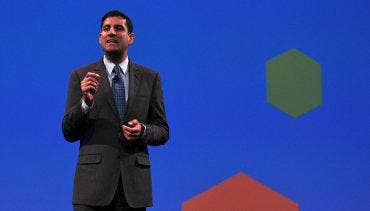
Former U.S. CIO Vivek Kundra on Thursday presented a unique case study about building efficient IT infrastructure featuring the biggest customer of all, the federal government.
Kundra, who between 2009 and 2011 served as the first CIO of the U.S. government under President Barak Obama, shared his experience in driving IT efficiencies with a large crowd of customers and partners at the Dell World conference, held this week in Austin, Texas.
Kundra, who was brought on-stage by Paul Bell, president of large and public enterprise at Dell, said the government spends about $80 billion per year on IT, and has about 12,000 major systems across the globe, ranging from the Social Security Administration to the Environmental Protection Agency to the Department of Defense.
Streamlining that huge and fractured IT infrastructure presented a real opportunity to not only cut costs but also to increase efficiencies, Kundra said. "(We started to) fundamentally think about the way the United States works," he said.
Kundra's job started in November of 2008 after Obama won the election, when he started gathering information what the government needed from IT. He officially took the CIO role after Obama was sworn in.
On his first day at the White House, Kundra was greeted by staffers who, instead of carrying smart devices, handed him a pile of papers. "'Here's a stack of .PDF documents about $27 billion of IT projects behind schedule,'" Kundra recalled them saying.
When he asked the staffers why they didn't have mobile devices, they answered that such devices were passed out based on seniority, and that there was a long wait list to get one. "I first realized the challenges facing the nation," he said.
The problem was not a lack of spending, Kundra said. Indeed, the government had spent over $600 billion over the last decade on modernizing IT.
Kundra identified four major priorities to rein in IT spending and increase efficiency for the U.S. government: better utilization of $80 billion the government was spending on IT; finding new IT efficiencies; bringing security front and center, and creating a more open and transparent government.
Finding ways to better use the $80 million the government was spending on IT each year required the elimination of wasted IT spending. Kundra said his first task was to set up a dashboard which showed up-to-date information on spending for each department.
Kundra said he found things like the Department of Defense spending $850 million over 10 years on an ERP system that didn't work, and the head of the Department of the Interior not being able to send e-mails to all his personnel because the department was supporting 13 different e-mail systems. He said reduced wasteful spending by $3 billion a year by cutting out such efficiencies.
For the second priority, finding new IT efficiencies, Kundra said he looked at how the government handled its data centers. He said that the government went from 432 data centers to over 2,000 data centers in 10 years, leading to an average processor utilization rate of under 27 percent and an average storage utilization rate of under 40 percent. He compared that to the average manufacturer which enjoys utilization rates of 80 percent.
Kundra then developed a plan to shut down 800 government data centers by 2013, and that 137 have already been shut down. "In my view, the government should have only three Ft. Knox-like data centers," he said.
Next: Cloud First And New Apps From Government Data
Kundra also developed the Cloud First policy as a way to start moving government IT operations to increase efficiency.
For instance, by moving the Government Services Administration and Department of Agriculture e-mail systems to the cloud, the government saved $45 million, he said. "We managed to get away from managing IT on a day-to-day basis," he said.
Security, the third priority, was also enhanced by the government's Cloud First policy with its ability to better protect government data in the cloud, Kundra said.
Security is not worrying about hacking from teenagers looking for fun, but worrying about nation states attacking the very infrastructure of the U.S., Kundra said.
The government has moved in several directions to increase security. A four-star general is now in charge of cyber warfare to protect against threats from nation states, Kundra said.
Additionally, federal systems are being put in place to protect citizens. "You'd be shocked to see how many attacks there are per second," he said.
Also, prior to having a CIO, the government's main security activity was getting consultants to do white papers on the need for security at what Kundra estimated to be a price of about $95,000 per page. Since then, he said, the government has set up "red" and "blue" teams to attack each other to look for vulnerabilities.
The fourth priority Kundra identified during his tenure as the U.S. government CIO was driving innovation through an open, transparent infrastructure. "The citizens don't care how many data centers the government has," he said.
Instead, citizens expect government to bring important developments to business and consumers, such as the use of Department of Defense satellites to add value to the GPS system or the move by the National Institute of Health to release human genome data to companies to develop better pharmaceuticals, he said.
Such moves led Kundra to consider whether the amount of government data could be scaled to make possible new applications, and so set up data.gov, which started in May of 2009 with 47 data sets and has since expanded to over 2,000 to provide data that third parties could use to create new innovations.
Along with providing the data, Kundra said the government, through the America Competes Act, provided funding to all agencies to release to third party organizations to stimulate innovative use of government data.
He cited several successful applications already using the government data, including one which allows smart phone users to scan items in their homes to see if anything has been recalled by the manufacturer, one in which consumers can rate medical care, and one which links with real-time flight information to let users determine the best time to leave their homes to go to the airport to pick up passengers.