Rockin' Rack Mount Server: Acer's AR380 F1
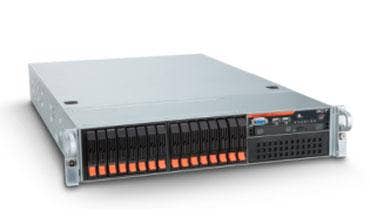
Customers don't have to plunk down $10K to own a high-performing rack server. Or for that matter, even $5K. That's thanks to Acer, which earlier this month began shipping the AR380 F1, a Xeon-based two-socket rack server that's as well-performing as it is flexible.
The well-equipped machine that the CRN Test Center received for testing outperformed all but one of the fastest servers we've ever tested, yet would sell for just $3,329 on the street. List pricing starts at $2,438.
The handsome, 2U server we received was populated with 24 GB of DDR3 memory, but its 18 slots could have handled as much as 192 GB. In the high-end machine was a pair of Intel Xeon X5675 six-core processors running at 3.07 GHz, but it also can accept two- and four-core parts from Intel's E56xx and L56xx series.
Also in the roomy cabinet is ample space for as many as 16 2.5-inch drives, which slide into a hot-swap back plane. In the tested system, two of the eight 15K SAS drives were set as a RAID 0 array and contained the operating system, which was a pre-installed copy of Microsoft Windows Server 2008 R2. Five of the remaining drives were configured as a RAID 6 array for storage; the remaining drive was designated as a global hot spare.
Handling all the RAID duties is an LSI MegaRAID SAS 9260-8i storage controller and LSI's MegaRAID Storage Manager software with battery-backed cache. Nice touch. Maximum storage for this unit is 9.6 TB of SAS drives are used; 12 TB with SATA. The base systems also include a pair of redundant, hot-swap 720 watt power supplies, which together consumed 189 watts during nominal activity, and peaked at 267 during benchmarks.
The Acer system is extremely easy to service. From the factory, the top cover is held in place with small screws, which once removed can be discarded or put aside for later use during transport. The cover snaps into place securely enough with thumb-latches on either side; it slides rearward for easy removal. On the underside of the cover is a motherboard diagram we've become accustomed to seeing on servers from Dell and HP. Beyond that, Acer also provides a detailed chart to ensure the proper insertion of memory for each CPU's three-channel memory addressing capability. Bravo, Acer.
Next: Under The Hood
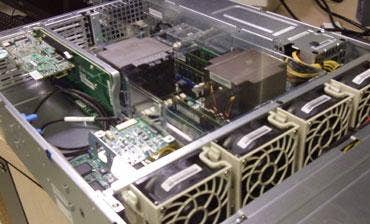
Under the hood, the impressions remained mostly positive. We liked the transparent duct that directs the flow of air from two of its four hot-swap (and relatively quiet) fans across the Xeon processors' sizable heat sinks out the back of the system. Removing one of those fans immediately sends the remaining three into overdrive to compensate. Its seven PCI slots are implemented on a riser card, of course, with one slot occupied by the MegaRAID card. Even with the cover open, the system is fairly quiet; far more so than most of the other servers we've covered.
A trend we've seen lately has been for server makers to omit the optical drive from their base configuration. Acer avoids this pitfall. Aside from initial set up and upgrades, the DVD-RW can be used as an additional means to store snapshots or other valuable data in the event of network or other catastrophic failure. While this might make sense for ultra portables and other laptops, we believe that it's premature to omit it from a server. There's also room for an additional 5.25-inch device such as a tape backup drive.
Also part of the base AR380 F1's base configuration are four Gigabit Ethernet ports plus a BMC port that's dedicated to out-of-band management. Acer Smart Server Manager also is included at no extra charge. Nice if it's needed, but if your customers are using an enterprise management tool already, its unlikely that this software will represent any real value to them. With the server-room crash cart in mind, we also like having VGA and USB ports on the front, and Acer has that covered.
To its extensive list of standard equipment, flexible options, favorable price-performance ratio, Acer adds a three-year warranty on parts, the first of which includes on-site service. Taking all these things together, the company delivers what's needed for the AR380 F1 to compete in a server market that's already populated with experienced, well-established players. After seeing Acer's sturdy AR380 F1 server perform, we think it has a shot, and we have no problem adding it to the CRN Test Center's recommended list.