Performance Boost: The Dell PowerEdge R820
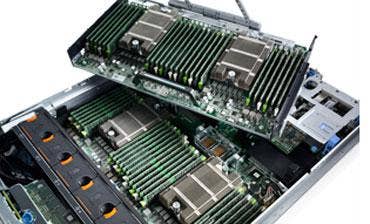
Its stock price might be sagging of late, but Dell continues to outperform in the server category. Last week the company unveiled its latest powerhouse, the Dell PowerEdge R820, a four-socket, Xeon-based 2U server that not only outran its R810 predecessor by a healthy margin but also substantially exceeded that system's ability to expand and scale.
The system Dell sent to the CRN Test Center was outfitted with four Intel Xeon E5-4607 six-core processors running at 2.20GHz. The system supports a maximum of four Xeons and 32 processor cores (64 threads), plus 1.5 TB of DDR3 memory running at up to 1600MHz. Compare that with the 1 TB of 1066MHz DDR3 memory maximum of the R810, which will be discontinued.
[Related: Review: With PowerEdge R810, Dell Doubles Density ]
Somehow Dell was also able to increase the number of PCIe slots from six in the R810 to the R820's seven, including two half-height, full-length x16 slots and five x8 slots of various shapes and sizes to accommodate the variety of RAID controllers and host bus adapters Dell has on offer. The R820 contains no x4 slots. Like the model it replaces, the R820 retains redundancy features such as dual, hot-plug power supplies, hot-plug drive bays and cooling fans, and dual internal SD card support.
The system that we tested came with the 64-bit version of Windows Server 2008 R2 Enterprise running on 96 GB of 1333MHz DDR3 memory in 12 of its 48 DIMM slots. Also preinstalled were five Seagate Savvio 15K 6 Gb/s SAS drives, two of which were configured in a RAID 1 array controlled by a PERC H710 RAID controller. Also inside was the Intel's C600 series chipset, which controls the 6.4GTs (gigatransfers per second) of the PCIe 3.0 peripheral bus.
NEXT: Dell PowerEdge R820 Performance Results After configuring Windows for maximum performance, testers downloaded Primate Labs' Geekbench 2.3.2 and fired up the 64-bit version. Dell's PowerEdge R820 delivered a top Geekbench score of 19,794, an increase of more than 30 percent from the PowerEdge R810 that we tested in March, 2010. Next we kicked off Intel's Iometer benchmark utility to measure the R820's transaction processing and throughput creds. Results were pretty good, with a maximum of around 61,000 I/O transactions per second when performing sequential reads of 512-byte files and a top transfer rate of 1.6 Mbps for sequential reads.
The PowerEdge R820 continues the tools-free design, which makes service and maintenance a breeze. Most internal components can be removed without tools, including fans, expansion and riser cards, and even the drive backplane. The system consumed about 160 watts at idle and peaked at 260 watts while performing benchmarks. Dell also includes OpenManage, its powerful browser-based software for performing remote diagnostics and troubleshooting. Its tools also plug directly into Microsoft System Center and VMware vCenter, as well as management platforms from CA, HP and IBM.
Pricing for the PowerEdge R820 starts at $7,499. As tested, the unit would list for $18,669 including all the hardware we've described here plus quad-port gigabit Ethernet, an out-of-band management port, disk backplane with a 16 TB maximum and multi-tier SSD storage option. The CRN Test Center recommends the PowerEdge R820 for its improved speed and greater expandability than its predecessor and for being a highly capable server for virtualization, transaction processing, HPC or general computing needs.