Accordance ARAID 3500 Speeds RAID Conversion
For resellers seeking a reliable, low-cost alternative to tape backup systems, Accordance Systems' ARAID line of self-configuring drive enclosures was just the thing for GM, and might be equally suitable for customers in need of real-time backup of legacy hard drives with instant recovery from failure.
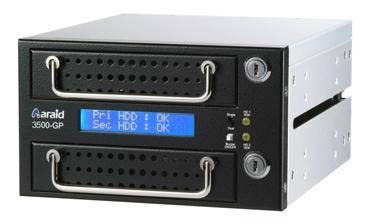
For review, Accordance sent the CRN Test Center one of its ARAID 3500 drive enclosures, a boxy-looking, all-metal enclosure that's designed to slide into two adjacent 5.25-inch external PC drive slots like a stacked pair of DVD drives. But rather than disc trays, the 3500 provides a pair of drawers, each of which accepts a 3.5-inch SATA II drive. Once two drives are installed, the ARAID immediately goes to work, converting the two drives into a RAID 1 array -- replicating the contents of the primary drive [in the upper drawer] to the secondary below.
The host system, meanwhile, is none the wiser, and sees the ARAID as a single SATA volume [there's also an IDE model for older systems like those at GE]. We verified this by running Geekbench during and after a drive replication; there was no difference in performance. And since no software or drivers are required on the host, this simple yet ingenious device is compatible with Linux, Mac OS X, Windows and any other operating system that can address a hard drive. Drives do not have to be identical. An LCD display tells you what's going on inside; an included Java agent can send alerts, if needed. It has its own fan.
Installation took literally about two minutes. We simply removed the boot drive from an existing system, bolted it into the ARAID 3500's upper drawer and slid it into the host machine. The machine rebooted as if nothing was different. Then we put a second, identical drive into the lower drawer, and about 79 GB of data was replicated from the primary to the secondary in about a half-hour.But that's not even the best part. With a RAID 1 array in place, we fired up IOmeter and began measuring transaction performance and throughput. Using a 512 byte data file testing sequential reads against a single drive, we were able to maximize performance at 2065 IOPS and 1.09 MBps. But with both drives configured as RAID 1, transactions jumped to 14,350 and throughput to 7.0 MBps, a performance improvement of just under seven-fold.
With the price of hard drives at all time lows, SATA media has become an extremely cost-effective and time-efficient alternative to tapes and tape drives. ARAID drives are always backed up, and are easily removed and taken off site. "We have customers that are buying extra drive [drawers] and keeping hard drives mounted in them for easy drive rotation."
But for GM, the ARAID 3500 was too big; most of the target machines didn't have two available drive bays. For such situations, Accordance in November began shipping the ARAID M300, which houses a pair of 2.5-inch SATA II drives in a single 5.25-inch drive bay and also is available with an IDE interface. "Using a ghosting utility, GM duplicated the contents of their desktop drives to the M300’s drive array," explained Accordance CEO Steve Johnson. "The M300 was then plugged to the computer’s primary IDE controller, which allowed the system to boot and operate normally without excessive downtime or loss of data," an experience that closely mirrors our own here in the CRN Test Center.
The ARAID 3500 and M300, both available now direct or through Seneca Data and other distributors each list for $395. The CRN Test Center recommends ARzxAID solutions for their simplicity, performance and utility.