Microsoft Revises Licenses To Support ERP App Hosting
This week, Microsoft hopes to remove some roadblocks to partner-hosted ERP adoption with the introduction of expanded Service Provider Licensing Agreement (SPLA) options for its full business applications lineup.
The plan aims to make it easier for solution providers to "rent" ERP software from Microsoft without paying fully up front and then host it for customers. Under the Software-as-a-Service model pioneered by companies like Salesforce.com and NetSuite, customers pay as they go for business applications hosted by vendors. Users typically pay a per-user, per-month fee of slightly more than $100 depending on the scope of the applications.
That subscription model obviates the old big-bang up-front license sales approach that historically drove business for software giants such as Microsoft, Oracle and SAP.
The trick for Microsoft, Redmond, Wash., will be to devise a way for its partners to play in this SaaS scenario while guaranteeing adequate service levels. Microsoft's latest response to the SaaS movement, to be delivered during the Convergence show in Munich, Germany, fits into its game plan of offering a range of delivery methods for its business applications.
"We fundamentally believe in choice, [in] having on-premise [applications], in having programs like SPLAs, so others can offer our products as a service, and Live offerings directly from us. They are all needed," Satya Nadella, corporate vice president of Microsoft Business Solutions, told CRN.
"We've had CRM available through SPLAs for some time and had fantastic traction with over 20 partners and 50 more in the pipeline," Nadella said.
This news, along with an update of Microsoft's CRM Live plans and forthcoming details about the new Dynamics CRM V.3c, which was updated to take full advantage of Vista and Office 2007, will be announced today at MBS' first Convergence show for Europe, Middle East and Africa this week. Microsoft Chairman Bill Gates will be among the keynoters.
While a handful of partners have offered hosted MBS Dynamics CRM and Great Plains applications for some time, they worked out their licensing options through one-off deals.
NaviSite, for example, was an early adopter and an early Microsoft hosting partner. The difference now is that Microsoft is making the SPLAs broadly available for all four of its ERP lines in a programmatic way.
"Think of this as a software license on demand. Instead of buying all the licenses up front, you now rent. That takes away the big up-front capital expenditure costs," said Mike Mazur, vice president of channel sales and alliances for NaviSite, Andover, Mass.
SaaS ranks will grow further this week as former PeopleSoft CEO Dave Duffield launches Workday, a new provider of on-demand enterprise business services.
Sage Software has offered hosted ERP apps for years, indeed well before the ill-fated Application Service Provider boomlet of the late 1990s. "We were in the hosting market before the market was ready," said Craig Downing, vice president and general manager for Sage Software's AccPac line, Pleasanton, Calif. "We kind of made it up as we went along, at a time when CFOs wouldn't use their credit cards online much less put their general ledger or accounts payable stuff up there."
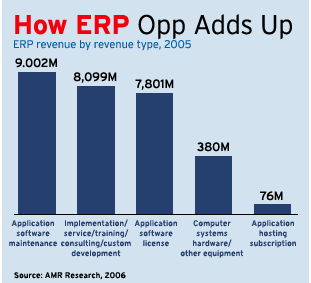
The market and the technology have now caught up with the idea of hosted mission-critical business apps, Downing maintained.
"The infrastructure is there in terms of broadband, storage, security, server virtualization, data center pricing, and here in Silicon Valley you have a [venture capital] model that understands service [which] it didn't get five or six years ago," he said.
Sage, like Salesforce.com and NetSuite, hosts its own applications as an option for customers, but unlike those pure-play SaaS players, it also sells licenses for on-premise use. It launched a partner-hosting model in 2002 but revoked it within a few years.
"We've been there, done that," Downing said of partner-hosted implementations. "We had programs that allowed organizations that satisfied our infrastructure standards to host our applications and to be honest, we repealed them. It wasn't that the idea was flawed, but we ran into a problem convincing ourselves and our clients that the standards in data centers we didn't control directly would be up to snuff."
Today, Sage's VAR partners receive margin on product sales and can generate consulting dollars for needs assessment, customization and implementation, but hosted solutions run on Sage's own infrastructure.
VARs say that Microsoft's "choice" message for delivering ERP software applications resonates with them and, more important, with their customers. "It really is all about customer choice," said Andy Vabulas, CEO of IBIS, an Atlanta-based Microsoft partner.
Vabulas and other solution providers say that the choice of a Microsoft- or partner-hosted ERP offering comes in very handy when faced with a Salesforce.com or NetSuite proposal on a customer's shortlist.
Jim Shepherd, senior vice president for AMR Research, has watched the hosted business apps tide ebb and flow for years. "There was a fair amount of hosting back in the 1980s when they called these MRP systems, and then again in the short ASP boom-and-bust. Now we're back again," Shepherd said.
For Microsoft, the key is including partners in what has mostly been a vendor-customer duet. For customers, the beauty of Microsoft's menu of options is that accounts can start out hosted and then move their applications in-house or vice versa.
"What'll happen is that the active resellers and consulting types will simply have these [hosted] options in their pocket, so if they run into situations where they compete against a hosted solution or a SaaS vendor, they can do that too, they have the pricing, they have the solution," Shepherd said.
"In many cases, I suspect customers will end up buying software the way they've always bought it, but having the option will be important," he added. "That's why Microsoft, Oracle, SAP are coming to the table." Scott Jenkins, CEO of the EBS Group, Lenexa, Kan., an Oracle applications partner, agrees that it's key to have more than one arrow in the quiver.
Partners wanting to jump into hosting will have to foot the bill for data centers or align with an existing secure data center, but in return will get a way to ease the price of entry into applications for small and midsize companies, Jenkins noted.
Conversely, "with the prices we're seeing from some of the online hosted guys, you can also make a pretty attractive three-year ROI case for owning your software vs. a continual subscription where there can be increases that end up nickel-and-diming you to death," he said. The advent of this latest wave of hosted solutions and the battle over who in the delivery chain will do the hosting exacerbates some already tense disagreements between vendors and partners as to who owns the customer relationship.
Microsoft, which built its huge base on an indirect sales model, needs to include partners who want a piece of the pie. But it also needs to contend with SaaS juggernauts like Mountain View, Calif.-based Google on the consumer side and San Francisco-based Salesforce.com and San Mateo, Calif.-based NetSuite in business applications.
Those companies have become media darlings over the past few years and, in Google's case, have built up a market capitalization that makes it a formidable competitor. Google has geared up a business push with free online productivity applications, for example. And Salesforce.com under Marc Benioff and NetSuite helmed by Zach Nelson may control their own data centers, but they're also aggressively reaching out to VARs and ISVs as well.
Both of the latter companies recently launched full application development environments for solution providers in an attempt to build out their ecosystems and offer the types of customization and verticalization that have already taken root in the world of on-premises software.
Some industry watchers maintain that ERP applications and data are so critical that many companies of all sizes remain wary of trusting them to servers and storage units outside their control. It doesn't matter if those servers are from their IT service providers or vendors.
"The nature of ERP is it's your most critical business processes and data, and many companies are legitimately uncomfortable about having that out of their sight," Shepherd said.
On the flip side, small companies that may be on the way up may see hosted solutions as a way to get their IT infrastructures to grow with them on a pay-as-you go basis.
"We have companies who install it on their network but as the business grows, we can turn on the tap of the data center and move the database, literally copy it to our data center and the next day it's hosted," Sage's Downing said.
NetSuite's Nelson maintains, naturally, that it no longer makes sense to keep ERP applications in-house. These applications, he said, are distributed from the get-go.
"Distribution businesses, manufacturing businesses and supply chains all involve multiple locations, so building those core processes on a Web-based application is much more efficient and simpler than using a piece of client-server software that was never designed to be easily accessed from outside a firewall," he said.
One thing is certain: With Microsoft pushing a partner-hosted ERP model for the midmarket, and pitching its self-hosted Live offerings to very small businesses; with SAP weighing hosted versions of Business One; with Oracle continuing its OnDemand push; and with Salesforce.com and NetSuite continuing to trumpet pure SaaS models, the options will expand further before they contract.