Small-Biz Meets ERP
Small business is the last, and greatest, frontier for ERP solutions. And for ERP solution providers.
As the name implies, enterprise resource planning applications are entrenched in big companies. Not so much in smaller ones. That means the land grab is on in the lower end of the market with both vendors and solution providers fighting for share.
"Before, everyone wanted Fortune 500 accounts. Well, guess what? There are only 500 of those so now everyone is coming downmarket. Vendors like SAP are coming to the midmarket and so are partners," said Jeffrey Goldstein, president of Queue Associates, a New York-based Microsoft Dynamics ERP VAR.
That means potentially big opportunities for solution providers because ERP is never—despite what vendors may say—an out-of-the-box fix. It requires a lot of hand-holding, a lot of time and a lot of care and feeding of customers. Most of all, it requires a good understanding of a customer's business.
AMR Research finds that many small- and midsize manufacturing and service companies, which it defines as companies with less than $1 billion in annual revenue, are driven by a demand to better use and analyze the data they already have. That was the No. 1 priority for the next 12 months for 21 percent of the 487 companies surveyed by AMR. Thirteen percent cited the "application of lean practices across the organization" as priority No. 1 and 10 percent said e-business.
ERP underlies all those prioritized tasks although the name may be a little grand for what the smaller companies on that scale need. For those companies—from mom-and-pop shops to those with maybe 20 or 50 employees—a VAR can go in easy and automate a process that is still done on paper or in Excel. For such accounts, QuickBooks or Peachtree Accounting may be fine.
Before we go further, some definitions: ERP has its roots in manufacturing but now encompasses far more businesses.
"ERP was an outgrowth of MRP II, and it linked the factory floor to financials, but that doesn't apply to higher education or health care or retail. All of those non-manufacturing industries have adopted the concept and term of ERP, and for them it means an integrated suite, including their administrative and operational applications," said Jim Shepherd, senior vice president at AMR.
The very fact that lines specializing in SMB ERP—including several Sage Software options, Microsoft Dynamics and SAP Business One—are doing well in companies with less than $100 million in revenue is an indicator that ERP is, in fact, moving downstream, Shepherd said.
While very small businesses are still transitioning out of shoeboxes, Microsoft said companies with as little as $5 million to $10 million in revenue are becoming good candidates for its Dynamics applications. Such companies can be expected to spend $1,500 to $2,000 on ERP software, the Redmond, Wash.-based company said.
Solution providers, too, say that many small businesses, as they grow into small enterprises, want to connect the dots in their organizations, much like large enterprises did a decade ago. With service-oriented architecture, hosted services and more robust server, networking and storage infrastructures, it is becoming easier for even small enterprises to integrate not only their own processes but to tie into those of their customers and suppliers, if needed.
Solution providers who now take care of their customers' networking, e-mail and storage infrastructures but leave the business applications to others need to ask themselves whether or not they should move "up the stack" into applications consulting as well. But if they do so, they need to bulk up their technology and business domain expertise.
Next: The Place To Start
The Place To Start
For startup customers, the usual path is planning a chart of accounts and helping them automate their general ledger, accounts payable and accounts receivables—the holy trinity of basic accounting.
VARs getting small companies started with a basic accounting package say they often find that once the customer gets automated and starts to grow, it will find more uses for technology. In addition to accounting software, solution providers then must be able to work with report writers, business intelligence tools and portals and write code as needed.
Accounting solutions is where Net@Work began 10 years ago. "Initially, we just did accounting software, not financial reporting or CRM," said Alex Solomon, president of the New York-based company. "We then added infrastructure, then e-commerce." Net@Work has since been growing with its customer base, as well as moving into larger accounts, and it launched a separate document management business.
The key for solution providers wanting to make hay in this market? One strategy is to work like an incubator for customers. "Start with smaller companies and grow with them. You get these people when they're babies. I'm willing to take a small deal and bet that this business is growing. I get them and nurture them and then they are my client and locked in," Queue Associates' Goldstein said.
People are often amazed at what automation can do for them, Goldstein said. He said financial reporting tends to be the big "wow" inducer. Basically, if the VAR can show customers that it can make sure they get home at a reasonable time rather than working all night on financial statements, it's a big plus.
Required Skill Sets
Another key, according to solution providers, is being a full-service partner and trusted adviser for clients. "The VAR is the single point of contact and typically manages the full cycle of the client's growth, not just the day-to-day stuff," said Dan Evans, president of Dragon 9, a Las Vegas-based ERP specialist that has worked with NetSuite's hosted ERP platform.
Even more so than accounting software, ERP applications require customization for vertical markets, and having both vertical-market focus and an ability to customize solutions is critical, solution providers say. Microsoft is certainly banking on that as it positions its four ERP lines as development platforms, even as it continues to add functionality to them.
Dallas-based ePartners builds atop Microsoft's Dynamics offerings, targeting the health-care, government and manufacturing segments. EPartners offers management advice and consulting services around how a company should organize its manufacturing, streamline order processing and close books faster. An infrastructure services group helps make sure that hardware, networking and security are up to snuff, said Jeff Margolies, executive vice president of consulting and professional services at ePartners.
Solution providers such as ePartners stress their own brand over that of the underlying ERP software, and that might be a good thing because it is often hard for customers to distinguish between ERP products, which have similar features. Thus, many customer buying decisions are not based on the product but on the solution provider that presented a solution. Marketing plays a larger role than product differentiation.
So do the solution provider's services. "The license sale is a one-time pop, but people won't necessarily continue to buy software," Margolies said. "Services let you engage with a client on an ongoing basis, and you use the software to drive significant improvement in the company. Once the software is in, you can sell more services to solve more problems."
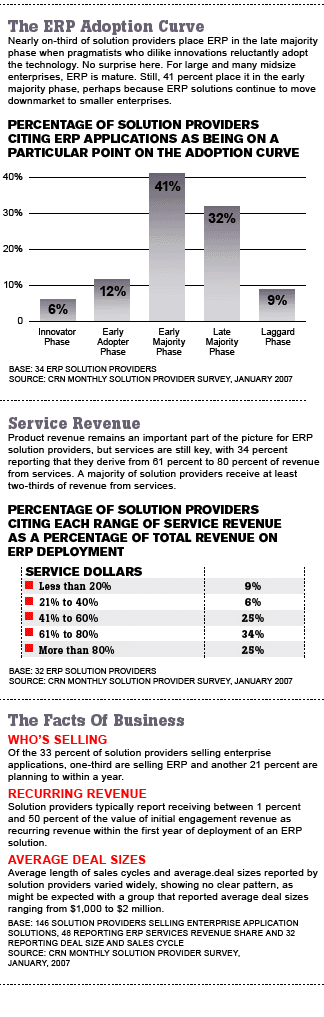
Services are big part of the equation for solution providers. According to the January CRN Solution Provider Survey, 34 percent of 146 ERP partners surveyed said they derive from 61 percent to 80 percent of their revenue from services, and a majority of respondents said they get at least two-thirds of their revenue from services.
Attacking the small-business ERP space need not cost big bucks initially. A CPA or VAR with accounting expertise can join the Intuit ProAdvantage program for a nominal fee, less than $400 per year. VARs wanting to build a slightly higher-end practice—say with Sage or Microsoft Dynamics ERP offerings—face relatively low monetary barriers to entry as well, although those costs vary.
Solomon said signing up with Sage costs about $5,000, and training costs between $5,000 and $10,000. Setting up a Web site is another $5,000 to $8,000. The real dough is spent on hiring experienced help. A full-time business consultant or a technical resource person generally earns between $60,000 and $80,000 a year.
The key is getting the domain expertise down. That takes time, and time is money. "We have to show we know their industry. We could be the best expert in the world on this accounting package, but if I don't know their business, it won't matter," Goldstein said.
AMI Partners analyst Laurie McCabe said while current ERP adoption is becoming "mainstream" in midsize businesses, it is still very early on for small-business adoption. AMI defines midsize businesses as those with 100 to 999 employees, and small businesses those with up to 99 workers. "The little guys aren't doing all that much yet. Probably because of cost and probably because many don't know what ERP can do," she said.
Next: A Look At The Key Players
A Look At The Key Players
But as that changes, solution providers should consider partnering with vendors that can offer small-business clients a clear migration path from basic accounting packages. Here is a CRN Test Center look at some of the some of the primary vendors in the market, beginning with Sage Software.
With its MAS line, Sage has created matrices to satisfy different industries, doing some of the vertical market customization. On its advanced inventory module, for instance, MAS can cover lumber, paper sales, apparel and textile, doors and windows building materials and other business variants.
The CRN Test Center also found Sage MAS 90 workflows concise and its reporting features mature. MAS arrives with customizable reporting on every module and integrates with Crystal Reports, so MAS partners do not have to get stuck using canned reports, an important consideration that is missing from Intuit's QuickBooks Enterprise line.
MAS also arrives with a business dashboard that is designed to give managers a quick look into their businesses. Dashboard fields can drill down to reports.
Clark Haley, president and CEO of San Antonio-based BCS/ProSoft, said his company has won business many times over the past 15 years by providing sound migration strategies using Sage's MAS 90. He said customers who have suffered through badly orchestrated upgrades often are wary of moving between vendor solutions, so being able to show customers a well-coordinated migration strategy is important.
Whether customers move from a QuickBooks or Peachtree to a MAS 90 or Microsoft Dynamics GP environment, they are going to need some training. Most midmarket ERP solutions have complex workflow environments and blend accounting with other business processes. This is another sticky point when selling a complex solution.
To help customers transition between accounting and ERP, vendors Intuit, Microsoft and Sage offer simple ERP products. Microsoft's Small Business Financials, for instance, provides accounting, light inventory, billing and purchasing and optional payroll functionality.
Financials competes with QuickBooks Professional, QuickBooks Enterprise, Peachtree and, to some extent, Sage's MAS 90. Customers that outgrow Financials can upgrade to the Microsoft Dynamics suite. Dynamics competes with Sage MAS 200 and other higher-end enterprise ERP solutions.
Dynamics Offers Customization
The four-pronged Dynamics suite is Microsoft's ERP crown jewel. With Dynamics, solution providers can develop warehouse management solutions using SharePoint portals. Dynamics also provides CRM, electronic banking and e-commerce.
Dynamics arrives with customizable modules, including more than 200 Web services designed to integrate many external systems. With Dynamics, solution providers can safely grow their services from the midmarket all the way to enterprise-scale solutions. The software giant provides development tools for every conceivable integration possibility. For instance, to connect inventory to operational systems that control shop floor machinery of a manufacturing company, solution providers can use Visual Studio to access low-level hardware output.
Much of the complexity doesn't end up passed on to the end user. Dynamics GP, for instance, arrives with a feature called Business Notifications that looks for events, allowing users to quickly find any information without having to navigate the software. Dynamics also integrates with Office's Smart Tags to find and view any transaction without having to search for it on a Dynamics desktop client. Users do not even have to be in the system to open up outstanding transactions.
Intuit Offers Seamless Migration
Like Microsoft and Sage, Intuit provides a fairly seamless upgrade path between its QuickBooks accounting software and QuickBooks Enterprise. Intuit has built various integrated midmarket solutions with ISV software. For instance, Intuit partners with TrueCommerce and Fishbowl Inventory to provide EDI integration and advanced manufacturing features, respectively. Because QuickBooks Enterprise's third-party solutions are integrated into the QuickBooks architecture, training and implementation costs are lower for customers.
Intuit also has reached out to solution providers by providing them with a developer network so that they can build and sell add-ons for QuickBooks products. Working with QuickBooks SDK is fairly simple. The SDK uses XML wrapped around class library to communicate between QuickBooks and external applications. Moreover, all client-based QuickBooks products use the same SDK specification, so solution providers only have to develop an integrated solution once.
QuickBooks Enterprise provides consolidated financial reporting by combining reports from different companies. Customers can view cash flows, balance sheets and other financial statements from multiple companies in a single report. However, companies that want to extend reporting to their customers have to look outside QuickBooks for a solution. Right now, QuickBooks Enterprise users have no way of extending information because they can only export reports into Excel.
Intuit's Full Service Plan entitles customers to use its online backup facilities and data protection services, including unlimited tech support. Intuit takes a more direct approach by providing a CD training kit called Mastering Quickbooks Enterprise to customers. According to Intuit, the CD helps solution providers sell expert services because customers are more aware of the pain points when transitioning between QuickBooks Professional and QuickBooks Enterprise.
Next: Open-Source Gaining Ground
Open-Source Gaining Ground
In the SMB sector, the ground is slowly shifting to open-source ERP alternatives. Solution providers are exploring low-cost open-source ERP alternatives because they have full control of the software and can easily differentiate themselves. Open-source vendors such as Apache's OFBiz, Compiere and OpenMFG offer well-developed ERP suites.
OpenMFG offers one of the most comprehensive ERP solutions. The company's open-source model abides by an exclusive source-code distribution license, whereby solution providers can get the code after buying the software. OpenMFG provides mandatory classroom sessions, which are included with the $3,000 annual program fee.
OpenMFG's ERP software is built on PostGres and its stored procedures, so solution providers do not have to write code to integrate it with other applications. A database link is all that is required. The OpenMFG software architecture allows solution providers to easily test new features by adding database objects such as event triggers and table fields. The software uses QT as its GUI and comes bundled with open-source OpenRPT to generate reports.
Compiere boasts that its open-source ERP software has had more than 1 million downloads. Compiere is an out-of-the-box ERP product, but with an unusual twist—the software uses a generic model-driven architecture to change the application and add new features. Its open-ended ERP solution arrives with built-in regenerative properties in the source code. Essentially, Compiere developers have abstracted many components that would normally be hard-coded in a finished application.
Whether solution providers go with one of the commercial vendors or an open-source alternative, they will need to offer a range of solutions and an ability to custom fit those solutions to businesses of different sizes. "One of the biggest challenges is how to start separating clients," Solomon said. "They have totally different needs."
Net@Work initially sold just one accounting system, but found that it needed to expand its line to service different customers. "It would often mean fitting a square peg into a round hole, so we brought in multiple ERP solutions from Sage," Solomon said. "When we talk to a prospect, we look at their business and come back with a recommendation. Now we sell Accpac Pro, Accpac Advantage, MAS 90, MAS 200 [and] MAS 500."
ERP solution providers such as Net@Work also commonly find in the small- and midsize-business market that they need to handle hardware and network infrastructure as well as applications. Alternatively, many solution providers catering to the small-business market are finding that being able to deliver integrated business applications, by whatever name they go by, is becoming part of what it means to be a full-service provider as ERP solutions come downmarket.