From Awareness To Action: What We Learned From Acronis’ Women In Tech Panel
At MSP Global in Tarragona, Spain, four leaders shared how equity moves from theory to infrastructure and why the next generation of innovators needs advocacy, not permission.
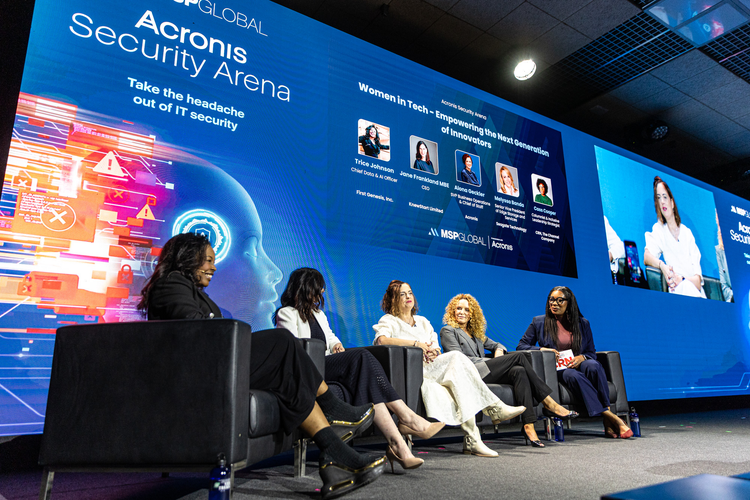
Sometimes the most powerful leadership conversations happen when the data fades into the background and the people step forward.
During Acronis’ “Women in Tech: Empowering the Next Generation of Innovators” panel at MSP Global 2025 in Tarragona, Spain, I had the privilege of sitting alongside four women who embody what transformation looks like when it is lived, not theorized: Jane Frankland, Trice Johnson, Melyssa Banda, and Alona Geckler.
Each of them brought a distinct truth to the stage, rooted in experience, not abstraction.
Integrity Over Optics
Jane Frankland, a 29-year veteran of cybersecurity and founder of the first female-owned ethical hacking company, reminded us that diversity cannot survive on optics alone.
“We do not need another initiative; we need integrity,” she said. “The data exists. What we need now is to act on it.”
Her message cut through the noise of industry platitudes. Equity, she argued, is not a marketing line. It is a measure of how systems are built, funded, and enforced.
Resilience Without Exhaustion
Trice Johnson, chief data and AI officer at First Genesis, reframed the word resilience for leaders who have long carried the weight of broken systems.
“Resilience is not about enduring what is unfair,” she said. “It is about building the mental and emotional capacity to redesign what is not working.”
In a world that often praises perseverance but rarely funds recovery, her definition resonated. True leadership requires rest, clarity, and the courage to rebuild what no longer serves.
Shared Responsibility
Melyssa Banda, senior vice president of edge storage and services at Seagate Technology, shifted the conversation from representation to responsibility.
“Equity is not a women’s issue. It is a leadership issue,” she said. “If men are not part of the solution, we are not solving the real problem.”
Her call for accountability reframed allyship as performance, not preference. It was a reminder that culture change requires participation from every seat at the table.
Culture As Daily Practice
Alona Geckler, Acronis’ senior vice president of business operations and chief of staff, emphasized that progress cannot be a campaign; it must be a rhythm.
“You cannot delegate culture,” she said. “It has to live in the business every single day.”
Her leadership within Acronis’ Women in Tech program demonstrates how inclusion becomes sustainable when it is embedded into operations, from recruitment to decision-making to recognition.
From Talk To Design
Moderating this panel reinforced the global need for increased intersectional inclusion. This specified type of leadership does not advance solely through inspiration. It grows when leaders create environments by design, not default. It is through policies, pay structures, and mentorship models that emphasize advocacy and sponsorship, alongside everyday decision-making.
The “FOMO at Work” report opened the conversation by quantifying the perception gap between men and women in tech. This panel proved that the next generation of innovators, women and allies alike, are ready to close it through action, not aspiration.
The future of the channel will not be defined by who talks about inclusion, but by who is brave enough to build it into how we lead.
The Inclusive Leadership Newsletter is a must-read for news, tips, and strategies focused on advancing successful diversity, equity, and inclusion initiatives in technology and across the IT channel. Subscribe today!