The New Glass Cliff: Why Women Keep Getting Asked To Fix Broken Teams
Women keep getting promoted during crisis moments. The new glass cliff is subtle, systemic, and is reshaping leadership in the IT channel.

We Named the Patterns Years Ago. The Problem Is They Evolved.
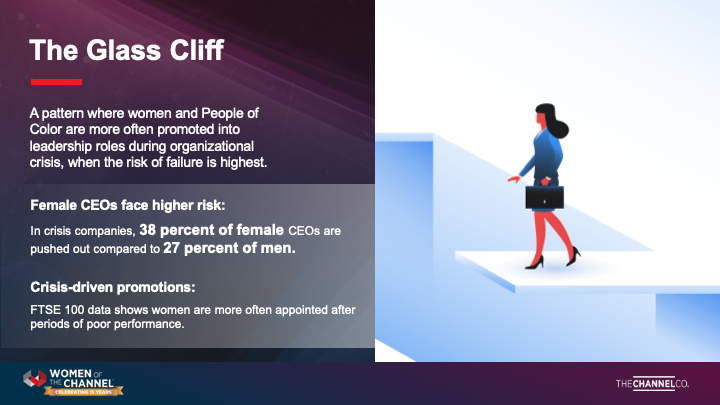
For decades, we have relied on metaphors to describe the barriers women face at work. The glass ceiling showed why women could see senior leadership roles but could not reach them. The broken rung, introduced by LeanIn and McKinsey and expanded in a 2025 book by Kweilin Ellingrud, Lareina Yee and María del Mar Martínez, exposed the real bottleneck at the first step into management. And the glass cliff, identified by researchers Michelle Ryan and Alex Haslam, described what happens when women are promoted only when the situation is already failing.
Today, the pattern looks different. It is quieter. It is more complex. And it is happening in the IT channel at a scale that deserves a real conversation.
Women are being elevated into roles that require emotional labor, crisis management, cultural repair and team stabilization. These opportunities are framed as leadership. Yet they are often rescue missions.
The title looks promising, but the conditions are not.
This is the new glass cliff.
Why Women Keep Getting Tapped in Moments of Crisis
Women are often evaluated on communal skills, such as empathy, listening, relationship building and conflict resolution. These are strengths, yet they are regularly treated as cleanup tools when the organization is already in trouble.
Leadership teams think:
“She builds trust.”
“She can repair morale.”
“She is good at communication.”
But the question almost never asked is whether she will have the systemic resources to create long-lasting change. Women often structurally inherit responsibility without influence, accountability without support, and visibility without safety. Many step into these roles because they want to lead and because they know their skills matter. The issue is not the women. The issue is the broken structures they inherit.
The Invisible Labor Behind The New Glass Cliff
Women in the IT channel carry a heavy load of invisible labor. They are the ones redirecting conflict, offering support to struggling colleagues, smoothing communication gaps and holding the emotional climate of teams. This labor is real, and it is essential. And it is rarely documented or rewarded.
So, when leadership is fractured or culture is declining, organizations look to the women who have already been quietly holding things together.
That is how a stretch opportunity becomes a glass cliff.
The organization says yes to her leadership, but she is stepping into a problem that was constructed long before she arrived, with the expectation that she rescue and recover.
What Happens When The Situation Does Not Improve
When the team does not recover fast enough or the culture does not transform overnight, the narrative turns inward. The woman is scrutinized more intensely than the system that failed her.
She is labeled not strategic enough.
Not assertive enough. Not ready enough.
The organization forgets that the situation was broken before she walked through the door. And the ultimate insult comes when she is replaced by a man once the team is more stable.
This is the pattern the original glass cliff research warned us about.
We are watching the modern version play out in real time.
The Glass Cliff Is A Systems Problem, Not A Skills Problem
Teams do not fall apart because of one leader. They fall apart because of unclear expectations, unresolved conflict, burnout, turnover, uneven accountability and years of organizational avoidance.
These are systems issues. They cannot be fixed with charm or empathy alone.
When women are placed into crisis roles without structure, resources or authority, the organization is not promoting them. The organization is using stereotype to facilitate a repair job.
Until leaders understand this distinction, the cycle will continue.
How Leaders Can Interrupt The Glass Cliff
Tell the truth about the condition of the role. Promotions are not favors. They are responsibilities. Name the crisis directly.
Give women real decision-making power. Culture cannot be changed from the sidelines. Authority must match the assignment.
Reward emotional labor. Track it, measure it and evaluate it like any other form of leadership work.
Invest in the team, not just the leader. A broken system requires shared accountability and structural repair.
Create objective success metrics. Without clear goals, the leader becomes the default scapegoat.
The Bottom Line
The glass ceiling kept women out.
The broken rung stalled them early.
The glass cliff pushes them into roles where success is unlikely and blame is inevitable.
The pattern is evolving, but the outcome is the same when organizations fail to change the system.
If companies want more women to lead, they must provide real authority, honest support and a culture prepared for genuine transformation.
Otherwise, we will keep promoting women into instability and calling it opportunity.
The Inclusive Leadership Newsletter is a must-read for news, tips, and strategies focused on advancing successful diversity, equity, and inclusion initiatives in technology and across the IT channel. Subscribe today!