Meter CEO On Microsoft Partnership And Disrupting The Legacy Networking Market Through NaaS
The entrepreneur spoke about the Network-as-a-Service specialist’s unique approach to a legacy IT market and how it’s competing against Cisco and HPE, the company’s all-important relationship with Microsoft and the resulting ‘tremendous’ opportunities for partners.
Network-as-a-Service specialist Meter set out 10 years ago to disrupt the static networking space and give the market incumbents a run for their money. For its efforts, the company has attracted the attention of Microsoft Chairman and CEO Satya Nadella, just to name one tech innovator interested in what Meter is bringing to the table.
Meter was co-founded by CEO Anil Varanasi and his brother and CTO, Sunil Varanasi. The two entrepreneurs saw some things that they “entirely disagreed” with within the networking industry. For starters, commoditized hardware, building products through acquisition rather than from the ground up, and often very high, up-front Capex costs associated with networking deployments. To that end, Meter is offering cohesive hardware and software that’s entirely home-grown and brings to the market a unique NaaS business model where channel partners are paid high-value recurring revenue, with no risky Capex expenses required.
But perhaps the biggest feather in the company’s cap is its five-month-old strategic partnership with Microsoft that allows customers to deprecate costs from their Microsoft Azure agreements, which will potentially drive hundreds of millions in new revenue for Meter and its channel partners in the next few years, according to CEO Varanasi.
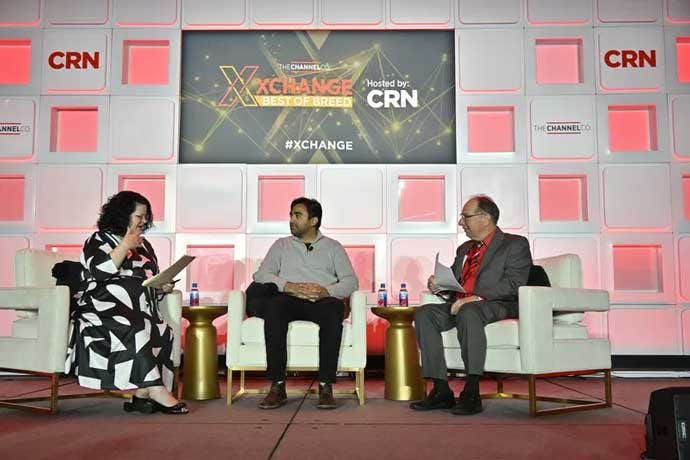
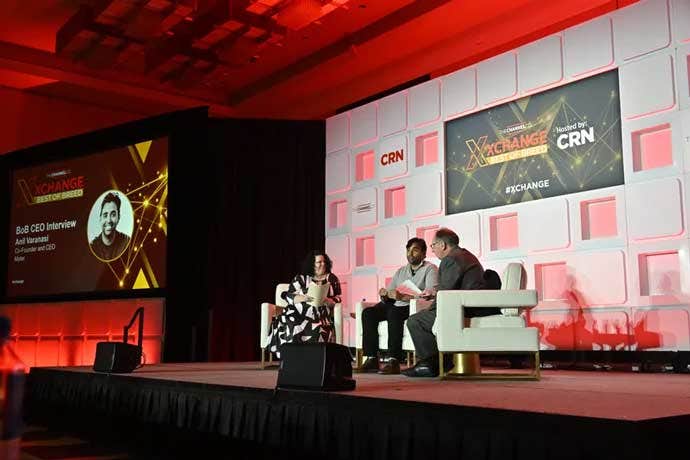
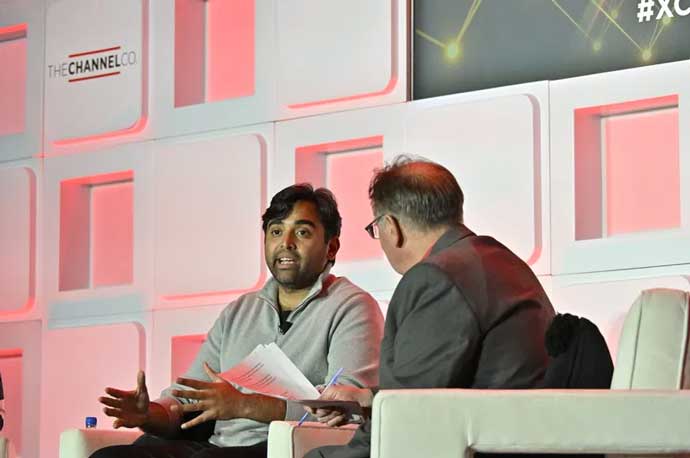
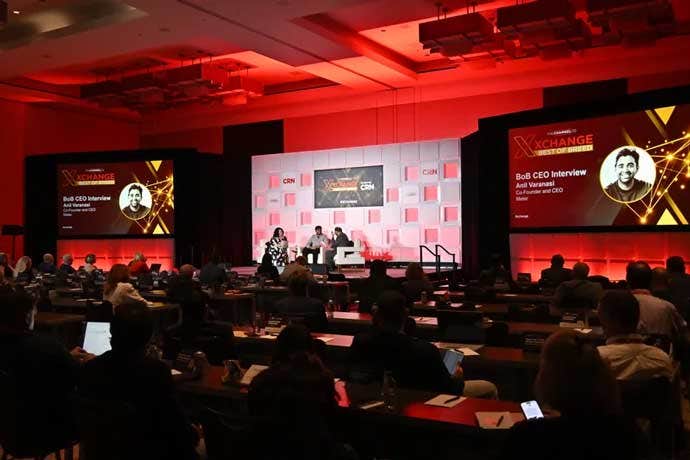
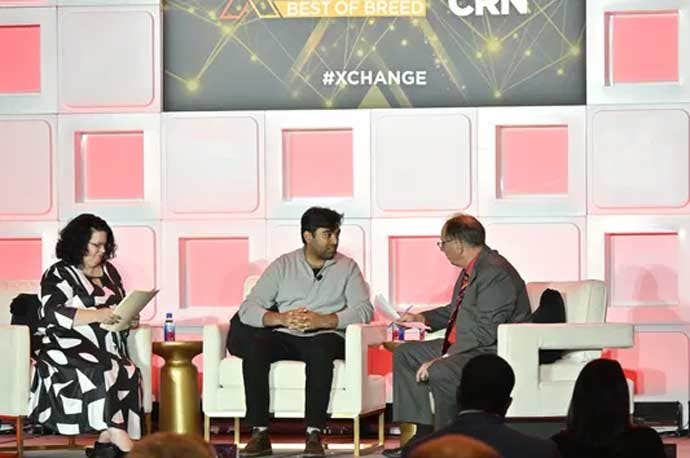
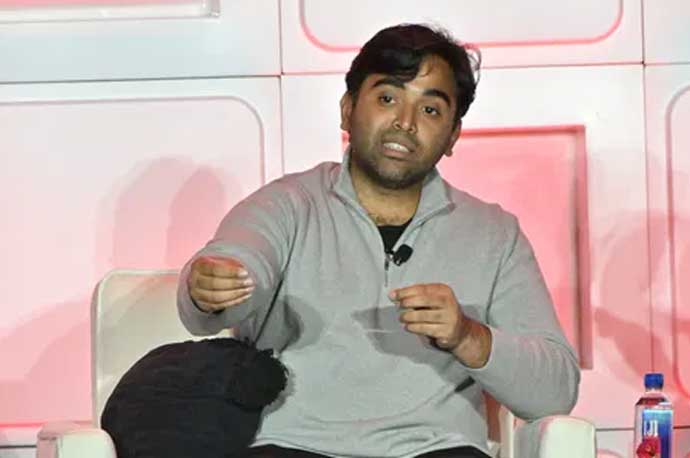
Varanasi, a passionate visionary in networking—and in his free time supporter of young entrepreneurs—sat down with CRN at the 2025 XChange Best of Breed event in Atlanta, hosted by CRN parent The Channel Company, this week to talk about Meter’s unique approach to a legacy IT market and how it’s competing against Cisco and HPE, the company’s relationship with Microsoft and the opportunities that abound for partners.
Here are excerpts from the conversation.
Tell us how Meter got its start and how you and your brother decided to disrupt the networking space?
Along with selling PCs, networking was one of the big impetuses for the channel 30 to 40 years ago. That’s how the channel grew, [by] selling networking. But if you look at networking, it’s one of the few industries that has multiple $200 billion market cap businesses, yet no new companies come in at all. It’s probably the most scathing review against the efficient market hypothesis. And we saw that there were a couple of things that were happening in networking that we entirely disagree [with]. First, vendors kept saying, ‘Hardware is commoditized.’ Second, the way that [networking vendors] were building products was mainly through acquisitions rather than building them together with cohesive software and operating systems. Third was the pricing model. They were trying to make hardware as cheaply as possible and sell it as expensively as possible. We disagreed with all of those things. We didn’t believe hardware was commoditized. We think there was something great to be done on the component of the design, the build, the quality of it, especially as you’ve seen other hardware get so much better in other parts of technology.
Then, we also believe that you can build the whole thing from the ground up together. Why should it be that every part of networking is actually built through acquisition? Why can’t it be that you build the hardware, the operating systems, the applications all together for power, routing, switching, security [and] wireless. It’s a much better outcome for customers and partners as well because most issues in networking happen either because of configuration and configurability issues or because of security issues. And then we had a different business model in mind too. Everything else was moving toward the vendor will only get paid [if] they continuously provide value. [Networking vendors] made a box, sold the box, then washed their hands of it. We thought that was also wrong, and we saw that as the opportunity to start the company.
Tell us about the Meter business model.
Usually, when you’re deploying networks anywhere, there are two big costs. There are capital costs, and there are operational costs. On the capital costs, the two big ones are obviously hardware costs and install costs, and the operational costs are either building out the team internally or working with [a] great partner. What we thought was both for the customers and the partners, taking away the capital expenditure would be great to be able to do. [Like with] AWS. Before AWS came along, you had to go buy the server, stack them, then figure out all these different configurations. Then somebody else took on the capital risks that customers and partners wouldn’t have to fund. So, same with us. When customers have existing hardware, we’ll buy that so there’s no sunk cost. We’ll install our racks entirely free of cost, which we take on the risk of everything from power, routing [and] switching, and then when new hardware is built because of new technologies that come out, or specifications, or anything like that, we will upgrade our customers as well. The underlying model is we believe that people that build the hardware and software should be the ones responsible for it and should be the ones taking on risk, so we take on all the capital risks.
How do partners get compensated?
It’s just a monthly cut or annual cut that’s recurring, high-quality, predictable revenue. For so many businesses in channel, networking is still a significant part, but it’s low-quality revenue today because you get one-time revenue, and it’s unclear how it’s going to be. We’ve all seen this transition in the last 15 to 20 years [in which] businesses that have recurring revenue are actually much higher than ones that are not. With Meter, we have set contracts with customers, and as we get paid partners get paid the same cut as well, while having much better hardware, much better software, which means [partners] have to spend less time designing, configuring and maintaining networks. That means they can take on more customers and have happier customers.
Meter has attracted backers like OpenAI’s Sam Altman and VMware founder Diane Green. How did you bring these people on board?
I think one of the remarkable things about Silicon Valley … it’s sort of like a very small community. San Francisco is just a city of 800,000 people … so it’s a very tiny place. When you’re building something that’s interesting, usually people are hearing about it. So, [Altman] heard about the work we had done and we met him through that. [Green], we met through some Google folks, but also through John Collison, the president of Stripe. These are people that we had admired for the work they’ve done, particularly somebody like Diane. It was very fortunate for us where they all saw the value of building better networking.
Meter has total control over its hardware stack to the point that you and your brother lived in Shenzhen, China, for a year to oversee production. What was that like?
If you imagine America not being that great at building infrastructure in hardware today, a decade prior it was even worse. We would design circuit boards, and it would take six to eight weeks to get back. And that’s no way to iterate really fast on any product. Usually, what you want to do is do some work, know if it’s good or not, or ideally, know if it’s great and then build on top of that. Just like San Francisco is the provider of software for the world, Shenzhen is one of the best cities—it went from 30,000 people to 30 million people in 30 years. It’s one of the most remarkable places, so it’s really great for us to go, to be able to prototype really fast, and all the components and factories are right there, situated in one place. It was a grand time. I think regardless of the geopolitical situation we’re in today, I think people are just great. They just want to do great work. They want to provide for their family and ideally be happy. Shenzhen was amazing for us to be able to do that, being able to prototype really fast, being able to walk up to any factory, get a component and just start trying things. It was some of the best time of my life.
Meter announced a multiyear strategic partnership with Microsoft earlier this year, opening the door for Microsoft partners to sell NaaS with no up-front cost through the Azure Marketplace. How big an opportunity is this for the partners?
It’s a tremendous opportunity. Most of the enterprises in the world have some sort of agreement with Microsoft to buy their services, and they have this thing called MACC [Microsoft Azure Consumption Commitment], which is this minimum spend with Microsoft. What this partnership enables everyone to do, especially partners, is [to] be able to sell Meter through that marketplace, and customers get to deprecate that cost from their agreement. That hasn’t been available for networking before on the Azure Marketplace. For partners, they’d be selling something that’s better economically for the customer yet still getting the same economics they might if they sold directly, and the customers [are] further incentivized to buy because it helps them with agreement they have with Microsoft. I didn’t understand it at first when [Nadella] said, ‘This will be great,’ I was like, ‘Ah, that sounds fine.’ But then, as I learned about it, I think it’s one of the most remarkable things they’ve done.
How big of an economic impact will this have on Meter?
We anticipate it will be the biggest channel we have over the next few years. We’re already seeing tremendous amount of progress with deals and with the amount of deals we have in the pipeline, [just] how many have a Microsoft agreement—I hadn’t appreciated [that] until I looked at our pipeline in the last few months.
What’s your pipeline like?
We’re now global, and the different pipeline we’re seeing is everybody from some of the largest enterprises in the world, to retailers, health care, manufacturing, facilities, schools, etc. At one end we have companies like Bridgewater, who’s the largest hedge fund in the world, running on Meter, to technology companies, manufacturing companies, some of the largest independent schools, Montessori schools, all running on Meter. And especially in the last two years, the pipeline is sort of growing on itself. I think partners have been an incredible part of that story. We’ve on-boarded some of the best channel partners in the last 18 months as we were building out the program, and it’s been really critical to our business.
What are some of the deals you’ve won as a result of the Microsoft agreement?
Retail is a big pull-in. Usually, IT teams at retailers are strapped on capital. They wait for end of life and end of support because the budgets aren’t there. It’s really tight financially. But because of the distributed nature, they usually have some sort of deal with Microsoft for any number of services they might be buying. So, what we’re seeing is two sorts of deals coming through our pipeline where Microsoft sellers are bringing us into their deals because they’re buying it, and then we bring in a partner to help us facilitate that deal ourselves, so then we’re bringing a pipeline to our partners, and at the same time, the other way around is a channel partner might bring us a deal, but we bring in a Microsoft seller [and] say, ‘Hey, this customer has this agreement of a cloud commit that will go down and they can buy Meter through it,’ so then, the deals are further accelerated. I think generally what we want in a business is bigger pipeline and faster close, and that’s what the partnership is enabling us to do.
How did the Microsoft partnership originate?
We released this product called Command about a year and a half ago. We built models from the ground up that understand networking to be able to design, deploy and maintain networks better than anything possible. Somehow, that caught the eye of everybody that’s building technology companies and running technology companies, and we had heard [Nadella] had also seen it and that he loved the product as well. One of our good friends who built a lot of things for Facebook ended up at Microsoft working directly with [Nadella], and [he] introduced us. We ended up just talking about products, what we wanted to do with infrastructure, and the context on Microsoft is they are obviously the one of the largest purchases of networking in the world. … Somebody like [Nadella] has such a strong sense of the technical aspects and he helped build Azure, so over the course of six to eight months, we ironed out a partnership for the next decade.
What’s the quickest way for these partners to monetize NaaS?
I think with any of [a partner’s] customers, existing or in pipeline, think about the fact that they also need networking. We can come in with our software, with our business model, and our partnership with Microsoft, to be able to both help accelerate the closing for any of the deals [partners] have and also increase the revenue you get with high-quality, recurring, predictable revenue.
Cisco spent $28 million on Splunk to provide a leap forward in network security and AI network automation. What impact do you see that deal having on the market, and what does it mean for head-to-head competition with Meter?
I think it’s a really good spin to take something like Splunk and AppDynamics and say it has something to do with networking. Yes, they’ve tried to build silicon, but if you look at the last 25 to 30 years, they bought the Catalyst business, they bought Meraki, they bought OpenDNS, they bought ThousandEyes, etc, etc. At one point in the ’90s, every year, they were probably buying 20 to 30 companies a year. That sort of led into the early 2000s as well. Only somebody not working in technology would assume you can just take disparate companies and say, ‘Combine.’ That’s not vertical integration. Vertical integration is having a single hardware platform, single operating stack, single data pipeline and a single application all built together knowing what’s happening. The thing that I think [Cisco does] well is having this large portfolio [in which] you can sell any random thing to a customer. That’s not our strategy, and we’re probably going to lose what customers and partners that want this ... [from] the same company that’s providing a network is going to give me where I can dump all my data … but what we’re seeing from our customers and partners is a combination of [Cisco] and others in the industry not focusing on great hardware, great software and an economic model that doesn’t work for customers. As much as we’re doing great work, I think it’s also the industry running toward us away from some of these legacy companies.
HPE has gone in a different direction with the $13.4 billion acquisition of Juniper Networks to dig more into AI with Mist. What do you see as the difference between the AI approach that you’re taking versus what HPE is doing?
I think this is one of the most important questions in our industry today. What most vendors are doing is either taking data that they get from their customers and shipping it off to one of these model companies without any sort of sticking on security and data privacy, etc. or they’re using models from 15 to 20 years ago that are open source and calling it AI. You don’t hear us say the word ‘AI’ much because we think it’s watered down. We believe in outcomes for customers, but the approach we’re taking that’s different than anybody in the industry is we are really focused on building models from the ground up that understand networking. What other people are doing is sort of the equivalent of taking ChatGPT and putting it in a car like Tesla. I don’t think any of us would get in a car if it was driven by ChatGPT, and I don’t think ChatGPT should drive our networks.
What’s your advice to partners on how to make this sales pitch to customers and overcome resistance that they might face because of the brand recognition of these long-standing incumbents?
Where we’re seeing partners have the most success are the ones that understand and want to drive customer outcomes. Usually, partners are selling reputation because they have these long-standing relationships with customers over the course of years and decades. What we’re able to do when we’re slot in is be able to pitch a better product that customers can touch and feel. Being able to feel a better delivery model [where] we handle, along with our partners, everything from procuring ISPs to designing and deploying networks. So that happens in a much lower cost and much faster for customers, and then this pricing model with zero capital expenditure.
How do you see the channel model evolving around subscriptions, and how do you see the model changing in terms of compensation, sales, incentives and profitability?
I don’t think I have all the answers, but roughly what we’re seeing on this is, with our model, there’s two really interesting things that are happening. Over the course of three to five years, we’re seeing partners who are making way more money than they otherwise would with networking because of the recurring nature of it. Yes, you might make a little bit less up front, but over the course of year two, three, five, seven, you end up making a lot more money from this resource—that’s such a big part of all the technology. Then, the quality of revenue matters a lot. You want to have predictable, high-quality revenue. Because of Meter’s business model of handling things end to end and vertically integrating the hardware, software, delivery and maintenance, a lot of the burden that usually was with partners to be able to do some of the lower-quality revenue things we’ve automated away with software and processes at scale. That means there’s higher-quality revenue that gets kicked to the partners. So, when we see some of the largest channel partners so quickly moving to Meter I think, along with the product, the economics are a huge part of the story.
How do you see AI impacting the NaaS model?
I think for the model we’re trying to do, most of the AI models are very incentive-aligned because what we are saying to our customers, and what our partners are saying to customers is, ‘We’re going to deliver this as a service. We’re going to stand by the quality of the network, and we get paid if we deliver a high-quality network that’s fast and reliable.’ So what the models are able to do is really push that even more because we’re looking at, as new data comes in, the networks are being used [and] the models should proactively do what’s happening, and some of the products we’re building that we’re going to announce in about a month at our conference is helping partners imagine, ‘What would it be like to be able to apply a million network engineers to every network?’ So being able to scale that up in the back end where our models are monitoring everything from the data that’s coming in, to the configuration changes, the entire stack and doing the steps that all [partners] would do if you were able to just concentrate on every single network and providing all that to partners, where partners get the credit because, ultimately, they’re the ones that are responsible for these networks, but Meter continues to provide this great software that scales. Ideally over the next year, year and a half, it should feel like every Meter partner does have a million network engineers. We should do that by scaling our software and scaling our models.
As both you and your brother are immigrants that came to the U.S. as young people, can you talk about your views on the immigration climate here, and what impact you think that’s going to have on American competitiveness and job creation?
This is a topic I’m incredibly passionate about, not just because I’m an immigrant, but because I believe in America deeply. Immigration is one of the best things the United States can do, both in high-skilled and low-skilled labor. We have long stream studies across decades that show a few things, which is in markets where there are immigrants, everybody’s wages go up, regardless of the socioeconomic status. Two, immigrants account for about 30 percent of all companies that are starting out. Three, the amount of talent that comes in—the United States has been the only country that’s been a net importer of inventors in the entire world. There’s a great chart by a professor at Harvard named Norman Kerr that shows this, which is every country is a net exporter of high-skill talent. Every country. United States is the only country that's a net importer of this capital, and I think it’s really incumbent on us [to make] sure that continues to happen the next 10 years, but also the next 10 decades.
You and your brother try to positively impact the world by funding young people to go and do interesting things, no strings attached. And can you just tell us about some of the really creative things that people have done with that funding?
Yes, something my brother and I had started doing a while back, which is, if anybody’s doing any great work on the internet—that might be somebody publishing a great open- source project, a YouTube channel, a podcast, a blog, etc.—if it makes its way to us, we have reached out to people and said, ‘How much money do you need to do this full time for six months?’ And there’s been some really interesting things that have come out of it. People making full-length feature films to [the young person who started] one of the largest podcasts in the world [to the] people that have gone on to start companies because of it. And honestly, we don’t do anything other than if we see something great on the internet, we just reach out and say that. Usually people say, ‘Who the hell are you?’ And somebody from our offices wires the money.