Pax8 CEO: AI Agents Will Turn MSPs Into Self-Running Businesses
‘We are entering an era where ideas execute themselves,’ says Pax8 CEO Scott Chasin. ‘Not with armies of people or months of planning, just a problem, a prompt and suddenly it’s running.’
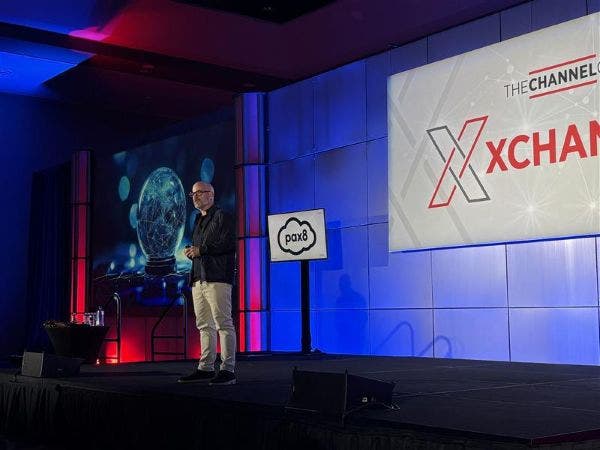
When it comes to AI, Pax8 CEO Scott Chasin hears three things: MSPs are fearful of being left behind, they realize just how big AI is and they want to know more about AI agents.
As the agentic inflection point occurs, MSPs will go from legacy systems to self-running businesses and from human execution to autonomous digital labor. This new economy, Chasin explained, will no longer be dominated by size, scale or even speed, but by ideas.
“We are entering an era where ideas execute themselves,” he said. “Not with armies of people or months of planning, just a problem, a prompt and suddenly it’s running.”
Chasin spoke to a room full of MSPs at CRN parent company The Channel Company’s XChange August event in Denver this week and stressed that AI agents are coming now, not in the future, and showed MSPs how to prepare for it.
[Related: The 7 Biggest Announcements From Pax8 Beyond]
There are four different levels of AI, from chatbots to fully autonomous agents capable of planning, executing and scaling workflows with minimal human involvement, “This is the shift from software that responds to software that reasons.”
And as companies continue to pile on apps and tools, the need for orchestration, not fragmentation, is more pressing than ever: “We have the chance to build something new from duct tape workflows to agentic infrastructure.”
The keynote from the Greenwood Village, Colorado-based cloud marketplace’s CEO was a call to action for MSPs to be the leading voice for the customers in the AI era.
The transformation, Chasin explained, is a multi-phase shift from traditional IT services toward an intelligent, agent-driven economy. At the heart of this shift is managed intelligence, a new operational model where digital agents execute tasks, make decisions and even drive entire workflows, autonomously.
He said there will be a massive leap in AI capability over the next four years where advances in models, compute and data centers are all compounding at once.
And with recent breakthroughs in large language models, AI is capable of handling not just text, but video, code and real-time workflows.
“These models are no longer just fast. They reason, they generalize, they collaborate.” Chasin said. “It’s not just about what agents can do. It’s about what humans and machines will do together.”
The transformation will unfold in three phases: From support to command where agents execute complex tasks independently. From manpower to mind power as agents achieve parity with humans in specific knowledge roles. And agentic entrepreneurship where workers launch AI-native businesses powered by agents, with zero code and minimal capital.
“We’re seeing lean AI unicorns right now,” said Chasin. “In this new phase, the most powerful companies won’t be the biggest, they’ll be the fastest to manage these agent ecosystems.”
And this wave of innovation is especially potent for SMBs who now outpace enterprises in AI consumption, according to the CEO.
“SMBs are no longer small,” he said. “They’re the new giants in disguise, leaner, smarter and powered by intelligence. This wave is already breaking.”
Tommy Vaughn, president of Lynchburg, Va.-based Central Technology Solutions, said everything Chasin said is unfolding.
What resonated with him most was the belief that the real disruption in AI and agent-based technology won’t come from big tech but from smaller players.
“It’s going to be the little guy who sees a need, builds something AI-related, something agent-related and brings it to market,” he told CRN. “That’s what’s going to really affect niche markets.”
Rather than waiting for larger companies to trickle down innovation, Vaughn believed the opportunity is now for smaller developers and SMBs to lead. And with companies like Pax8 helping amplify those ideas, the ripple effect could be “industry changing.”
“Seeing AI grow from small business into niches, into the MSP space, without it having to come down from the Metas of the world? That’s what makes this moment so exciting,” he said.