Schneider Electric Exec: ‘We’re Equally Serious About Software’
‘When you put the two together, great hardware and great software, you unlock opportunities you just can’t reach with one alone. … The takeaway for you is, the more of your customers’ experience you own, especially how their power is managed, the more strategic and long term that relationship becomes,’ says Larry Hann, director of channel field sales north and digital services strategy for Schneider Electric.
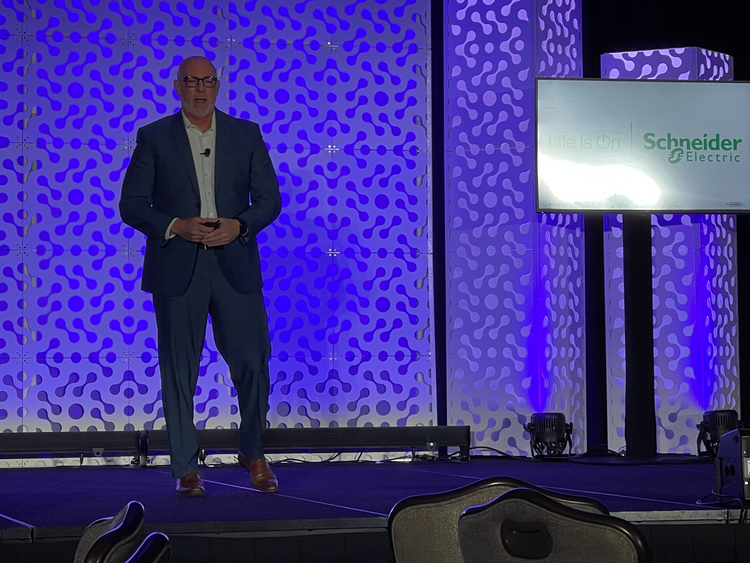
Software is now just as important as hardware when it comes to powering the data center, and Schneider Electric partners that take advantage of the software side of IT power management will find new opportunities from old technology.
That’s the word from Larry Hann, director of channel field sales north and digital services strategy for Schneider Electric, who told MSP attendees of this week’s 2025 XChange NexGen conference that intelligence, software and services can transform power into real business advantage.
XChange NexGen is being hosted in Houston by CRN parent company The Channel Company.
[Related: Schneider Electric Provides Partners ‘Gateway’ To Capture Infrastructure IT Spend]
Hann said the idea of developing hardware and software together is not something new.
“I’ll take you back to 2007 when Steve Jobs revealed the very first iPhone,” he said. “He quoted computer scientist Alan Kay, ‘People who are really serious about software should make their own hardware.’ … That’s what happened. They didn’t just make a phone. They created a whole experience and changed an industry.”
Most people probably know Schneider Electric as APC, a hardware company, and a pretty good one at that, Hann said.
“But here’s what might surprise you,” he said. “We’re equally serious about software. When you put the two together, great hardware and great software, you unlock opportunities you just can’t reach with one alone. … The takeaway for you is, the more of your customers’ experience you own, especially how their power is managed, the more strategic and long term that relationship becomes.”
Power is a way for solution providers to differentiate themselves and unlock more opportunities with existing and new customers, Hann said.
“This is where the power infrastructure assessment comes in,” he said. “It’s designed to help you start that conversation, whether you’re hunting new opportunities, consulting with a customer or building a recurring revenue stream. It is flexible to your business model, and it’s even been very agnostic.”
This is especially true in regard to disruptive downtime, which happens at the most inopportune times, Hann said.
“Most people will develop it 25 percent of the time due to an unmanaged or reactively managed UPS,” he said. “Most customers buy the UPS, deploy it and then forget about it, so either they have no visibility or they’re reacting to an event after it happened, which leads to downtime. But it’s not just the UPS. We also see issues with device security, with outdated firmware, unauthorized access by humans that end up doing human things, or downtime costs from excessive heat or humidity.”
Such downtimes are avoidable with proper life-cycle management and visibility, Hann said.
“By not having visibility and actionable data, you end up wasting time and resources chasing ghosts, and it can result in multiple truck rolls and extended downtime,” he said. “These result in real, tangible costs to the customer.”
It’s an issue that will only grow as businesses continue their swift adoption of AI, Hann said. He identified three main areas where that will play out for solution providers:
- There will be a large buildout at the edge. “Forty percent of the power needed to support AI, which will be half of all power consumed, will be in places that you play today,” he said.
- There is no set it and forget it. “You will need software management for it to work,” he said. “They’re talking about 20, 30, 40 kilowatts per rack. And you will see that at the edge. If you’re not managing it in your NOCs [Network Operations Centers], that will take those businesses down.”
- Customers will need help planning to enable infrastructure to support it. “As you start to explore AI for your customers, power will be an integral part of that conversation, and the power infrastructure assessment will allow you to establish a beachhead to AI readiness by providing a baseline of the current environment,” he said.
Schneider Electric has built flexibility into the models that lets solution providers choose the best way to use power infrastructure assessments to bring more value and to help build the business case using customer-installed case data and customer tech support call data, Hann said.
“In our edge calculator tool, you can hunt for new opportunities or logos to augment your virtual CIO or customer success offers or to expand your managed service practice,” he said. “The assessment will provide the customer [with] visibility into the health of their environment and help identify immediate needs, along with guidance on how to budget for the future for future expenditures. It also allows for the partner to consult with the customer on life-cycle management plans that allow them to anticipate and budget in alignment with their current and future growth goals, including AI.”
Frank Huston, president of Essential Net Solutions, a Melbourne, Fla.-based solution provider, told CRN that his experience in managing a data center made him a believer in the importance of managing power.
Just adding software won’t solve every issue, Huston said.
“I have a college that I know has power issues, but the power is so old, the physical hardware is so old, I don’t know that it’s going to show up in any software analysis,” he said. “It’s going to require a physical presence review, something of that nature.”
However, talking about power management is valuable for opening customer doors, Huston said.
“Absolutely, because so many customers have issues,” he said. “They don’t understand why. What I’m intrigued about is how does that toolset identify hidden issues such as with software pick-up on smart breakers. But if they don’t, how do you know unless you send a Schneider expert on site to do that analysis, which I’ve done at prior facilities, but that’s the part that intrigues me.”
Huston said he has worked with Schneider Electric for 15 to 20 years.
“They know their product, they know electricity, they know infrastructure,” he said. “I know if I walk in and try and talk about it, I’m probably above most just because of the experience I’ve had. But if Schneider walks in with me, absolutely I can open doors with it.”