Solution Provider Exec Says Consistent Messaging Is Key: ‘Sing The Same Song Your Content Does’
‘'If you get that inbound ask and all of a sudden the story is different, you're at a risk of losing that, especially in the channel. You have to educate on why it’s important to other people you’re selling with,’ says Wil Klusovsky, revenue and growth officer at Appalachia Technologies.
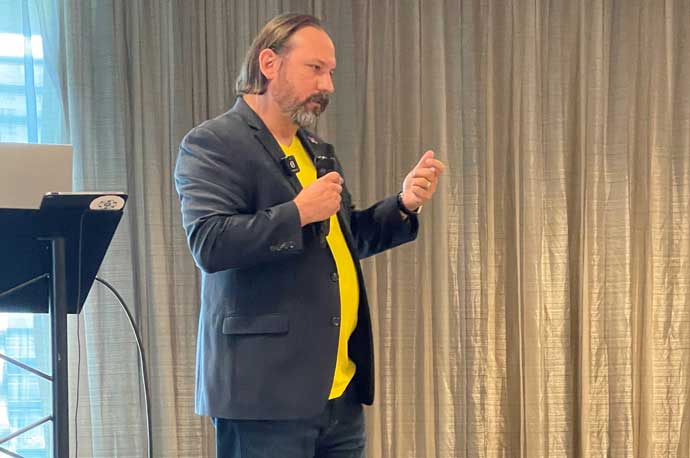
Success as a solution provider comes from teams making their company and themselves visible with consistent messaging to show customers the value they will receive from a relationship.
That’s the message from Wil Klusovsky, revenue and growth officer at Appalachia Technologies, a Mechanicsburg, Va.-based security-focused solution provider who used his presentation at this week’s XChange NexGen 2025 conference to introduce fellow solution providers to what he called the EEC framework.
XChange NexGen, being held this week in Houston, is hosted by CRN parent The Channel Company.
[Related: The 2025 Managed Service Provider 500]
The EEC framework is short for educate, engage and convert, he said, and defined the three key terms behind it.
- He defined the ideal client profile, or ICP, as the individuals being targeted as potential consumers of a company’s products and services. “These are the people you want as clients,” he said. “If you don’t know who your ICP is, or you think your ICP is everybody with a computer, you have no ICP and you have no clients. You have no go-to-market strategy. You’re just hoping and wishing.”
- Demand generation is the key to EEC, he said. “The goal here is visibility and awareness,” he said. “People know who you are, what you do, and they come to you.”
- He also described the difference between inbound vs. outbound. Inbound, Klusovsky said, is when customers come to you looking to buy or for help, while outbound is when you reach out to customers. “If you build enough of the demand gen up, you can get a lot of your revenue inbound, which means you don’t have to do any work for it,” he said.
Outbound, as in outbound marketing, is often “pray and spray,” which Klusovsky said often results in generic messages sent to everyone, including messages just sent to every CIO or CISO, he said.
“So even if what you have is relevant, if you haven’t identified why that person cares or why they’re going to read [your message] or cares about the benefits that they’re going to get out of it, they have no reason to read your DM [direct mailer], to read your email, or to answer the phone,” he said. “You’re just speaking to a wall.”
Furthermore, focusing one’s message on the technical details doesn’t work, Klusovsky said.
“That doesn’t tell me, as a potential ICP, as a client, why I should buy it,” he said. “And you’re like, ‘Well, what [does it] matter?’ The product sells itself. If the product sells itself, it’s not going to sell, right? The idea is, the CISO for a financial services organization has very different OKRs [objective and key results], KPIs [key performance indicators], and other metrics and personal goals that they want to achieve versus the CIO of a nonprofit organization.”
Instead, Klusovsky said, it is important to dial that into those people individually and specifically.
“Why does it matter to them?” he said. “What’s the benefit they get out of it? If you think about doing the outreach portion of this, if you’re going to spend 30 hours doing research, finding the right people, learning about their pain points, understanding their industry, figuring out why they would even care, and then crafting and targeting that outreach specifically to them as individual people, it’s much better to send 20 DMs, 20 emails, 20 cold calls to very highly targeted organizations and get five meetings with potential buyers than it is to make 600 random phone calls and book five meetings with people who just wanted a free lunch.”
Given that customers will most likely continue working with their existing technology partners and not constantly shop for new vendors, outbound content has to be developed specifically for them, Klusovsky said.
“If you treat your content as transactional, they will see it as transactional,” he said. “It will not matter. You have to be giving information before the sale and after the sale, everything you can. You want to give all of that knowledge away. That’s going to be the engagement, the education part. That’s exactly what the whole EEC thing’s supposed to be. It’s all about building trust so that you can book a meeting that actually is going to matter.”
Consistency in client outreach also is important, Klusovsky said.
“Your sales teams, your marketing teams, your SDRs [sales development representatives], whoever it is that fielding that first phone call or that first email response, needs to sing the same song that your content does,” he said. “If you get that inbound ask and all of a sudden the story is different, you’re at a risk of losing that, especially in the channel. You have to educate on why it’s important to other people you’re selling with. [And] if you create the content, you have the right story, the right message, that’s going to build up your demand. You’re going to do the right kind of outreach. You’re going to get inbound and outbound leads, and that’s going to build up your pipeline, and that’s going to drive your revenue, but you need all of these assets to be successful.”
It’s important to engage with customers often while also understanding where they are because that’s where to engage them, Klusovsky said.
“For most of us in this room, it is LinkedIn,” he said. “But there is Reddit. There is YouTube. There is Instagram. There is Facebook. There are all kinds of other stuff depending on what you’re doing and where your people are, and by ‘your people’ I mean your ICP, that’s where you want to be. My guidance is, pick one and master it. Don’t try to master all of them at once. You’re going to combine that with good email.”
When it comes to using social media for reaching clients, it’s important to get the message out quickly while remembering that all social media platforms do change and they all get saturated, Klusovsky said.
“And they all kind of, I won’t say ‘go downhill,’ but it’s harder,” he said. “I do a lot of work on LinkedIn. I know a lot of other people who do work on LinkedIn. Here’s the reason I say, ‘Start tomorrow.’ If you don’t, it’s harder to grow today than it was last week, than it was three years ago, and every day, it’s just going to get harder. The top 1 percent of us who are actually doing it, using it, yes, our growth is slower than the people who did it a year ago, but it’s still exponentially faster than everybody else who’s posting once a week, or not using it, or not doing it.”
Roberto Elizondo, president and CEO of TRiNet International, a McAllen, Texas-based MSP, told CRN that he likes to hear different views on how to get new clients or new leads and the different approach what tools people use.
“Klusovsky’s approach is very interesting because he’s talking about the different types of processes and different types of tools that he’s using,” Elizondo said. “For example, I wasn’t even thinking about LinkedIn, and he uses LinkedIn a lot. Most of the stuff that I’ve been doing is via Facebook. That’s what I’ll really be taking home from his presentation.”