WOTC Panel: Leadership Means Showing Up When It’s Hard
‘We talk about authenticity a lot. But what does that actually mean? It’s knowing what you believe in, holding true to it and being able to convey that to your team,’ says Alex Stanton, VP, global partner marketing and growth studio at Arctic Wolf.
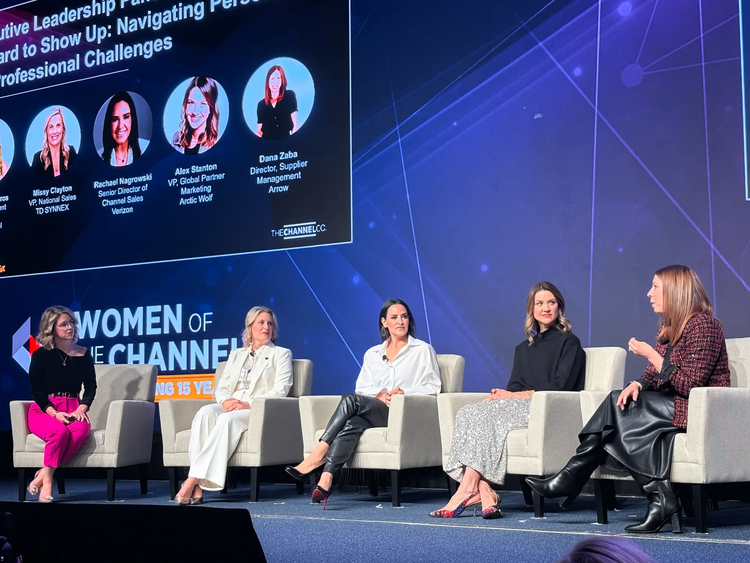
In an era when personal struggles and professional demands collide more than ever, five industry leaders came together to speak candidly about what it truly means to lead when life is heavy.
Andrea Medeiros, VP, The Content Studio, Communities, at The Channel Company, moderated a panel titled “Leading When It’s Hard to Show Up: Navigating Personal and Professional Challenges” at CRN parent company The Channel Company’s Women of the Channel East conference in New York City this week.
The panel included Missy Clayton, VP, national sales, TD Synnex; Rachael Nagrowski, senior director of channel sales, Verizon; Alex Stanton, VP, global partner marketing and growth studio at Arctic Wolf; and Dana Zaba, director, supplier alliances at Arrow Electronics, each offering raw, unfiltered reflections on authenticity, courage, trust and the unseen weight many women carry in leadership.
Across their stories, common threads emerged: the pressure to appear flawless, the fear of asking for help, the guilt of balancing family and ambition, and the responsibility leaders hold in creating safety for their teams. Whether confronting perfectionism, supporting employees through private battles or learning to lift others while navigating their own challenges, these leaders reminded those in the room that leadership isn’t about having no struggles, it’s about showing up with honesty, empathy and humanity.
“Leading with empathy, showing up for your team and knowing that’s how they’ll show up for you has become a guiding principle,” said Zaba. “Watching loved ones face health challenges has shaped how I supported others, reminding me that any time you lift someone up, they’re going to support you back.”
Here’s what the women had to say about leading with grace, seeing the whole person and finding strength, together, when it’s hardest to show up.
Clayton On How Learning Shaped Her As A Leader
Sometimes the hardest part of struggle is staying true to who you are.
“You can’t let the defeat or what you’re dealing with change who you are as a person,” she said.
That’s why women need people who are understanding and to act as safe spaces that hold individuals steady when they get lost in their own heads, she added.
“But authenticity begins with asking, ‘What is the story I’m telling myself?’” she said. “It reminds you that there will be plenty of things I can’t control, but to be authentic… how can I get through this moment right now and speak to that lie?”
And the answer is simple and strong.
“The lie is that it’s going to keep you down,” she said. “It’s not because we’ve done hard things before. We’re going to do hard things again and we’re going to do them together.”
Stanton On Not Chasing Perfectionism
As a mom of two young girls, Stanton says her journey has reshaped “how I show up for them, how I show up for me, how I show up for my team.”
Perfectionism had “completely crippled” her, and the validation she once sought from honors, awards and discipline no longer defined her worth.
She realized that when we look at someone, “you’re seeing the tiniest little thread of that entire rope of who they are.” Behind every moment are health challenges, aging parents, young kids, “life happening in full force.”
This awareness, she said, expanded her empathy.
“Every person is showing up the best they can, and if they’re not, there’s probably a reason,” she said. “Creating space, safety and curiosity, “Talk to me about this,” allows people to show up honestly and ask for what they need.”
Zaba On The Power Of Lifting Others Up
As a working mom of two young kids, Zaba reflected on the weight of mom guilt.
Between travel and career demands, she’s learned that “no matter how big or small anything might be that you’re dealing with, people are struggling every day with something.”
What grounds her is knowing we’re not alone.
“Leading with empathy, showing up for your team and knowing that’s how they’ll show up for you has become a guiding principle,” she said. “Watching loved ones face health challenges has shaped how I supported others, reminding me that any time you lift someone up, they’re going to support you back.”
Nagrowski On Meeting Team Members Where They Are
People have different levels of comfort when it comes to opening up, and a vivid example stood out to Nagrowski.
A long-time top performer suddenly began missing calls, showing up late and missing deadlines. It was a moment that revealed how closely organizations can sense when something is off, sometimes even before the person realizes it themselves.
“Because I had a strong relationship with this individual, I chose to reach out personally,” she said. “They shared only that they were undergoing medical tests and weren’t ready to discuss the details, and they also asked for privacy from their direct leaders. I then faced the challenge of supporting them, honoring their boundaries and still maintaining accountability.”
Rather than leading them the way she preferred to be led, she focused on what they needed. She set up weekly check-ins, offered resources and committed to giving honest feedback. Over time, the employee opened up more, deepening a relationship she thought had already reached its peak.
“That patience ultimately helped the individual get the medical care they needed and return stronger,” she said. “Building trust doesn’t happen overnight. Sometimes it takes months, even a year, but once it’s there, that’s when the real magic happens.”
Stanton On Leading With Transparency
Building trust with a team starts with authenticity
“We talk about authenticity a lot,” Stanton said. “But what does that actually mean? It’s knowing what you believe in, holding true to it and being able to convey that to your team.”
She shared that she often leads with transparency, a habit shaped by leaders who modeled the power of context and trust.
“It’s a two-way street,” she said, adding that while she aims to nurture and create space for openness, she also believes in empowering her team to speak up and trust that their voices matter.
“My job is to create the space where people feel safe to speak up,” she said. “Their job is to use their voice.”
Zaba On Creating A Culture Built On Trust, Communication And Celebrating Wins
Zaba emphasized that trust starts with openness and “creating a culture where employees feel safe.”
“When we tell our own stories and communicate honestly, it opens the door for them to talk to us,” she said.
She also highlighted the power of celebrating successes. “We don’t do that enough,” she admitted. Sharing wins publicly, she said, helps strengthen culture, boost confidence and make people feel seen. “Promote people in public, that matters.”
Clayton On Being Courageous
It’s all about the courage to ask for help, especially for those who are new and may fear looking weak.
“Asking questions or asking for help is not a weakness,” Clayton said. “You have to have a safe place to do that, whether it’s with a leader, a colleague or someone outside the industry altogether.”
She acknowledged the fear that comes with admitting you’re struggling, but emphasized the relief and clarity that follow, “It feels so much better to say it.”
Nagrowski On How To Start Being More Courageous, Transparent
Build a trusted circle.
“Once you find the people who can really hold your confidence, that’s your tribe,” Nagrowski said. “They are rare in this world, hold on to them.”
She shared how she uses her tribe as a sounding board, letting everything out “with no filter,” then workshopping how to bring the message to a leader with authenticity but also clarity.
The goal, she said, is to walk into the conversation knowing “this is what’s happening, this is what I’d like to do about it, and I want your help.”