AI-Driven Replacement Of Workers Will Be ‘Fairly Significant,’ More Imagination Needed On Creating New Roles: Former Fed Official
With the likelihood high that AI is on track to drive a substantial amount of worker displacement over time, businesses are also showing a surprising ‘lack of imagination’ when it comes to what the AI-powered jobs of the future might look like, according to former Federal Reserve Bank of Atlanta President Raphael Bostic.
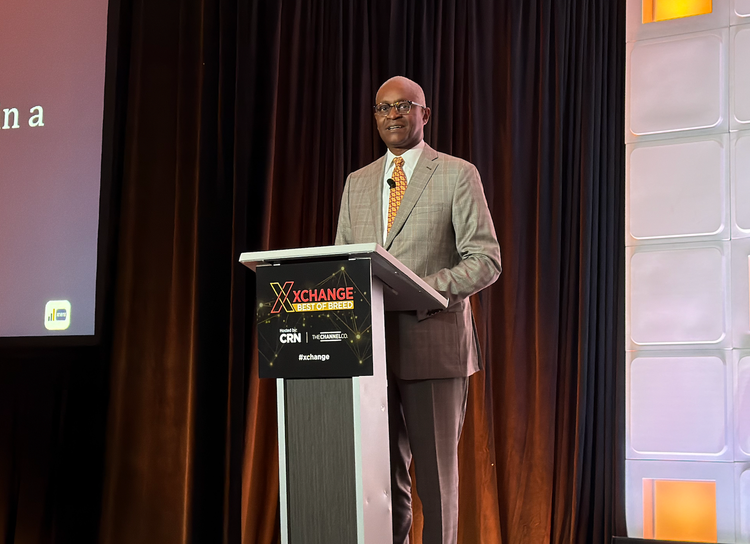
While AI-powered technologies do not appear to be leading to widespread replacement of jobs just yet, AI and agents are nonetheless still on track to drive a substantial amount of worker displacement over time, according to economist and former Federal Reserve Bank of Atlanta President Raphael Bostic.
Among the problems the economy is facing, however, is the fact that businesses so far are also showing a surprising “lack of imagination” when it comes to the AI-powered jobs that will take make up for the displaced roles, Bostic said Monday during the 2026 XChange Best of Breed Conference.
[Related: Driving AI Transformation: The 2026 CRN AI 100]
For the time being, as the industry familiarizes and experiments with the usage of new AI tools, there is not much evidence that businesses are eliminating large portions of their workforce through the automation available in the new technologies, he said during the conference, hosted by CRN parent The Channel Company in Atlanta.
“That isn’t really what we’ve seen,” said Bostic, who served as Federal Reserve Bank of Atlanta president from 2017 until his retirement in February. “We’ve not seen wholesale replacements of offices or departments or tasks. And when you look at the aggregate data, what is happening seems to be something a bit more passive.”
Specifically, instead of laying off staff to be replaced with LLM-powered capabilities, many employers have simply become more reluctant to replace the workers who leave on their own, he said.
So while that may not lead to widespread job losses right away, those decisions can add up to a massive change in staffing levels over time as a result of businesses leveraging AI in greater measure, according to Bostic.
Eventually, when it comes to the impact of AI on jobs, “I think there is going to be replacement,” he said. “And I think it’s going to be a fairly significant amount.”
Partner Perspective
For many MSPs, the major changes from this AI-driven shift are already becoming noticeable within their own businesses, according to Ahmed Mahmood, CEO of Ashburn, Va.-based Ocean Solutions.
At Ocean Solutions, for instance, adoption of AI has dramatically reduced the time required for tasks such as billing reconciliation—enabling customer growth for the MSP without needing to add operations staff, Mahmood told CRN.
Billing reconciliation previously required two Ocean Solutions employees to spend about four days each month dedicated to the task, he said. With the help of AI, the process now takes only about 30 to 45 minutes each month for a single staffer, he said.
“Getting that time back allows a company like us to grow the client base and not add operations staff to accommodate,” Mahmood said.
Still, Mahmood said there are many questions around who should reap the benefits of the dramatic productivity increase from AI.
While Ocean Solutions has generally prioritized keeping prices stable for customers, the question is certainly still worth exploring whether there would be ways to allow workers to gain more of the financial benefits from AI, he said.
Who Benefits?
During the session Monday, Bostic said there is undoubtedly a key broader question raised by the massive adoption of new AI-powered technologies around the industry: Who will actually participate in the benefits of AI?
The reality is that many workers “do not think they’re going to capture any of these gains. And that shapes how they view AI and its role—and how much they should support its adoption or participate in its adoption,” he said.
That is part of why the industry needs to begin putting more emphasis on imagining the new types of jobs that can be created thanks to AI—which could go a long way toward ensuring that more workers can envision their place in the future economy, Bostic said.
“The question that we have here is, what are those new job categories?” he said.
“Today, I feel like there’s been a lack of imagination about what that could possibly be,” Bostic said. “So the people who are being disrupted—or are pretty sure they’re going to be disrupted—don’t have anything else to fall back on. And that’s scary. That’s a frightening prospect.”
Thus, a crucial goal the industry should be working toward is to develop a clearer vision of the coming opportunities from AI as a way to help workers see a future for themselves as AI transforms employment, according to Bostic.
Ultimately, “figuring out how to talk about that would be quite useful in terms of getting all of us feeling like we’re pointed in the same direction,” he said. “Because today, I don’t believe many people feel that way.”