AI’s Workforce Shock Is Unlikely To Ease In Near Term: Circana
However, the surging adoption of AI-powered technologies is expected to continue driving massive opportunities in identity and security, says Circana’s Mike Crosby.
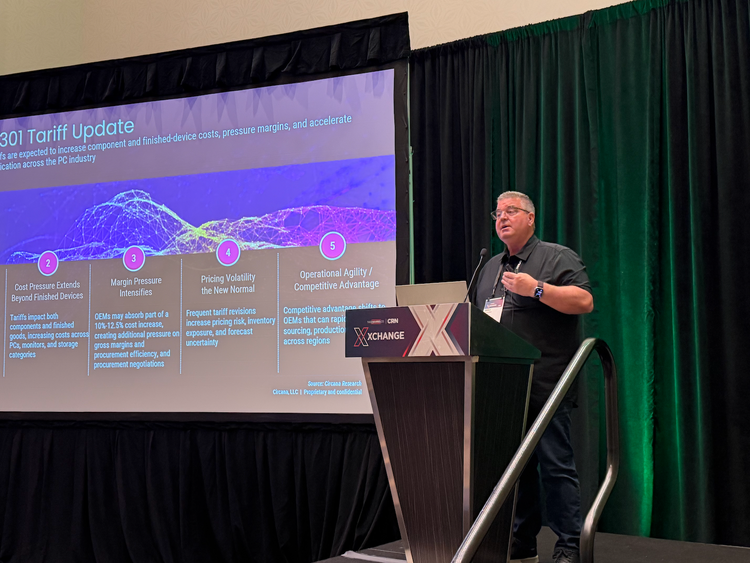
The upheaval that AI is creating in the workforce is unlikely to ease until 2028 even as the adoption of LLM-powered technologies is expected to continue driving massive opportunities in identity and security, according to Circana’s Mike Crosby.
Through the rest of 2026 and through 2027, it’s probable that AI-driven disruption to hiring activities will remain a major factor, Crosby said during a session at XChange August 2026.
[Related: Amid AI Surge, ‘Trust Is Becoming The Product’: GTIA Exec]
Currently, the industry remains in a “low-fire, low-hire” environment, said Crosby, senior industry advisor for B2B and B2C at research and advisory firm Circana.
But by 2028, job growth could return after businesses have adjusted to the new workforce realities spurred by AI and agentic adoption, he told an audience of MSP executives Sunday during XChange August 2026, which is hosted by CRN parent The Channel Company and being held this week in National Harbor, Md.
At that point, the industry is “going to be through a lot of this AI turnover and some of the staffing reductions, some of the challenges—and start to show an inflection point on expansion and growth,” he said. “I think from a business standpoint, we’ll have a little bit better tailwind on us with AI. And again [we’ll] be through a lot of the disruption that's going on right now.”
Meanwhile, security is likely to continue to be one of the biggest opportunities that organizations are continuing to invest in as a result of the need to securely enable AI usage, Crosby said.
Increasingly, cybersecurity is not considered a discretionary or optional area of spending in the budget, he said.
One of the fastest-growing segments within software overall is identity and access management as leading growth areas, which was up 21 percent in the latest Circana survey, he noted. SIEM (Security Information and Event Management), meanwhile, has been up 12 percent and network gateways and firewalls have been up 10 percent, according to Crosby.
“Security continues to drive heavy [growth],” he said.
Without a doubt, there’s increasing demand from customers for security capabilities to protect against rising cyber risk from AI such as with preventing data leakage and exposure, according to Theron McLarty, founder and CEO of Atlanta-based Skout Advisory.
Expanding interest in preventing data leakage—as well as the related increase in focus on data classification and data sensitivity—“that’s directly tied to AI because people are really concerned about what they can’t see,” McLarty said.
At the same time, it’s less clear that the workforce may be able to recover even within several years, he said.
“The changes are coming very fast, but there’s going to be a lag,” McLarty said. “I’m not sure that mid-2028 is going to be the return to [normalcy] in terms of the labor pool. As we know, historically from other shifts, the labor pool takes a little while to retool.”
Hardware Recovery
Hardware sales could also see a bigger recovery starting in 2028, according to Crosby.
Circana expects IT hardware unit sales to decline about 5 percent in 2026 and another 3 percent in 2027 before reaching an “inflection point” in 2028, he said. Hardware revenue should prove steadier, however, due to the increased prices that are offsetting the reduced unit sales, Crosby noted.
Surging demand for AI-related IT infrastructure is also expected to keep memory and storage prices elevated through 2028, he said. Circana expects supplies to begin normalizing in 2029—though an easing of prices for end customers will probably take longer, Crosby noted.
“In 2029, we [expect] to start to see a little bit of relief on memory and storage,” he said. “But it’s going to start with availability before its price. Probably price is going to lag, which it traditionally does.”