Arctic Wolf CEO: 75 Percent Of SOC Roles Could Become ‘Almost Entirely Agentic’
At the same time, new AI technology under development by Arctic Wolf will also aim to make it easier for partners to inject human judgment within crucial security operations center (SOC) processes, CEO Nick Schneider tells CRN.
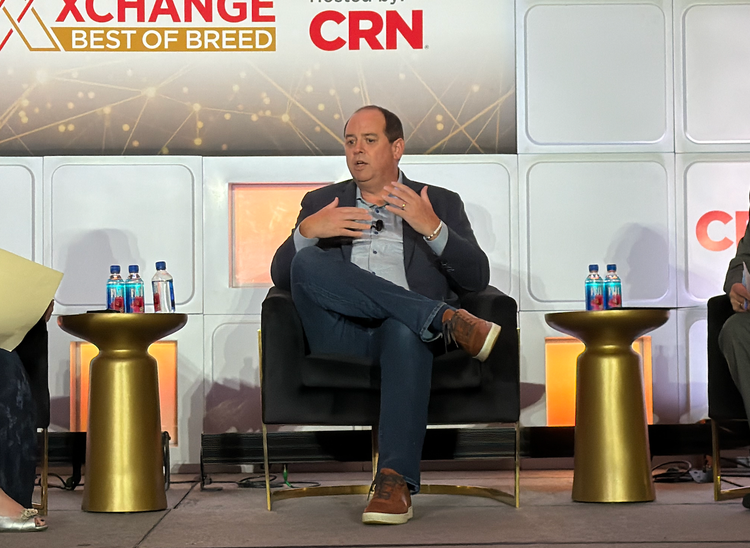
The rapid advancement of ultra-powerful AI models for cybersecurity means that a large majority of work inside the security operations center (SOC) is on track to become predominantly agentic in the not-too-distant future, Arctic Wolf CEO Nick Schneider said Monday.
At the same time, emerging AI technology—including capabilities now under development by security operations platform vendor Arctic Wolf—could also make it easier for partners to inject human judgment within crucial SOC processes, Schneider said in response to questions from CRN editors during the 2026 XChange Best of Breed Conference.
[Related: Arctic Wolf CEO Nick Schneider On Delivering ‘Superior’ Security With New Agentic SOC Platform]
Arctic Wolf’s findings suggest that AI agents can take on a sizable portion of SOC tasks, with humans retaining key decision-making and responsibility for customer interaction and oversight, he said during the conference, hosted by CRN parent The Channel Company in Atlanta.
“We’ve done some analysis on what you would need, at bare minimum, to be able to operate a SOC. And you can get about 75 percent of the roles to be almost entirely agentic,” Schneider said. “What you’re really leaving, to the human, is some level of trust and interaction.”
The extent to which SOC work can transition into an agent-driven process will, of course, differ “customer by customer and partner by partner—where their trust threshold is at a different level,” he said. “Some customers are like, ‘I’m going to err on the side of leveraging the agents.’ And some customers are like, ‘No, how about we go this far, and the rest I still want to be human.’”
To help enable this substantial shift to an agent-powered SOC, Arctic Wolf is now in the midst of developing capabilities that would provide partners with greater visibility into the activities of its AI agents, according to Schneider.
The idea is to allow partners to more easily intervene within certain security operations processes when human judgment is most needed, he said.
“Think about a world where a customer could denote where they want a human involved—and then that human could be Arctic Wolf, or it could be the partner,” Schneider said.
While there is no doubt “a lot of product work that has to get done to make that possible,” the resulting offering that Arctic Wolf ultimately has in mind for partners “will be very differentiated in the market,” he said.
‘Massive Differentiators’
There’s no question that the agentic SOC vision articulated by Schneider speaks to the pressing need for security teams and partners to keep pace with AI-powered attacks, according to Manak Ahluwalia, president and CEO of Canton, Mass.-based Aqueduct Technologies, a longtime Arctic Wolf partner.
Aqueduct, No. 331 on CRN’s 2026 Solution Provider 500, has seen Arctic Wolf make major strides in leveraging AI in its security operations platform and the plans for expanding that approach going forward appear highly promising, Ahluwalia said.
A key question in the current AI-dominated market is, “What ultimately becomes a differentiation if we can develop at machine speed?” he said.
“The reality is, it's going to be the context that you're feeding into it and the data that you have,” Ahluwalia said. “And I think organizations like Arctic Wolf that have [the data]—and have it for the practical use of the SOC—are just such massive differentiators.”
The possibility that approximately 75 percent of SOC roles in the future could become primarily agent-driven sounds realistic, and will no doubt be sorely needed in response to the acceleration of attacks powered by the same AI technologies, according to Ahluwalia.
Organizations that are “being attacked at machine speed will want to know that they're responding at machine speed,” he said. “I think the only way to reasonably do that is if you're going to have to have machines responding to some of these specific elements [such as] correlation, analysis, verification.”
Partner-Focused Capabilities
For Arctic Wolf’s partners, new agentic capabilities that are planned for the near future aim to make SOC work easier to inspect—while also creating more ways for partners to participate in service delivery, Schneider said Monday.
The company expects to release its offering within the coming months that will make the activities of its agents observable, he said.
The new offering “shows what each agent did, why they made a decision that they made, where a human had to be injected into the loop—and we will have a mechanism for the partner to inject themselves in that, as well,” Schneider said.
The idea is to provide a “hybrid engagement model” that allows customers to choose which critical decisions require a person either from Arctic Wolf or their solution provider, he said.
Meanwhile, Arctic Wolf is also developing new ways for interactions to occur with its agentic SOC platform—including through tools such as Slack and Teams, as well as via a conversational, LLM-type interface, according to Schneider.
All in all, “we've always gone to market, at least since I've been at the company, 100 percent through our channel community,” he said.
And without a doubt, Arctic Wolf’s channel commitment remains as strong as ever in the AI era, Schneider said.
It’s the partners, he said, who “understand the customers and [who] can help to augment, in particular, some of the services or other product capabilities that a customer might need to be protected.”