For MSPs, Sustainable Leadership Means Trusting The Team: Panel
‘I don’t need to be in every meeting. If I have the right stakeholders in those meetings, they can do what needs to happen and they can send me the update. It can also give someone else the opportunity to be developed and be able to have the trust to go and try that without me in the room,’ says Laura Muysenberg, vice president of marketing and sales operations at People Driven Technology.
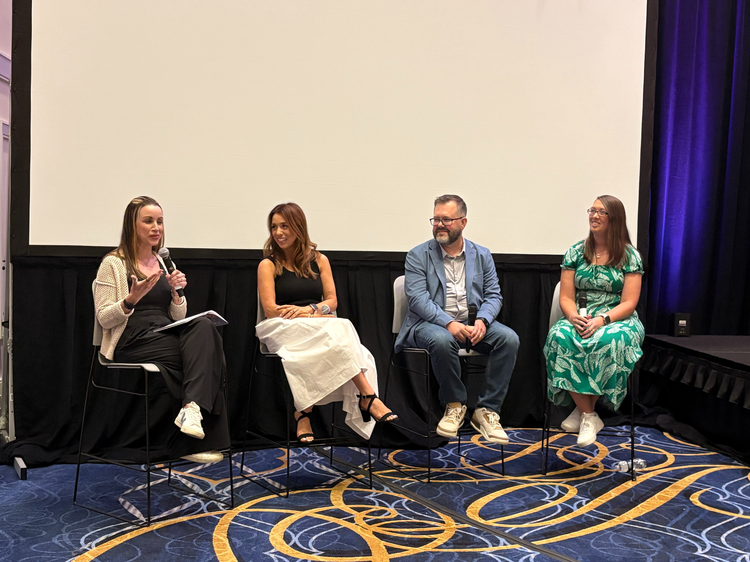
Leadership in the IT channel is often defined by being the person with every answer, every call and every fix. But a panel of MSPs argued that sustainable leadership may require knowing when to step back.
Sustainable leadership, they said, is about building teams that can operate without constant intervention, setting boundaries that protect leaders and employees, and creating relationships strong enough to get through difficult moments. It also requires leaders to recognize when their own habits, from perfectionism to being always available, are undermining the teams they support.
The panel, held at CRN parent company The Channel Company’s XChange August event in National Harbor, Md., was moderated by Jacquie Rives, senior director of Women of the Channel Community and Programs at The Channel Company, and included Laura Muysenberg, vice president of marketing and sales operations at Grand Rapids, Mich.-based People Driven Technology; Chelsea Skinner, president of Lewisville, Texas-based Oversee My IT; and Brian Ruschman, president of Covington, Ky.-based C-Forward.
While the panelists discussed a variety of challenges and opportunities about leadership, they all agreed that leaders cannot build sustainable organizations if everything depends on them. Trust has to be implemented.
For MSP JP Keesey, the biggest takeaway from the panel discussion was Skinner comparing life’s responsibilities to glass balls and rubber balls.
Skinner said not every responsibility carries the same consequences. Some things, like rubber balls, can be dropped and picked up later. Others are glass balls that are fragile and important.
“Quit juggling all of it,” Keesey, co-founder and CEO of Fort Worth, Texas-based F1 Information Technologies, told CRN. “Figure out which one’s going to break, and deal with that one first.”
Whether it was encouraging an employee to unplug on vacation, showing up at a family funeral or letting a team member make a key decision without a leader in the room, the panelists said leadership isn’t about being visible at every moment. It’s about giving people the trust, space and support they need to succeed.
Leaders Have To Stop Being Available All The Time
Muysenberg said she has created boundaries around when she is available, particularly as a mom of young children. Her phone goes into focus mode when she is with her family, and she said work can wait until she is ready to return to it.
“When I’m home, I’m mom,” she said. “Things can wait. Once they’re sleeping, I’m back online. So for my team, it’s not necessary that I need to be available all the time.”
She even eliminated the red notification badge for email as she noticed the notifications were pulling her attention away from the person in front of her.
“I could be in the middle of having a conversation with you. I look at an email, and even though I’m not answering it, I’m thinking about it,” she said. “It takes me out of the moment. I can check my email when I need to and when I want to. It does not need to control my life.”
The same approach applies to time off with family. For Skinner, her employees learned to hold her accountable when she fails to practice the boundaries she encourages them to follow.
“I really have to practice what I’m preaching to my team because if I don’t, they’re not going to listen to me,” she said. “They’re going to follow exactly what you’re doing because you’re being the example of that."
Ruschman has combined those two approaches by disconnecting email from his phone during family vacations.
“The phone, the sync for the mail, is turned off,” he said. “I know that periodically somebody could call or text or whatever, but they also know that I’m not looking at emails. The out-of-office is set. The voicemail greeting is set. That’s family time. That’s what I'm doing. When I come back, we’ll address everything else that happened during that other time.”
Leaders Burn Out When Everything Depends On Them. Empowerment Changes That.
Ruschman said his approach to leadership was shaped partly by his military experience where leaders were taught that they could not leave their teams behind. However, in business he learned that taking responsibility for everything could become counterproductive.
‘I probably took it too far and would do a lot of things that didn’t need my attention,” he said. “Empowering your teams is huge for your own sustainability to be a leader.”
Skinner said that delegation can also be challenging for leaders who have strong opinions about how work should be done.
“I am a control freak. I will admit it,” she said. “I’m going to go ahead and blame it on having an accounting background. I like things done my way, and my way is the correct way.”
But the panelists agreed that leaders have to distinguish between something being wrong and something simply being different from how they would have done it.
Muysenberg said she has also learned that being involved in everything does not necessarily make an organization more efficient.
“I don’t need to be in every meeting,” she said. “If I have the right stakeholders in those meetings, they can do what needs to happen and they can send me the update. It can also give someone else the opportunity to be developed and be able to have the trust to go and try that without me in the room.”
Difficult Situations Require Transparency Without Uncertainty
Muysenberg once had to step away to deal with family matters. Rather than attempting to hide the situation or remain constantly available, she told her team what they needed to know and then trusted them to operate without her.
“I sent an email to my team that my dad is having heart surgery and that I’m not available,” she said. “They can handle bad news. They don’t need to know anything else. What I need to make sure is that they don’t have any uncertainty.
“Everyone always asks, ‘How can we help? What can we do to help while you’re out?’” she added. “I just said, ‘Just keep it going. You know what to do. I trust you. You’re here for a reason.’ So I just reminded them that they can do it without me, and maybe just know that I’m not going to respond right away."
Skinner, who described herself as a more private person, realized that complete silence is not always the healthiest approach. She now relies on a team who can help absorb some of the load if she has to step away from the business.
“I can tell them, ‘Hey, times are hard. I’ve got 20 percent,’” she said. “And they can help pick up the rest. So I don’t have to say much more than that.”
Mistakes Should Become Lessons, Not Leadership Scars
Ruschman said leaders should resist the temptation to dwell on what went wrong once an error has occurred. Instead, they should understand why it happened and learn from it.
“With disappointment, you have to look at it as something that’s happened. It’s something that is now gone,” he said. “You deal with it immediately and you make sure it doesn’t happen again. If it was just incorrect technical support, maybe it’s training, maybe it’s something like an educational moment of when you’re in over your head. Let’s not try to do that one thing anymore that you just did that really caused these three other things to snowball.”
The same thinking applies to empowerment. If leaders want employees to make decisions, they must accept that they’ll sometimes get it wrong. Punish every mistake, and people will stop making decisions altogether, Ruschman said. The better approach is to give employees room to act, then use mistakes as chances to learn and improve.
“If we make a mistake, we learn from a mistake,” he said. “I mean, it’s bound to happen. We’re a 27-year-old company … it’s happened. But you learn from it and you go on.”
His MSP enforces that philosophy by holding quarterly staff roundtables.
“Everybody has to attend at least two of those a year,” he said. “You don’t have to be at every one, but at least every six months you have to be at a staff roundtable where we listen to what’s going on in smaller groups.”
Sustainable Leadership Is Ultimately About Relationships
Ruschman said his company makes a point of celebrating birthdays and anniversaries, but some of the most meaningful gestures happen during difficult moments.
"There is no employee that will forget if you attend their father’s funeral. They never forget that,” he said.
Skinner described a similar approach in daily interactions with employees.
“When my team is talking to me, [my phone] gets put away. I’m not looking at it or checking my watch,” she said. “If they want to tell me about how excited they are to go to their kid’s soccer game or one of my guys is moving his daughter into college, I’m making sure I’m actively listening and participating.”
Muysenberg said leaders should be asking themselves what the organization would look like if they weren’t in every room. That, she said, may be the clearest measure of sustainable leadership.
“When you can help your team develop and do well, then when things are happening you don’t have to necessarily figure it out on your own. You can be the person that’s calm and giving the clarity instead.”
Pictured above left to right: Jacquie Rives, Laura Muysenberg, Brian Ruschman, Chelsea Skinner