Intermedia Sees Teams As Big Opportunity For MSPs Managing Voice, Complexity Challenges
An Intermedia executive tells MSP executives at XChange 2026 that Microsoft Teams’ collaboration dominance has created a major opening for them to solve voice, complexity and workflow challenges for customers while driving larger deals and stronger growth through integrated Teams communications offerings.
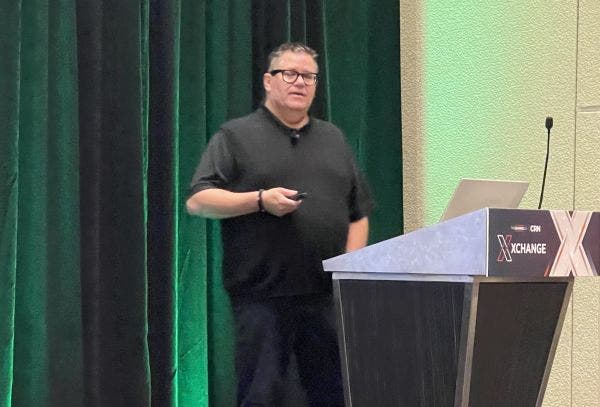
Microsoft Teams may have won the collaboration battle, but Intermedia says the platform’s limited voice adoption has created a major opportunity for MSPs to solve customer communications challenges without forcing them out of the tools they already use.
That was the message from Cameron Boswell, vice president of global learning and enablement at Sunnyvale, Calif.-based Intermedia, who told MSPs at this week’s XChange 2026 conference in National City, Md., that they need to move beyond selling traditional communications technology and instead help customers address business issues around productivity, customer experience, business continuity, and technology complexity, particularly around Microsoft Teams.
“Today’s world is we solve business problems, right?” Boswell said. “You’re problem finders and you’re problem solvers, right? … And that really means you need to understand your customer really well.”
[Related: Intermedia CEO On 26North Deal: ‘Fresh Capital’ Without Channel Disruption]
XChange 2026 is hosted by CRN’s parent organization, The Channel Company.
For many partners, Boswell said, Teams has been a persistent challenge because it is embedded in the broader Microsoft 365 environment. Displacing Teams is difficult, adding a third-party voice application can increase workflow complexity and expense, and walking away from Teams-related opportunities leaves revenue on the table, he said.
“Has anybody ever tried to displace Teams?” he said. “Pretty tough to do because it’s not just Teams. It’s Office 365 or M365. I call like a little universe.”
The scale of the Teams installed base makes the opportunity too large to ignore, Boswell said. Teams grew from 20 million users worldwide in 2019 to more than 320 million today, but only 20 million, or less than 6 percent, are using Teams voice.
“I think we can all admit that Microsoft has won the collaboration battle [with] 320 million users,” he said. “So we have to look at, not only did Teams become popular, they became the place to work for our customers.”
That creates a voice opening for Intermedia, which earlier this year released Unite for Teams, its Intermedia-branded product, as well as Elevate for Teams, a white-label version sold by MSPs. Boswell said partners selling the Teams products are seeing bigger deals and faster growth than partners not selling it.
“[We] saw 40 percent of the deals for these partners were coming out of this specific space,” he said. “But the more important number was these deals were three times larger than a standard Unite deal. Even more importantly, they saw 200 percent more growth year over year compared to our partners that were not selling this solution.”
Intermedia’s approach is not to compete with Teams chat, meetings, and files capabilities, Boswell said. Instead, he said, the approach is to add integrated communications capabilities inside the Teams experience, including UCaaS (unified communications as a service), CCaaS (call center as a service) and archiving, plus company messaging, SMS, voicemail, click-to-dial, and calling.
“We’re not touching chat meetings and files,” he said. “Microsoft does that well, even though our platform has that built into it. We’re not fighting them. We’re going with them. We’re working with them.”
Boswell positioned the Teams integration as a way for MSPs to simplify customer technology stacks while preserving the Teams workflow customers already rely on. He said Intermedia’s archiving also collects data from Intermedia services and Microsoft components such as chats and meetings, making the information available for sentiment analysis, transcription, training, and customer interaction review.
Intermedia also removes another pain point by not requiring the additional Microsoft voice license that can cut into partner margins, Boswell said. He tied the Teams opportunity directly to the larger MSP mandate: meet customers where they work, reduce complexity, and use communications, data, AI, and insights to help them stand out, spend less, and sell more.
“You run into a customer that has Teams,” he said. “Don’t go against the grain. Go fix the grain. You’re much more likely to win that deal. … Once you win that deal, you have other things you can do in the future as well.”
Susan Hilliard, director of field services at Indianapolis-based MSP Bell Techlogix, told CRN that her company currently works with NiCE CXone, which provides AI-powered automated customer service, and is interested in seeing how Intermedia’s offering competes.
Boswell talked about some of the issues that people face working with Teams and efforts to enhance customers’ Teams deployments, Hilliard said.
“What was interesting to me is that most of our customers already have Teams in place,” she said. “If we can bring in a solution that integrates with something they’re already using, that’s a whole lot easier to sell than selling something completely separate. And if it integrates well with Teams, you get the benefits of having a one-stop shop for everything versus, oh, in order to do this now I have to go over here to something else.”