MSP Panel: Clients Want To Use AI To Cut Staff, But It Doesn’t Work Like That
‘They think […] you just bring in AI and then you get rid of 10 percent of your staff, and they’re not understanding the basics behind it,’ says Tim Harper, COO of Urbandale, Iowa-based Dymin, in an XChange NexGen panel about how MSPs are talking to clients about AI.
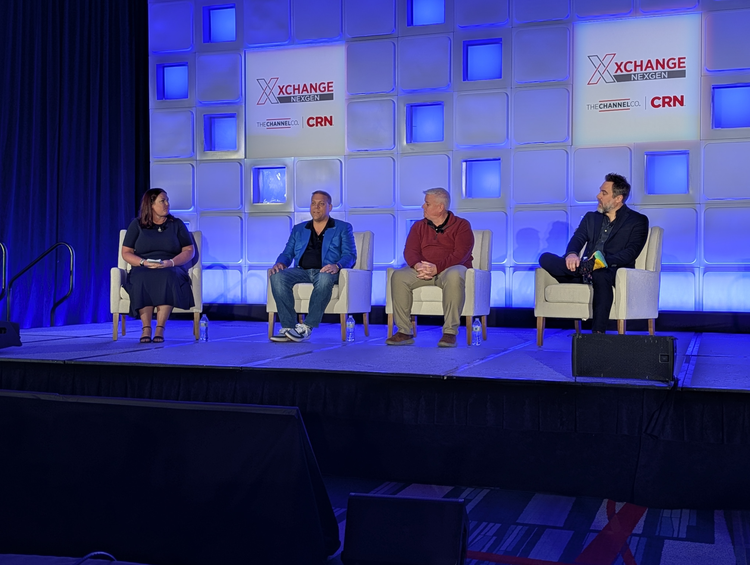
This is according to two MSP leaders who said their customers expect AI to enable a quick turnaround in reducing jobs, which they don’t think is a realistic goal.
The leaders spoke about this and other AI topics they discuss with customers on a Monday keynote panel moderated by CRN Senior Associate Editor CJ Fairfield at the XChange NexGen 2026 event in Orlando, Fla., hosted by CRN parent The Channel Company.
“[There’s] this misconception that they’re just going to be able to use AI and replace staff, quite quickly,” said John Douglas, president and owner of Wichita, Kansas-based Pileus Technologies, which serves small businesses. “[…] And once we start getting into how they should be using AI, it kind of changes their tune just a little bit.”
Tim Harper, COO of Urbandale, Iowa-based Dymin, said “most conversations” his company has with customers are “about reducing headcount.”
“They think […] you just bring in AI and then you get rid of 10 percent of your staff, and they’re not understanding the basics behind it,” he said.
One issue, according to Harper, is these customers don’t yet appreciate how AI tools can cost money, particularly when it comes to advanced use cases.
“The funniest question we get now is, ‘what’s a token? I thought this was free,’” he said, referring to how AI tools can charge by token usage.
But in a follow-up interview with CRN, Harper said the deeper issue is that these AI tools just won’t help these customers eliminate jobs.
“The technology is not going to replace anybody currently, and the amount of effort that it takes to train and safely execute AI, I don’t see it in the near future eliminating any jobs or reducing the time that you would then have to reinvest to make sure that the AI is actually doing the job correct,” he said.
To help educate customers on how AI can actually help them, Dymin now holds “lunch-and-learn” sessions not just with the principals of these companies but also their employees, according to Harper, because it’s critical to keep everyone in the loop.
“If you’re not talking about it in your own family, then the misinterpretation can really come back to bite you,” he said.
Pileus Technologies’ Douglas said his company also holds lunch-and-learn sessions with customers to talk about basic AI issues, which can then lead to workshops and other kinds of “deep engagement” about the various challenges they face.
“We are just trying to play that layered approach to where they can bring everybody in for a workshop, but maybe the leadership is getting in on the surface,” he said.
Power Users ‘Don’t’ Want To Understand Liability ‘They’re Creating’
One of the other major issues discussed during the panel were the security risks associating with using AI tools, particularly if they haven’t been sanctioned by MSPs.
Seth Kilander, founder and CEO of Denver-based Ki Security and Compliance Group, said his company has started doing regular training sessions to address these issues with its largest clients, which include private equity firms and investment advisers.
However, Kilander has found that these kinds of sessions only seem to attract lower-level users who are still learning how to use AI—and not the power users.
“The ones who actually need to understand the vulnerabilities, the liability they’re creating, don’t want to,” he said.
Kilander said one driving force behind the security risks is FOMO, with customers living in fear of missing out on any given AI tool that other organizations are using, even if the tool hasn’t been approved for use in regulated industries.
“We do not recommend this, and then they were just freaking out about how they had to have it that day because somebody else was already using it,” he said. “And so that trickles down to all the other tools: ‘Do we think they’re using it? Can we use it? What’s your use case? We don’t know yet, but we know they’re using it.’ This is chaos for us.”
While Kilander said his customers aren’t expecting to use AI to cut jobs—unlike the two other MSP leaders on the panel—they have unrealistic expectations for how much the technology can accomplish without considering the potential fallout.
For instance, he cited how AI tools used by executive assistants at these firms are incorrect enough times that it “will cause major errors for these processes.”
But managers push for the executive assistants to use the tools anyway, saying, ‘They should be using it, she’s saving us money,’” according to Kilander.
“But it’s going to cost you money. It’s going to cause a lot of errors,” he said, to which the managers respond, “we don’t care.”