ITPartners+ CEO To MSPs: ‘Valuation Is Not A Mystery. It’s A Scorecard.’
‘If your MSP doesn’t differentiate, valuations compress not because you’re bad but because buyers pay for scalable, repeatable, predictable businesses. So the goal isn’t just more revenue. The goal is less risk and more leverage,’ says Kevin Damghani, founder and CEO of ITPartners+.
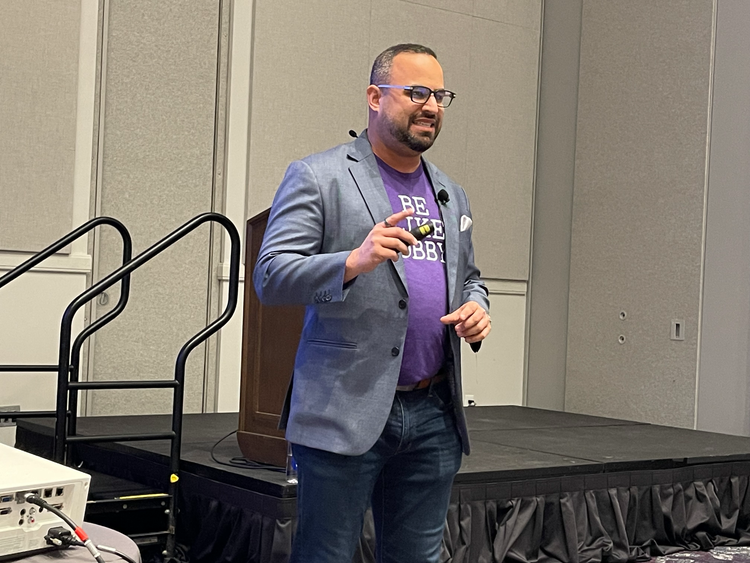
Understanding the value of an MSP business is not really that difficult, according to Kevin Damghani.
“What buying six MSPs taught me is pretty simple,” Damghani, founder and CEO of Grand Rapids, Mich.-based ITPartners+, told an audience of MSPs at last week’s XChange March 2026 conference. “Valuation is not a mystery. It’s a scorecard. And leverage is the difference between a lifestyle business and a real business.”
XChange March 2026 was hosted by CRN parent The Channel Company last week in Orlando, Fla.
[Related: MSP Valuations: Up-Front Conversations With Potential Buyers Key To Success]
Damghani has overseen acquisitions of six fellow MSPs as well as secured $30 million in strategic funding from Metropolitan Partners Group, a New York-based private investment firm, to scale while remaining independent.
Whether looking to be acquired or to stay in business for the long haul, MSPs need to be realistic about the value of their business, Damghani said. That, he said, is what Bobby Umphlett did last June when he sold his company Cloud Server Techs to ITPartners+, which is a member of CRN’s MSP 500.
“[Umphlett] chose leverage over ego,” he said. “He chose alignment over control, and he chose a bigger future over doing it the hard way, alone.”
MSP owners work hard, often handling sales, services, escalation and human resources, Damghani said.
“When someone talks about M&A like it’s a just a transaction, it really feels disconnected, and I get that,” he said.
To be clear, the financial side matters, Damghani said.
“It keeps the engine running,” he said. “It funds growth. It creates options for owners. But the most important score for us is human impact, and positively impacting people is not a tagline for our website. It’s the filter we use for decisions, who we hire, who we partner with, and how we grow.”
ITPartners+ has found its impact by supporting schools serving poor and abandoned children in the Dominican Republic and Uganda, Damghani said.
“We have a big goal,” he said. “We want to write stories and invest a million dollars per year into positively impacting people, not someday, but as a North Star that keeps us grounded while we scale. Because if you build a big business and you lose your soul, I really feel like you don’t win. And here’s why I'm telling you this in an M&A presentation. When you merge, you’re not just choosing a valuation. You’re choosing what you’re building next and who you’re building it with. If you’re going to trade some control for leverage, the platform, in my opinion, has to stand for something, and this is what we’re building.”
Damghani said after over 600 valuation conversations with MSP companies, he has seen that MSPs can scale their business faster when part of a larger organization.
Average deal size has grown from about $2.5 million in 2022 to about $5 million in 2025 as MSPs merge to get more value, he said.
“If your MSP doesn’t differentiate, valuations compress not because you’re bad but because buyers pay for scalable, repeatable, predictable businesses,” he said. “So the goal isn’t just more revenue. The goal is less risk and more leverage. And private equity is everywhere. Platforms are everywhere, from New Charter to Evergreen and everywhere in between. There’s buyers everywhere.”
What is often overlooked in the conversation is most deals are smaller businesses being folded into a platform, Damghani said.
“The brand often disappears,” he said. “Control often disappears. Culture often gets rewritten. Behind closed doors, buyers talk about three things. They talk about risk, they talk about repeatability, and they talk about who is still required for your business to function. Because if the answer is you, they price it like a job. If the answer is a team, a system and recurring revenue, they price it like an asset. This is why structure matters in your MSP.”
At some point, MSPs need to realize they’re not running a lifestyle business, Damghani said.
“You’re building something that other people might buy,” he said. “Lifestyle businesses can survive on creativity in the books, but real businesses need clean financials. They need clean reporting, and they need repeatable discipline. That’s where the value, or that shift, is, where the valuation starts. And it’s where most MSP owners get stuck, in my opinion, because we are used to doing whatever it takes to survive as MSPs. I mean, I’m an accidental business owner myself. I started as an engineer. But buyers don’t pay for survival. They pay for clarity.”
Buyers look at margins, growth, diversification, employee depth, size, percentage of recurring revenue on gross margin, and whether the business can survive and run without the owner, Damghani said.
“If I remove you for 180 days and revenue increases, your multiple goes up,” he said. “If it collapses or stays stagnant, you don’t have a business. I hate to break it to you. You have a job, and you are dependent on you to call the shots.”
Revenue mix is important, and hardware sales hurt valuations, leading to lower multiples as it provides lower value than project and consulting work does, Damghani said. Even more valuable is subscription revenue. Above that is recurring revenue, with contracted recurring revenue, or true monthly recurring revenue, the most valuable because that revenue is predictable and sticky, he said.
“So ask yourself two questions,” he said. “What percent of my revenue is truly contracted and recurring, and second, if I stop selling for 90 days, what would happen to my cash flow? Real recurring revenue builds enterprise value.”
In Damghani’s experience, an MSP business dependent on the founder for business with low recurring revenue, higher customer concentration, weak systems, and no real management team might be valued at 1X to 3X revenue. In the middle, MSPs can get 4X to 8X valuation with steadier revenue, more recurring revenue, better reporting, and emerging leadership, he said. Valuations of 9X to 10X-plus come from having a majority of revenue that is recurring, along with strong KPIs, low customer concentration, real leadership and high growth, he said.
MSPs should consider making the changes needed to become a good acquisition target and look for potential deals early for maximum value, Damghani said.
“If you grind alone for 20 years, and most businesses MSPs have been in business 20 years, and you finally get to $500,000 in EBITDA, you might trade at 4X or 5X,” he said. “That’s a pretty great outcome. But if you merge earlier, roll equity and build a platform together, that multiple can move to 10X and far beyond. With a platform, it’s the same owners, the same work ethic, but it’s different leverage. And that’s the whole game. This isn’t about selling for a check. It’s about compounding equity with other owners.”
Damghani’s presentation struck a chord with Manuel Villa, CEO of San Antonio-based MSP Via Technology, who told CRN that he is currently exploring the future of his company as he gets ready to turn it over to his three sons after he retires in the near future.
Villa said his sons have bought into the vision of Via Technology and are ready to “rock and roll” after his exit.
“My exit strategy has always been to build a legacy business and have my family run the business once I step out,” he said. “Whatever they want to do is up to them, but I met my goal to build a legacy company. I think I’ve accomplished that.”
Damghani’s point about recurring revenue is correct, Villa said.
“We need to increase our recurring revenue model,” he said. “As an example, next time you fly out of San Antonio, you see all the digital signage all throughout the airport. Well, that’s a 12-year contract for us. That’s monthly recurring revenue. We have to give more contracts like that throughout the community. We’re going to be pushing hard right now is getting some new logos or going deeper into our logos and getting multiyear contracts.”
Once Villa retires, he said the future will be up to his sons.
“Once you step away, it’s their decision. It's going to be their choice. I would love to have the family business to continue for generations, but once I step away, I have no control.”