MSPs’ Real AI Advantage Is Relationships, Not Technology: OpenText Exec
AI ‘actually elevates, in my opinion, the importance of that relationship’ with the customer, OpenText’s Mike DePalma said Monday.
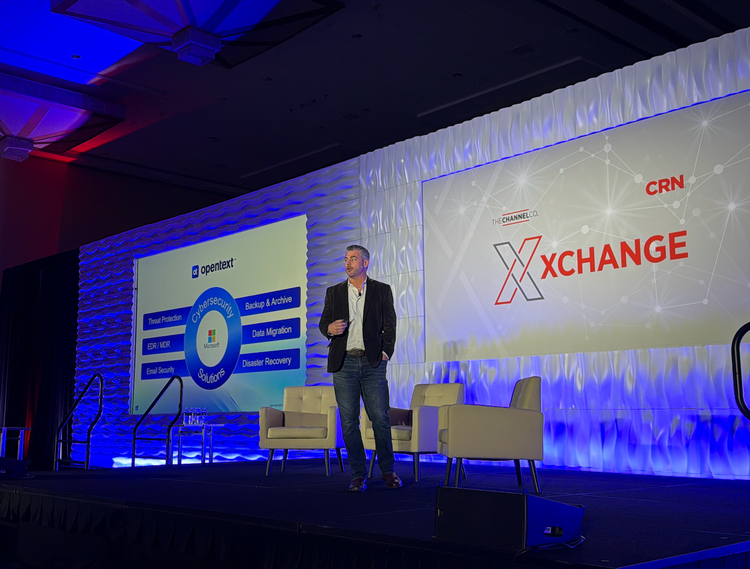
Even with greater AI-powered automation of various aspects of managed IT services that can boost efficiency and response times, the biggest competitive advantage for MSPs in the AI era will continue to be their human relationships with customers and across the channel community, according to OpenText executive Mike DePalma.
“The one thing that gives an MSP an advantage is that AI cannot replace relationships,” said DePalma (pictured), vice president of business development at OpenText, during a keynote session Monday at XChange August 2026. “It actually elevates, in my opinion, the importance of that relationship.”
[Related: Amid AI Surge, ‘Trust Is Becoming The Product’: GTIA Exec]
DePalma offered the comments during a panel session with Ntiva CEO Steve Freidkin and Hatz AI CEO Jimmy Hatzell at the conference, which is hosted by CRN parent The Channel Company and being held this week in National Harbor, Md.
Without a doubt, the trusted adviser role has only become more important as Ntiva has introduced increased automation into its operations and engagements with customers, according to Freidkin, who is also co-founder at Ntiva, a McLean, Va.-based MSP.
“We all crave human connection. And a good, trusted adviser—a good partner, a good relationship—is what this whole journey is about,” he said. “The more of these automations and AI that we put in place, the more important that [relationship] becomes.”
In reality, SMBs are unlikely to achieve real transformation on their own simply by signing up for an AI platform, said Hatzell, who is also co-founder of Hatz AI, an MSP-focused secure AI platform.
Instead, SMBs need help from MSPs with introducing the technology effectively as well as with teaching employees how to use it and expanding the adoption across the business, he said.
“AI doesn’t work without people,” Hatzell said.
Without a doubt, the dramatic rise of AI-powered automation is making the human side of managed services more valuable rather than less, according to Zac Paulson, vice president of technology at Fargo, N.D.-based ABM Technology Group.
“I don’t think relationships will go away. I think they’ll become more important in the future of AI,” Paulson said. “The machines will do what the machines will do. But the humans will do what only humans can do. And I don’t think that’ll go away.”
This is highly encouraging, given the fact that AI also can actually free up MSPs to spend more time with customers through automating repetitive tasks, he said.
Making Money From AI
At the same time, the panel led by DePalma pointed to the continuing challenges around AI monetization for MSPs.
For years, the MSP model was to provide customers with a tech stack and mark it up, DePalma noted.
However, “that is not the way I see MSPs generating revenue from AI,” he said. “It’s more about business outcomes.”
There’s no question that most MSPs are still trying to figure out how to turn AI into a major driver of revenue, Paulson said.
“I’m seeing clients use it a lot, but I’m not seeing ways that I can interject myself to make dollars,” Paulson said. Reselling certain AI services, such as from Hatz AI, does seem to offer a potential for capturing margin, however, he noted.
The key, according to Hatzell, is for MSPs to provide “recurring value” around AI in order to generate recurring revenue. For instance, that can include managing data and applications around AI while also securing its use and monitoring consumption, he said.
Ntiva, meanwhile, is still working out its AI monetization strategy, Freidkin said. While the MSP has developed repeatable AI offerings for customers, the more significant wins have come from engaging with a customer to tailor AI to its specific needs, he said.
That can include understanding the customer’s workflows, processes and outcomes—and then working to “help craft solutions for that,” Freidkin said. “That’s where we’re starting to really see success. How do you scale that? Not quite sure yet.”