NinjaOne’s Paul Redding: MSPs Need To ‘Automate, Specialize’ To Reclaim Profitability
‘The profitability paradox is what we’re talking about,’ says Paul Redding, head of MSP partnerships at NinjaOne. ‘You guys are seeing a place where profitability and growth are not matching up. Your cost has changed. You’ve added more technology, more tools, more applications. The complexity of your environments has grown, but you haven’t been able to go back to your customers and say, ‘This is getting complicated, I need to add 30 percent.’ Nobody’s comfortable doing that.’
The channel’s economics have shifted with MSPs bringing in more revenue, but rising security, compliance, tooling and customer demands are eating into profits and making growth harder to monetize.
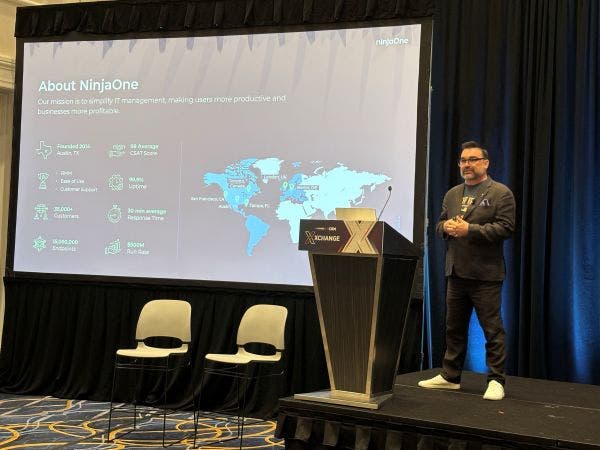
That’s the message conveyed by NinjaOne’s Paul Redding to a room full of MSPs at CRN parent company The Channel Company’s XChange August event in Washington, D.C., this week.
“The profitability paradox is what we’re talking about,” said Redding, head of MSP partnerships at Austin, Texas-based NinjaOne. “You guys are seeing a place where profitability and growth are not matching up. Your cost has changed. You’ve added more technology, more tools, more applications. The complexity of your environments has grown, but you haven’t been able to go back to your customers and say, ‘This is getting complicated, I need to add 30 percent.’ Nobody’s comfortable doing that.”
Those pressures, he said, are creating an opening for automation and platform consolidation. NinjaOne is trying to eliminate the proliferation of those separate tools and interfaces.
[Related: NinjaOne Didn’t Need $400M, But Investors Came Knocking Anyway]
“Every single agent is a risk factor. Every single agent is somewhere else your tech has to drop in. Another click, another multifactor authentication, more time, more clicks, and clicks in time are death. It kills your profit,” he said. “If you can pick a vertical, get in and get deep, and automate your services, then the customer does not view you as the weird IT guy. They view you as a member of their team.”
And the company’s broader strategy is around how an endpoint has expanded beyond traditional PCs to include mobile devices, network infrastructure and other connected systems.
Gabriel Sierra agreed that many MSPs are looking to consolidate technology stacks and maximize built-in automation rather than layering multiple platforms onto the same customer environment.
“One customer, five different tools to achieve one goal is very unproductive,” Sierra, founder of New York-based Consultiply, told CRN.
His biggest takeaway from Redding’s talk was to reduce the number of systems technicians must manage and make better use of automation already available within platforms.
“We always like to maximize all the automation that is built in,” he said. “If we can leverage something that is extremely custom, we’re going to work with it.”
For MSPs trying to improve profitability, Redding emphasized automation, vertical specialization and centralization. He said specialization can make an MSP harder to replace because customers want providers that understand their specific business, regulatory requirements and operational challenges.
“Smart MSPs are starting to realize that,” he said. “Automate, specialize, talk to them about what keeps them awake at night, and build yourself an internal advocate. That’s what it takes. That’s where the profitability starts to come back.”
He also sees AI as an efficiency tool rather than an immediate replacement for technicians. The ultimate goal, he said, is to make NinjaOne a partner in MSP growth rather than just another vendor.
“There is a difference between a vendor and a partner,” he said. “A vendor sells you something. When you’re done with that, they’re done with you. A partner mitigates your risk, makes you safer, improves your efficiency, makes you faster and grows your revenue. We help you make more money.”