‘Not Sexy’ EOS May Give MSPs The Growth Discipline Their Peers Are Missing
‘What [EOS] provides for you is accountability and guardrails, because most of us are too busy running our business and dealing with all of the fires from a day-to-day standpoint to actually fix the things that we want to fix or do the things that we want to do,’ says Paul Vedder, co-founder and CEO of VXIT.
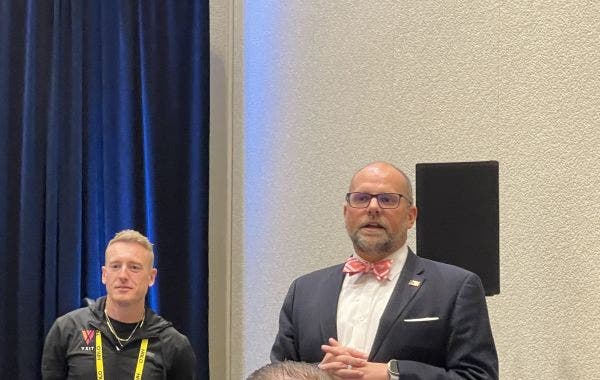
Executives at MSPs and other solution providers looking to run their businesses in a more efficient manner should look into implementing EOS, or Entrepreneurial Operating System, which is a simple system aimed at helping entrepreneurial leadership teams get aligned, gain traction, and more quickly reach their goals.
That’s the word from a couple of MSP executives who used a presentation at this week’s XChange 2026 conference in National City, Md., to show fellow leaders how to take advantage of the EOS framework to improve their own businesses.
XChange 2026 is run by CRN parent organization The Channel Company.
[Related: MSP Execs: KPIs, Metrics Key To MSP Growth, Eventual Sale]
Paul Vedder, co-founder and CEO of West Palm Beach, Fla.-based VXIT, a $9 million, 30-person MSP that’s been doing EOS for about five years, said there are several books that MSPs can read to learn about EOS, including “Traction, Rocket Fuel,” and “What The Heck Is EOS,” the latter of which is the easiest to read.
“Spoiler alert: EOS is not sexy,” said Vedder (left in photo). “There is no magic pill or anything like that. … What it provides for you is accountability and guardrails, because most of us are too busy running our business and dealing with all of the fires from a day-to-day standpoint to actually fix the things that we want to fix or do the things that we want to do.”
EOS is a very simple framework that allows entrepreneurs including MSPs to focus on the important things related to running their businesses, Vedder said.
“You’ve heard the analogy of the glass jar, the sand, and the pebbles or rocks,” he said. “You can take an empty glass jar, and if you put all of the sand in the jar first, you’re going to have no room for the pebbles, and the pebbles are bigger things and probably a little more important. If you put the pebbles in first, you can fill in the jar with the sand. And that’s an analogy that you’ll hear about with an EOS.”
There are several other good frameworks that offer similar benefits as EOS, said Reagan Roney (right in photo), chief experience officer and principal at Solvere One, a $28 million Washington, D.C.-based MSP.
“The reason we went with EOS is because up until that point, we were extremely secretive about our company and the revenue that we made with our employees,” Roney said. “We had foundation, we had core principles, all that lovely stuff that most companies have. But what we weren’t sharing with them was our profit, our revenue, our goals, what we were trying to do as an organization, reassuring them that that year we weren’t going to sell. That we just wanted to help. There was a huge gap between what we wanted as an organization and what everybody else thought we wanted. EOS actually helped put us all in the same boat, rowing all in the same direction.”
EOS provides a system that lets entrepreneurs build a system with a clear direction and goals along with accountability to improve one’s culture, Roney said.
“It took me three years to get to the point that people weren’t quitting my company because they didn’t fit in,” he said. “When I say that, we’re a very welcoming company to all. We have dogs in the office. Everybody’s welcome. But they didn’t fit into how we respected integrity, accountability, and work ethics. Those are some of the byproducts of EOS that are built in that you’ll realize if you are patient with a problem.”
Vedder said EOS starts with vision.
“As entrepreneurs, as business leaders, we have a vision of where we want to take the company,” he said. “We have a vision of the customer service experience that we want our clients to have. Taking that vision and being able to disseminate it across the organization so that the right people are in the right seats and they’re all rowing in the right direction.”
Implementing EOS is not cheap, Vedder said. He estimated it will cost the average entrepreneur about $25,000, which includes a few days working with an implementer.
“You can self-implement EOS, but what I’m going to say is that I will die on the hill that that is a bad idea because you are too busy,” he said. “Not lazy. Too busy to roll this out, and you need accountability. It’s worth the investment.”
Defining the company’s vision was the most difficult part of the EOS framework, according to an MSP in the audience whose company had already implemented it.
“My business partner and I had a vision,” the MSP said. “We had a mission. We had it all drawn out in the core values. [But] during the process, our implementer came in and said, ‘You know, you got to scrap all that. You got to start over because you need a leadership team that’s all going to buy in because it’s going to trickle away from you and down to them, and so forth. And so we had to change everything. And where we were supposed to spend maybe two hours on renewing your core values, it took us almost a whole day to go back through core values because we fought. We actually fought to do that. But now every decision, every vision that we create has to do with those core values.”
An MSP that is not running EOS or a similar framework is definitely leaving money on the table, said Don Monistere, CEO and president of General Informatics, a Baton Rouge, La.-based MSP and a member of the Elite 150 of the CRN’s 2026 Managed Service Provider 500.
“You really don’t know what the potential is for your business because you’re not typically disciplined enough to track those things that can lead you to growth and that can lead you to the efficiencies it creates,” Monistere told CRN. “And so anytime people talk about scaling their business or efficiencies of scale, the only way you can do that is measure, and it’s got to be consistent. And that’s what EOS teaches.”
Monistere is the author of “Enhanced Corporate Performance,” a book about General Informatics’ framework based on the corporate structure he developed on his own. He said whether entrepreneurs use EOS, some other framework, or develop their own, success only comes from forcing themselves to measure everything.
“I always say, if you think about it like how a sports team runs, they always have a very clear goal,” he said. “There’s a championship to win, and to win that championship, there has to be the right coaches in place, right? And if you have the right coaches, then you have to get the right players. And then from the right players, you have to have the right playbook. It’s the same concept, but we don’t always put that into business.”