Schneider Electric To Partners: Stop Treating UPS As A One-And-Done Sale
‘There is emerging a whole industry called energy tech. We really believe that we’re at the forefront of that energy tech. It’s about digitalizing energy. It’s being able to get it down to a digital layer so that you can track and know where your energy is going, know how it’s performing,’ says Adam Compton, offer management leader at Schneider Electric.
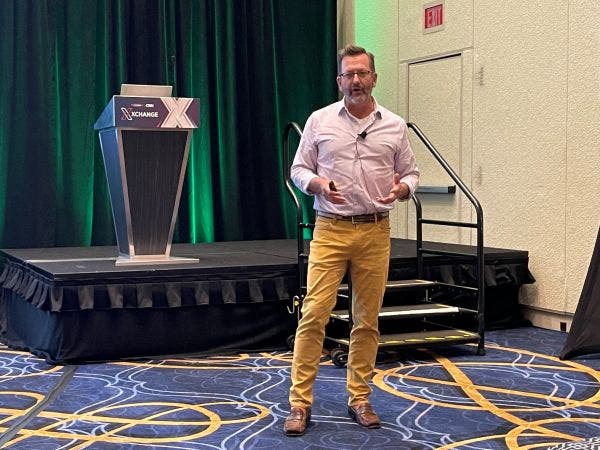
Schneider Electric wants channel partners to think beyond one-time UPS sales and use power infrastructure as a recurring strategic conversation with customers, starting with its new SmartUPS technology to broader shifts in energy management, data center density, and future battery chemistry.
That’s the word from Adam Compton, offer management leader at Schneider Electric, who used a presentation at this week’s XChange 2026 conference in National City, Md., to frame his company’s IT business as part of a much larger energy management story.
XChange 2026 is owned by CRN parent company The Channel Company.
[Related: Schneider Electric Gives Channel Partners New UPS Battery Upgrade, Services Opportunities]
Schneider’s IT operations, built on the legacy of its 2007 acquisition of APC, have been in the data center market for 45 years. Schneider Electric, founded 190 years ago, generates about 40 billion euros or about $45 billion by providing electrical distribution hardware from utility-scale systems down to the plug, Compton said.
That position matters, he said, because electrical distribution is being disrupted by new sources of energy, pressure for efficiency, and the need to make energy use more visible.
“There is emerging a whole industry called energy tech,” he said. “We really believe that we’re at the forefront of that energy tech. It’s about digitalizing energy. It’s being able to get it down to a digital layer so that you can track and know where your energy is going, know how it’s performing.”
Compton said Schneider’s relevance to data centers extends across medium- and low-voltage switchgear, rack power distribution, UPS systems, enclosures, and cooling. Cooling is becoming a larger piece of that discussion as racks move beyond what traditional air cooling can handle. While 70 kilowatts per rack once sounded high, he said customers are now seeing racks with 200 kilowatts or even 400 kilowatts of load, creating more demand for companies that can address both power availability and thermal management.
For partners, the key opportunity is to make power infrastructure part of a yearly risk-mitigation discussion rather than a forgotten attachment to a server or closet upgrade, Compton said. Customers buy uninterruptible power supplies because they want operations to keep running when utility power fails, but he said many organizations treat those systems like insurance policies they rarely review.
“My big takeaway over 30 years is, what people care about is lower risk of disruption,” he said. “And you are in a unique position to be able to have those conversations on an annual basis. The way that we’re doing it with our partners now is through something we call power infrastructure assessments.”
Those assessments use free software that lets channel partners scan a customer network, identify installed UPS systems, and evaluate their health. The process can uncover aging batteries, end-of-life systems, overprovisioned units, or opportunities to consolidate equipment, Compton said. That gives partners a different way to discuss continuity, guaranteed outcomes and lower risk, while also potentially creating managed services and recurring revenue opportunities around power monitoring, he said.
Compton said partners can combine the assessments with a refresh of customers’ UPS with Schneider Electric’s new SmartUPS into a longer lifecycle discussion. Rather than waiting for a customer to buy new IT infrastructure, partners can assess the existing UPS footprint, refresh the systems that need attention, and help customers plan a future migration to better battery technology, he said.
As part of that refresh, Schneider Electric used XChange 2026 to unveil its new single-phase, next-generation SmartUPS online series. Compton said the platform being replaced was more than 10 years old, making the update significant even in a category that does not refresh as often as networking, storage, or server technology.
The new SmartUPS platform brings higher power density, lower embodied carbon, more recycled plastic, 96 percent efficiency and up to three times more runtime than its predecessor, Compton said. Its biggest differentiator, however, he said, is battery flexibility, with a single chassis that can accept either traditional VRLA lead-acid batteries or lithium-ion batteries.
That flexibility gives partners a staged modernization story, Compton said. Customers can start with VRLA today, then move to lithium-ion later as costs decline and comfort with the technology grows. Compton said the company is calling the capability “multi-chemistry” rather than dual-chemistry because Schneider expects other battery technologies to emerge.
“What we’re announcing is an industry first, and that is that one chassis … will accept either VRLA or lithium-ion in the same chassis,” he said. “In the past, you had to buy a VRLA UPS, and you had it for its lifetime.”
Schneider has a center of excellence studying energy storage, evaluating battery technologies for safety, commercial readiness and supply chain viability, Compton said.
“There are other chemistries coming,” he said. “There’s clearly going to be other ways to store energy. They exist today, but when they become commercially viable, we will build the new battery replacement battery cartridges, such that you can put them in here.”
Compton’s discussion about Schneider Electric’s new SmartUPS was a great way to introduce the new model and the fact that customers can use interchangeable battery technology, said Claude Bird, founder and principal consultant at BirdNest IT Services Training & Consulting, a Dallas-based solution provider.
“It looks great because it preserves some costs,” Bird told CRN. “And while he didn’t say it, it also will be a more green option for customers.”
Customers may initially not understand the benefit of being able to upgrade the battery chemistry in a UPS, but from a cost perspective, over time lithium-ion may be cheaper, Bird said.
“Just upgrade the battery because the technology will work either way,” he said. “From a customer perspective, I think it always comes down to cost. So if moving to lithium-ion when the batteries need to be replaced anyway provides them with a cost saving that’s the only thing really matters.”