StorMagic CEO Susan Odle: ‘The Edge Is Absolutely Not The Data Center’
Odle tells channel partner attendees at this week’s Best of Breed conference that the technologies suitable for a company’s core IT infrastructure are not always suitable for the edge, but can often be used in conjunction with other vendors’ core data center technology to ensure customers’ requirements are met.
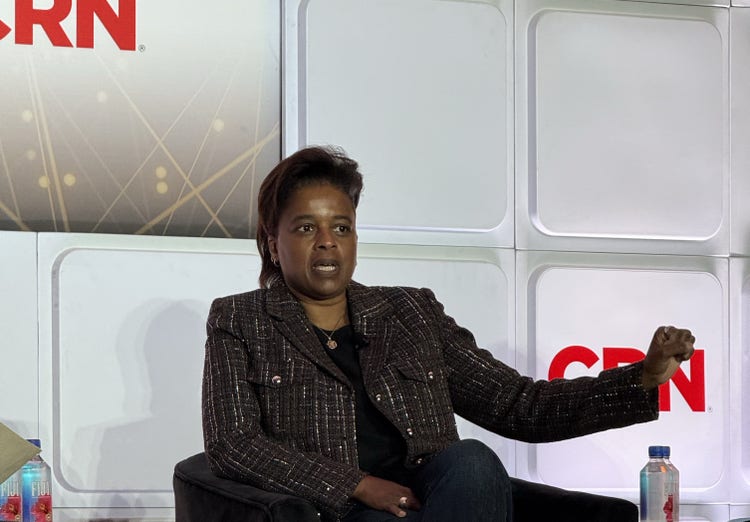
For StorMagic CEO Susan Odle, the most important distinction channel partners can make is also one of the simplest: The edge is not the data center.
Odle, talking with CRN Executive Editor Jennifer Follett and Executive News Editor Steven Burke before an audience of solution providers at this week’s XChange Best of Breed conference in Atlanta, said the distinction matters as customers weigh infrastructure choices amid rising hardware costs, delayed refresh cycles, and continued uncertainty around VMware. Rather than push one technology across every location, Odle said partners should assess the business and technical requirements of each environment and recommend the best fit—even when that means blending vendors.
The XChange Best of Breed conference is hosted by CRN parent The Channel Company.
[Related: StorMagic CEO On Mako Partnership, VMware And The Edge: ‘We Are The Edge’]
Bristol, U.K.-based StorMagic develops software-defined storage technology that most recently was expanded to a hyperconverged infrastructure offering that sometimes competes with VMware but just as often peacefully connects to its SvHCI at the edge with VMware at the core.
A data center platform may be appropriate for use at the edge in a large manufacturing or operational technology site, Odle said. But at scale—where thousands of locations repeatedly run the same workloads—the economics can change dramatically. In those environments, she said, deploying a data center-oriented solution at every site often makes little sense.
“So blend it,” she said. “[Our job] is to make sure our partners understand the edge is not the data center, and understand both the business and the technical requirements, and recommend to our customer the best fit. Which might be one vendor. It might be a blend. It typically will be a blend.”
The edge has long faced intense cost pressure because remote locations often lack on-site IT personnel yet still must remain operational, Odle said. Three- or five-year refresh cycles that once brought innovation to those sites are becoming harder to maintain as server prices rise. That makes it more important for partners to help customers extend existing fleets without slowing deployments of point-of-sale, computer vision, surveillance, or manufacturing workloads.
Artificial intelligence is increasing the urgency, Odle said. Computer vision used for retail surveillance, manufacturing productivity or workplace safety may need to recognize a risk and trigger a decision immediately, without waiting for data to travel to and from a centralized data center.
“You can’t have a lag of 30 seconds up to the data center, and then that person ends up injured, right?” she said. “So that is why AI and the edge go hand-in-hand. The need to have that kind of data security, that ability to make decisions at the point of operations, has definitely moved edge into its prime as a market center.”
Odle said the role of StorMagic is to offer purpose-built virtualization for small-footprint edge environments with the flexibility to run on existing x86 hardware while coexisting with broader data center platforms. She cited Altoona, Pa.-based convenience store company Sheetz as an example, saying the company migrated over 830 stores’ edge operations remotely over four months while remaining a VMware customer in the data center.
“The ROI is massive,” she said. “On top of that, though, if you think about the cost savings over the cost of VMware at the edge, you’ve got the reduction in licensing costs as well as the time to deploy and maintenance. They’re a very happy VMware customer, though, in the data center. It’s a good example of coexistence.”
For partners, that coexistence creates both an economic and advisory opportunity. They can help customers avoid premature hardware purchases, modernize existing infrastructure, and reserve budget for innovation. They also can bring together ecosystem technologies—including systems, networking, security, and migration tools—to deliver an edge solution that can be managed from deployment through ongoing operations, she said.
“How do we add more things so that all of you can go out and deliver a total hyperconverged solution for the edge, cradle to grave?” she said. “If you’re an MSP and you want to manage that infrastructure, you can do it.”
Odle described “optionality” as central to StorMagic’s development strategy and to the value partners can deliver. Customers can choose the form factor, surrounding components, and security footprint that fit a particular site instead of being locked into a single stack.
That approach also changes the sales conversation. Odle urged partners to become trusted consultants who understand both the market and the customer, even if solving the immediate problem produces a smaller initial sale. The payoff, she said, is a deeper relationship and longer-term opportunity.
“If you’re not consultative now, you need to become as consultative as you can be to help navigate the water,” she said. “You understand the market. Understand them. Help them solve problems now, even if it means an incrementally smaller sale for you right now. It’s going to build trust. It gives you the long-tail sales indefinitely.”
Ultimately, Odle’s message to partners is not to treat edge infrastructure as a smaller copy of the data center. It is to match technology to customers’ requirements and use that discipline to provide customers choice while building trust.
Odle was spot on with her view of the importance of the edge, said Michael Tanenhaus, CEO of Mavenspire, an Annapolis, Maryland-based solution provider.
StorMagic in the past provided secondary storage to other vendors’ technologies, but after Broadcom changed how VMware works, StorMagic built out a hyperconverged infrastructure stack that still can be added to any solution, Tanenhaus told CRN.
“That means they’re keeping a focus on the edge, which basically, if you think about how she’s using that word, it’s where the innovation is going to happen: automation in factories, automation on the farms, changes to how frontline defenders and fire and public access stuff works,” he said. “How literally the next generation of Flock [camera]-like technology works. That’s all the edge, and that’s how she’s using that term, which traditionally would be OT (operational technology), not IT.”
Odle is also implying that it’s an IT world, and so at the same time, people that do IT today will be absorbing OT because that will be the application of the future, Tanenhaus said. He cited the panic that IT people experienced in the past when faced with bringing in other new technologies like phone systems and security systems.
“The edge will become how the business operates,” he said. “And so that’s why it’s so interesting how she’s using the word ‘edge’ because she’s making it clear that it’ll have to encompass what we would normally provide to customers.”
StorMagic has been doing software-defined storage for a long time, and didn’t build arrays, Tanenhaus said. Instead, the company showed how to use software to combine existing assets together to store data and realized business users need storage at the edge and in the data center.
“Storage is the memory of a company’s business and processes, and so I can see why she’s excited,” he said. “StorMagic is sitting in a place where the neat thing that people always need is storage. They need capacity. And she’s kept it flexible so that it can plug in wherever it is needed, even when there’s an incumbent. And she doesn’t want to fight.”