Why MSP Leaders Can Be Their Company’s Biggest ‘Constraint:’ Expert
Many successful, founder-led MSPs can see growth stall unless their leaders can translate that success into systems and processes that are more scalable, according to AmplifyGTM founder Amy Roman.
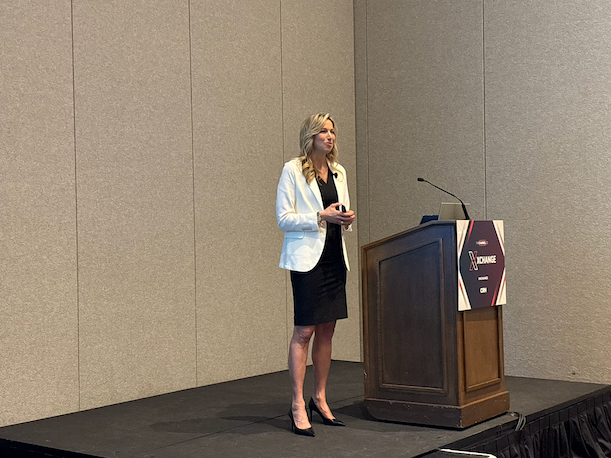
Many successful MSPs can see growth stall unless their founders can translate that success into systems and processes that are more scalable, according to AmplifyGTM founder Amy Roman.
It’s natural for a founder who has achieved strong initial results at their MSP by leading the way to continue holding tightly onto the reins into the next phases of growth at the company, Roman said Sunday during a session at XChange March 2026, an event hosted by CRN parent The Channel Company being held this week in Orlando, Fla.
[Related: The 2026 Managed Service Provider 500]
However, the MSP founder—or other “key person” in a leadership role—cannot remain the primary driver of growth over the longer term, Roman told an audience of MSP executives Sunday.
“If you are your No. 1 growth engine, you are your company’s No. 1 constraint,” she said.
Such a leader is often the “top closer” as well as the trusted voice, authority on pricing and escalation point for all major issues within the organization, Roman said.
“That feels like power,” she said. “But the fact is, that’s actually not leadership. What you’re doing is accelerating ‘key-person risk.’ And ‘key-person risk’ devalues you—and creates risk in your organization that’s going to stall growth eventually.”
The answer—to enable scalability and a higher valuation for an MSP—is to take that initial success achieved by the founder or key person and then leverage it to create repeatable systems, Roman said.
“That means you need strategy, you need structure and you need sustained investment,” she said. “When all three engines are firing, that’s when you get predictable growth.”
Those “growth multipliers” for an MSP include shifting from a founder-led (or key-person-led) strategy to institutional authority, according to Roman. MSPs must also move from relationship-based selling to “engineered access,” as well as shift from one-off, lead generation campaigns to revenue infrastructure, she said.
Roman invited two MSP leaders to come on stage to discuss their experiences in helping to enable this type of transition within their organizations.
Donald Monistere, president and CEO of Baton Rouge, La.-based General Informatics, said that instituting these types of scalable processes has been critical—and that it has, for many processes, involved him having to “learn to let that go.”
In cases where the company loses a deal at this point, “it’s typically because we got off the railings of our overall process that we use,” Monistere said.
Brian Ruschman, president of Covington, Ky.-based C-Forward, said he and his company have also worked hard to make the name of the company itself into a strong brand in the local community—making the business much less dependent on a single key leader.
“You want your business name to be the first one that they think of when they have a technology issue that needs to be addressed,” Ruschman said. “We’ve done that now for a while, and it’s just paying great dividends for us.”
Many of the points made by Roman and the two MSP leaders resonated strongly, given the challenges of achieving a scalable MSP model, according to Ali Johnston, founder and president of Satellite Beach, Fla.-based Bel Tech Services.
One of the themes of the session was that MSP leaders can often “get in their own way” but have a blind spot about that, Johnston said. Without a doubt, that is a major issue to overcome, she said.
“I know that I’m at the point where I need to get out of my own way and give [more of] the reins over to someone else,” Johnston said. “It feels good to be in this room and hear that I’m not the only one.”