‘You Have To Be Willing To Take Some Risks:’ Caylent’s Fast-Moving Anthropic Bet
Caylent CEO Valerie Henderson told fellow solution providers how her company accelerates Anthropic growth through short Claude engagements, rapid adaptation, AI expertise and customer enablement while navigating Anthropic’s continuously evolving channel strategy and partner programs at scale.
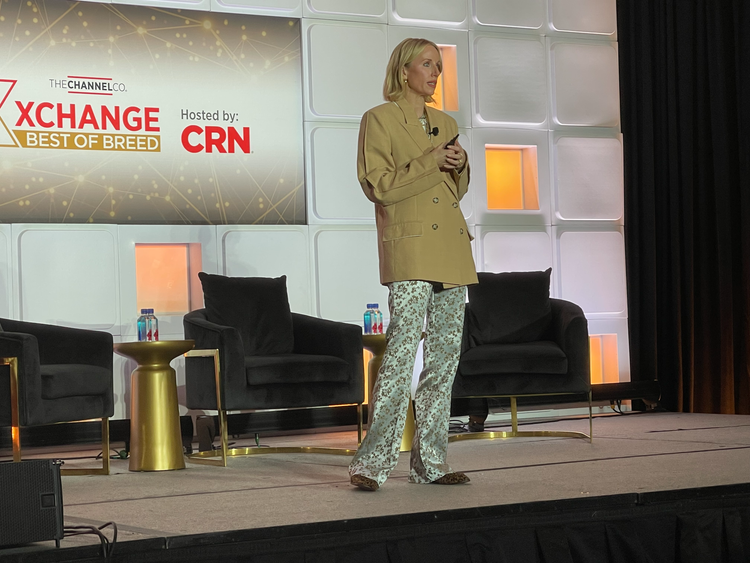
Caylent has built its relationship and business with AI developer Anthropic by moving quickly, starting customers with shorter Claude engagements and adapting as the vendor’s channel strategy evolves, CEO Valerie Henderson said.
The Irvine, Calif.-based AWS Premier Tier Services Partner and Anthropic Preferred Services Partner became the first North American systems integrator with an official Anthropic partnership and now has about 1,400 Anthropic certifications, Henderson this week told an audience of solution providers who attended the XChange Best of Breed 2026 Conference in Atlanta.
The XChange Best of Breed Conference is hosted by CRN parent The Channel Company.
[RELATED: AWS Star Caylent’s FDE Push Drives Millions In AI ROI; More FDEs On The Way]
About 40 percent of Caylent’s business comes from applied AI, ranging from helping customers develop evaluations to building and integrating AI platforms, Henderson said.
“Things are changing at such an insane rate,” she said. “You have to have a level of adaptability and a dynamic execution because you can’t hold the wheel too tight or you’re going to miss things. You’re not going to necessarily make the right bets. You have to be willing to take some risks, and then if it doesn’t work, change and evolve fairly quickly.”
Caylent’s broader AI experience grew from its AWS work, including a program that let it complete about 115 generative AI prototypes in 75 days. Henderson said the lessons from that intense period helped Caylent decide where and how to develop its business.
That flexibility is particularly important with Anthropic, whose programs and processes change rapidly, Henderson said.
“You have to be willing to not hold on to anything too tight with them because it is going to change,” she said. “I think there were several iterations of the partner portal in a very short period of time, and I think you can be frustrated about that, or you can just understand that they are moving so fast and their release cycle is so fast, just be OK with that and be adaptable.”
Henderson said Anthropic appears to be keeping its field sales organization smaller so it can scale through partners. Caylent responds by aligning its capabilities and teams with Anthropic’s field approach.
“I feel like that is a choice that they are making that they want to scale through partners,” she said. “So they’ve intentionally said, ‘This is what we want to do. Here’s how we want to work with our partners.’ We try and mirror our capabilities and our teams to the way they’re thinking about the work in the field.”
After her presentation, Henderson told CRN that her company first helps customers with the enablement part of Claude to get to a ground zero framework for employees to understand Claude and the capabilities and how it can work within their organization. From there, she said, it’s on to actually building skills, turning those skills into agents, and managing those agents like that’s a process.
“We really think about the activations as being a great way to start,” she said. “A lot of partners don’t do that part. They don’t do the activations. It can be challenging because you want to staff them with very experienced people, but they’re shorter engagements. But that’s something Caylent’s been doing with AWS for a very long time. We already had the framework built, but a lot of larger companies struggle with that.”
Starting with the Claude activations gives Caylent context across lines of business, leadership and departmental workflows, Henderson said. Those engagements can lead to broader work, although not each one does.
During her presentation, Henderson said Anthropic’s alliances team sets clear metrics and KPIs, but they can change.
“If you aren’t willing to move at their pace, it’s going to be difficult to partner with them,” she said.
Caylent serves customers from startups through Fortune 100 companies, with about 45 percent of its customer base in technology, Hendeson said. Its Anthropic-related revenue comes from services rather than reselling larger AI programs. Anthropic is also developing accelerator programs that can provide services funding based on the size of a customer commitment, similar to an AWS approach, she said.