MSPs Say AI Is Bigger Than Another Tool In The Stack: Panel
“Most MSPs, when they first heard the buzzword ‘AI,’ the first thing they thought about is, ‘Can I put it in my stack? How can I put it in my stack? How can I make some money off of this?’ But I’m going to make a case for something different. What if AI was the foundation of everything? What if it was the foundation of the beginning of the relationship, of the beginning of the customer?” says Melvin Williams, CEO of M&N Communications.
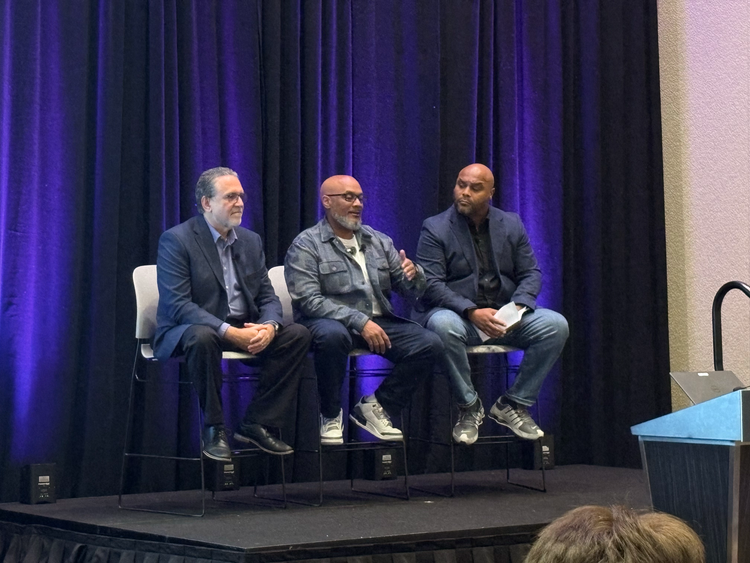
MSPs are beginning to rethink their role as AI moves from an emerging technology into an everyday business tool, according to MSP leaders who said the industry’s biggest opportunity may not be selling AI products but helping customers redesign how they work.
MSPs Michael Goldstein, Corey Kirkendoll and Melvin Williams used a panel at CRN parent company The Channel Company’s XChange August event in National Harbor, Md., to make the case that the traditional model of managing infrastructure, devices and software is giving way to helping customers identify business problems and build AI-driven solutions to solve them.
Williams, CEO of Blue Bell, Pa.-based M&N Communications, said the industry needs to resist the temptation to treat AI simply as another product to add to an existing technology stack.
“Most MSPs, when they first heard the buzzword ‘AI,’ the first thing they thought about is, ‘Can I put it in my stack? How can I put it in my stack? How can I make some money off of this?’ But I’m going to make a case for something different,” he said. “What if AI was the foundation of everything? What if it was the foundation of the beginning of the relationship, of the beginning of the customer?”
[Related: 10 Hot MSP Tools To Expand Automation, AI, Agentic AI Capabilities]
That mindset, he said, changes the conversation.
Rather than focusing on which tools to install, Melvin said MSPs should be asking customers what business problems they need to solve and then determine whether AI and agentic technologies can help.
“I don’t believe that the future belongs to the MSP that installs the most software or manages the most devices,” he said. “I believe it belongs to the MSP that helps organizations solve problems faster, make better decisions and unlock the potential of their people.”
For Kirkendoll, CEO of Allen, Texas-based 5K Technical Services, AI feels like the next big technology turning point.
“I’ve lived through a lot of inflection points, but I’ve never lived through anything like this AI inflection point,” he said. “I think that we went so fast because in this world today, it’s on someone’s TikTok, it’s on someone’s Instagram, it’s on news feeds.”
That speed is creating both an opportunity and a security problem for MSPs, he said. His company approaches AI as a cybersecurity conversation, beginning with visibility into what customers are actually using.
“All roads lead to cyber,” Kirkendoll said. “As you start talking about exposing your data, for me, these products are going to change over time. I don’t care if it’s a Microsoft product or Google product. We still have to go out and make it a cyber play.”
The issue, he said, is that customers may have dozens of AI tools or agents working inside their environments, creating an opportunity to turn AI governance into recurring revenue.
Goldstein, market president of Fort Myers, Fla.-based Entech, said the relationship between MSP and customer remains critical, especially as more companies begin evaluating AI independently.
“It’s not about the tool stack, it’s that relationship,” he said. “No matter whether you’re the newer MSP or the older MSP, at this point it’s all about that trust factor with our customers.”
Leonard Ozoemena has already been making that shift with AI.
“We need to have a mind shift from the kind of services and products that are traditionally MSP products to a different kind of approach,” Ozoemena, owner of Washington, D.C.-based Compass Solutions, told CRN. “If the customer is empowered to do some of the things that you can do for them, then you need to find a way to remain relevant by being an authority.”
The company, which has worked with AI for about three years, is also seeing its business model change as off-the-shelf AI agents replace customized solutions.
“We are really seeing the past and the present struggling to redefine how the future will look,” he said. “That’s why what they’re saying is relevant.”