Selling Small Business, Dell Computer, server market | Serving Notice
For years, Dell&'s aggressive pricing tactics have fueled the market for low-cost servers aimed at cost-conscious small-business customers. Now, even IBM is getting into the game. The Armonk, N.Y., vendor, which has a reputation for playing more effectively at the high end, launched in the third quarter a low-end server with prices starting at $599, as well as Power5 Unix-based systems priced as low as $4,000.
“Everyone is trying to get one up on Dell,” said John Marks, CEO of JDM Infrastructure, Rosemont, Ill.
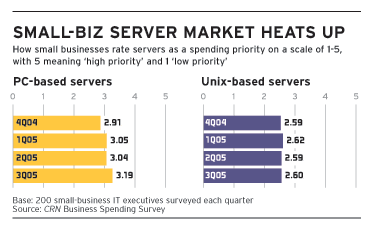
The new servers couldn&'t come at a better time. Solution providers say a number of trends are converging to fuel growth in the small-business market. On the low end, small offices are finding a need for security, spam filters and collaboration features that only can be delivered through a server. Meanwhile, larger small businesses—frequently 75 to 100 seats—are finding uses for more powerful servers as consolidation, analytics and other higher-end technologies move downstream.
“Look at all the products like spam filtering, Web-enabled tools and e-mail tools,” Marks said. “Even three- to four-people offices are saying, ‘We need this stuff.&' ”
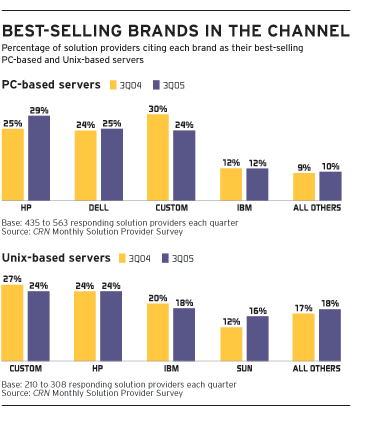
Though solution providers agree they wouldn&'t offer most small businesses a sub-$1,000 server with one hard drive and a low-end processor, they say the price point helps attract the attention of thrifty customers. Both IBM and the x86 server market leader, Hewlett-Packard, Palo Alto, Calif., have special channel programs to help solution providers sell servers into this space.
But the more interesting maneuvers are aimed at the larger companies. Kathy Durfee, CEO of TechHouse, a Microsoft shop in Sarasota, Fla., pairs Small Business Server with financial, database, collaboration and e-mail applications. In particular, she said, more powerful database and financial software is driving the need for more robust servers.
“Products are starting to ship with core data warehouses built in,” Durfee said. “With Excel sitting on top, a small business can analyze that data, but you might need two processors to do it.”
Analytics in small business? Durfee said unlike 10 years ago, many of today&'s entrepreneurs in the small-business space are coming out of corporate America and are used to working with sophisticated technology systems. “We are now in a situation where the administrator running an IT area for 50 or 75 people has been in the business for 10 years,” she said. “They are more aware of what is new and what it takes to make it happen. We can now have tactical and strategic discussions with them.”
More recently, Durfee added, small businesses are coming to TechHouse for more than software solutions. They are asking for hardware as well—the complete solution. These companies want to aggregate vendors to minimize complexity. “They are coming to us for all of it,” she said.
That&'s one reason IBM scaled down its high-end pSeries systems that use the Power5 processor and can run IBM&'s AIX Unix or Linux. The company is recruiting VARs that service small and midsize businesses to help with the push. IBM also is lowering the barriers to entry to sell pSeries systems, said Elaine Lack, director of worldwide marketing execution for pSeries systems at IBM. With the systems, the company offers training, simplified certifications, and virtualization software that solution providers can use to set up a micropartition in three clicks. “We are making it easier to sell multiples of smaller boxes,” Lack said.
IBM&'s pSeries push came just weeks after Sun Microsystems, Mountain View, Calif., released its own low-cost servers. The Sun Fire systems, touted previously under the Galaxy code name, start at about $1,000. They are based on Advanced Micro Devices&' Opteron processor and can run Windows, Linux or Solaris, according to Sun.
Those rack-mount systems have received an enthusiastic response from solution providers. While they are aimed primarily at the midmarket, Sun and its partners believe there will be applications for smaller businesses over time. Applications that run on AIX and Solaris tend to demand a robust infrastructure. The same is not true for Linux, and as a result many solution providers expect to see more Linux-based systems drop into the high end of the small-business market.
TamGroup CTO Christian Franklin mostly uses pSeries systems in the midmarket but said there is still some interest among small businesses that require high-transaction capability such as life science, financial and e-commerce applications.
In addition, low price points have prompted other small businesses to bring in a number of x86 servers, making the IT infrastructure harder to manage and upgrade. “When they have 10 to 12 servers sitting there, that is a very good server consolidation story,” Franklin said.
With a variety of new low-cost server options available to solution providers, that story becomes even more compelling.