Solar Power
Several of Sun's top executives, including newly appointed President and COO Jonathan Schwartz, told CRN last week that Sun is putting extra muscle behind its channel efforts across all lines of the company's business as part of its overall mission to increase sales.

This week at its annual iForce Partner Summit in San Diego, Sun plans to introduce a new sales model that will add 25 percent more channel salespeople by the beginning of its next fiscal year, which starts July 1, said Gary Grimes, vice president of U.S. partner sales at Sun.
The company also will reveal a consolidated partner program that drastically simplifies partner classifications and requirements, as well as for the first time unites all of Sun's hardware, software and services partnering efforts under one program umbrella, said Bill Cate, director of the U.S. iForce program office at Sun.
The vendor's determination to leverage the channel to return to profitability is hardly a new strategy: Company executives have stressed the importance of partners for the past three years, as Sun has faced financial woes and weathered executive shake-ups in its continuing effort toreinvent the company as a comprehensive systems vendor.
The changes to Sun's channel program come in the wake of yet another major management shakeup in which Schwartz has solidified much of his control over Sun. Just six months ago, Schwartz headed Sun's software efforts and reported to Chairman and CEO Scott McNealy along with Patricia Sueltz, executive vice president for services, and Neil Knox, executive vice president, volume systems products. But less than two hours before its third-quarter earnings call late last week, in which the company reported a quarterly loss of $760 million on sales of $2.65 billion, Sun announced that Knox and Mark Tolliver, chief marketing and strategy officer, had resigned. Sueltz had resigned earlier this year to join Salesforce.com. Sueltz's replacement, Marissa Peterson, now reports to Schwartz. Meanwhile, Andy Bechtolsheim, a Sun co-founder who returned earlier this year, is now senior vice president and chief architect of volume systems products.
Sun last week also unveiled a corporate restructuring to create two separate hardware groups, one for products based on Sun's microprocessor technology and one for servers built with Intel and Advanced Micro Devices chips. And the vendor killed the development of its UltraSPARC V processor in order to concentrate its resources on next-generation SPARC processors (see news story on page 74).
Combine this restructuring and a $7.5 billion cash balance with a renewed channel push that comes not as a nebulous effort but as part of a companywide strategy and, some solution providers say, Sun may just have a fighting chance at regaining some of its former glory.

\
(l. to r.): Robert Youngjohns, Marissa Peterson, Gary Grimes and Bill Cook
"The fact that Schwartz was put into the president's role makes me bullish that Sun will continue to take the steps they need to make the transition to drive revenue through solution sales, not just hardware sales," said Marc Maselli, president of Needham, Mass.-based solution provider Back Bay Technologies. "He's the new guard. Having a software guy in charge of all of this sends a message [to the rest of the company]."
Schwartz said he recognizes that confluence across all lines of business is not easy to achieve, especially for a company with a reputation for being rich with innovative ideas but poor when it comes to actual market execution. But the 38-year-old executive, who tackled the job of restoring order to Sun's software strategy with a comprehensive branding effort and a disruptive pricing model, is committed to bringing that same level of Type-A organization to the entire company.
"For us to be a systems provider, first and foremost, Sun Microsystems has to be a system,one system,where the evolution of a single product triggers adaptation in everything from organization models, to compensation models, to naming architectures, to financing options," Schwartz said. "It's really that level of coordination that we brought to the software world that I'm now going to seek across Sun."
Schwartz insisted the channel is an important part of the fabric of his grand scheme. He said Sun plans to share some of its $7.5 billion in cash with its channel partners, as well as deliver more channel-only sales opportunities like one he launched with the Java Enterprise System in January. The software suite, which is sold to customers for a yearly subscription price of $100 per employee, is an exclusive channel play for VARs targeting companies with less than 1,000 employees.
"We will continue to cordon off portions of our business so that they will be exclusively served through our channel partners," Schwartz said.
Channel chief Grimes said Sun's sales organization is about to launch a new model across the United States that aims to fill coverage gaps in regional markets where solution providers need extra help delivering focused solutions using Sun's broad product portfolio.
"What we're really talking about here is how we execute at the sales engagement level more effectively than we have in the past," Grimes said.
While Sun's sales organization will pay closest attention to partners that make about $5 million or more in revenue a year, the little guys will not be left out, Grimes said. Sun plans to tap distributors GE Access and MOCA to "be more proactive" in areas where Sun is not providing direct coverage to VARs, he said.
One solution provider said he was encouraged that Sun plans to increase its channel field-sales force even as layoffs hit other areas of the company. The announcement of a 3,300-person head-count reduction came on April 2, the same day Sun and Microsoft unveiled their pact and Schwartz was tapped as president and COO.
"It's a redirection of some of their efforts," said Don McDowell, vice president of server solutions at Skokie, Ill.-based Forsythe Solutions, one of Sun's largest U.S. solution providers.
Cate said the new consolidated channel program Sun will roll out at the iForce Partner Summit is aligned with giving partners a more focused set of resources. The program is designed to address Sun's current mishmash of programs with their various specialties, certifications and titles, which are a result of Sun's transition from primarily a hardware player to one that sells hardware, software and solutions. The new program offers two partner levels,Foundation and Premier,comprised of solution providers and VARs that focus on reselling hardware, software or both, Cate said. Foundation is for entry-level partners, and there are minimum competency requirements for joining. Premier partners, where most of Sun's channel will fall, are a step above Foundation in terms of requirements (see chart).
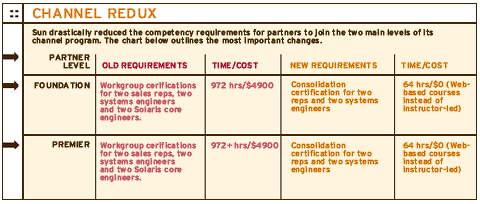
Sun also is offering two specialities for its partners, one for delivering services and another for delivering data center solutions. For partners that make a particularly significant investment in their Sun relationship, there are three Elite partner designations in the new program.
To accompany the unified program, Sun also has significantly reduced the complexity of competency requirements for each level of membership, Cate said. "Hopefully, the partners will be doing somersaults over this," he said.
Showing solidarity between Sun's global sales organization and its channel program team, Robert Youngjohns, executive vice president of global sales, told CRN in an interview last week how crucial partners are to Sun's strategy to offer more focused solutions that build longstanding customer relationships rather than result in one-off product sales. "The criticality of partners is not just more warm bodies [to augment Sun's sales force], they add to our solutions set," Youngjohns said. "They take all of the things that come out of Sun's R&D and turn [them] into things customers care about."
This kind of commitment to providing solutions through partners also extends to Sun Services, now under the direction of Peterson, who has the new title of executive vice president of customer advocacy, network services and worldwide operations. Sun will roll out a new Site Support Managed Services offering for U.S. partners at the iForce Partner Summit, Peterson said.
Some partners say the corporate message about solution-selling still hasn't trickled down to the field-sales force. There, pushing boxes remains the order of the day, they say.
Other Sun VARs point to the vendor's recent financial troubles as a reason solution-selling efforts have been hamstrung, but say they would welcome more channel-focused initiatives.
John Sheaffer, chairman and CEO of Sysix, a Sun VAR in Oak Brook, Ill., said that because of the recent round of layoffs, the company by necessity has shown more reliance on the channel. But Sun still could beef up its partner resources to be more on par with larger competitors such as IBM.
This week, Sheaffer and other Sun partners will see an onslaught of channel initiatives from the company. However, it's clear Sun has an uphill battle ahead before it reaches full financial recovery.
Recent news that the vendor scrapped plans for an UltraSPARC V processor shows second-guessing in one of Sun's most valuable business units, which could spell trouble for the vendor's long-term processor and hardware strategy. But with the overall market on the mend, it shouldn't be too long before partners discover whether Sun's corporate and management reshuffling will help restore the company to its former position as a Silicon Valley powerhouse.
CRAIG ZARLEY contributed to this story.