Lock and Load
The system builder channel has long been allied with the Wintel platform, and that is not likely to change anytime soon. But neither are system builders waiting for mainstream 64-bit desktop market to arrive. With 64-bit components becoming available, they are adding Linux and Solaris to their arsenal in a move that is certain to expand the horizons of the custom-systems channel as it moves into new markets and product categories.
Custom-system builders are finding creative ways to arm resellers with high-performance 64-bit computers today in the hunt for bigger game, new markets and better margins.
With the arrival of 32-bit-compatible 64-bit chips from both Intel and Advanced Micro Devices, increasing support from components vendors and the penetration of Linux—and now perhaps Sun Microsystems’ Solaris—into the system-builder channel, some system builders see markets and opportunities opening up.
These custom 64-bit solutions no longer are aimed exclusively at the traditional workstation and server applications running high-end engineering analysis and CAD software, but at the enterprise server, storage, gaming and even desktop office-productivity markets.
“We build 64-bit systems right now because we are building for the future, not for yesterday,” said Patrick McNicholas, president of Maverick Computers, West Palm Beach, Fla. He said he is a firm believer that making investments today in 64-bit computing will pay dividends both now and tomorrow.
While many customers are running Windows XP on Maverick’s 64-bit AMD-based systems, McNicholas sees an opening for Linux. One enterprise customer who has ordered 4,800 desktops from Maverick is debating whether to go with Linux, he said. “They are deciding on an OS right now as we build the machines,” he said. “They know it’s a big decision because it will mean replacing their Windows server infrastructure, too. But with Linux, in the long term, they have the potential to save a lot of money.”
| AD | |
|---|---|
| id | unit-1659132512259 |
| type | Sponsored post |
JWB Associates is finding that one of the best things about 64-bit systems right now is the higher profit margins, said John Boghosian, president of the Atlanta-based custom-system builder. Like many system builders, Boghosian still sees a limited number of 64-bit systems being requested. What gets ordered from JWB’s 64-bit menu are mostly workstations with a server thrown in at a 1-to-12 ratio. “But the margins are better because the parts are more expensive and there’s a performance premium factored in,” he said.
Other custom-system builders are taking 64-bit designs beyond the PC, workstation and server and applying the higher-performance technology in the storage arena.
ZT Group International has been seeing huge success with its 64-bit branded storage and RAID servers, said Jordan Shen, director of business development at the system builder.
\
ZT builds and sells the 64-bit storage arrays from a variety of different components, including chips from Intel and AMD, and RAID controllers from Adaptec or 3ware, Shen said. For about $4,999, ZT sells entry-level 64-bit storage systems with 1 Gbyte of memory and can pack more than four times that much memory in 64-bit storage products that sell for between $10,000 and $20,000.
Shen also said ZT has been an aggressive promoter of 64-bit computing in the channel, selling a steady number of 64-bit servers to enterprise customers. Until now, though, most 64-bit servers sold by ZT have been for simple tasks such as file serving.
But Shen said he believes interest in 64-bit computers will broaden with the arrival of AMD’s dual-core 64-bit chips. The wide choice of motherboard designs from vendors such as ASUS Computer International and Micro-Star International simplifies the customer design process for 64-bit systems, he said.
Still, the lack of applications designed specifically for 64-bit addressability has put some drag on the market. ZT has been promoting Athlon 64-bit systems, but they are still running 32-bit applications and operating systems, Shen said.
“To that, we foresee more of a market embrace of 64-bit in the early near future once [Microsoft’s 64-bit] Longhorn OS is released,” he said.
But why wait for Microsoft? Custom-system builders said Linux offers a solution today when it comes to providing an operating system for 64-bit systems.
When B3 Computers, a custom-system builder in Gwinn, Mich., polled its solution provider customers, 84 percent indicated they planned to sell Unix or Linux systems over the next 12 months, said Fred Schlaffer, president of B3 Computer.
That’s why the company is currently selling 64-bit systems with Red Hat Linux, Suse Linux and Mandrake Linux and is among system builders talking with Sun about its initiative to bring its technology to OEM channel partners. “It’s something different; it’s the enterprise getting down to the white box,” he said.
“Now we are selling branded 64-bit B3 computers, we’re selling Sun running Solaris, we are offering 64-bit on the server and the Java desktop, and we are seeing demand in all sorts of verticals such as data entry applications, engineering and manufacturing,” Schlaffer said. “And the thing with the verticals is you don’t have to worry about a universe of applications being available. These verticals have their own applications already, so its no problem.”
Perhaps the biggest problem Schlaffer has seen in selling custom 64-bit systems is making sure all available configurations are properly designed with the right hardware to maximize 64-bit performance. With AMD and Sun getting into the business of certifying components, that has been a help.
“We offer our customers, who are VARs and resellers, a tool to configure systems that we know work,” he said. “But the biggest problem in the 64-bit environment is that there is still a lot of hardware that may not be supported such as certain ATA drives, and certain motherboards won’t give you the performance.”
Dan Hodkinson, workstations business development manager at Seneca Data Distributors, a system builder in North Syracuse, N.Y., said he also sees Linux as a way to achieve full 64-bit performance today. “Right now, the only true performance gains in 64-bit are with Linux,” he said. “Because to get the full benefit of 64-bit computing, you need a board and a BIOS that supports it and also an operating system with the proper driver set. With Linux, the driver set is there and a complete 64-bit kernel.”
Seneca also plans to make room on its custom system configurator for 64-bit gaming machines, which require state-of-the-art graphics and sound technology. The beauty of courting the gaming market with 64-bit machines is that the requirements for gaming PCs are very close to that of a 64-bit engineering workstation, Hodkinson said.
“We are seeing an increase in requests for gaming-specific systems, and so we have been doing market studies on it,” he said. “We plan to dabble in higher-end gaming systems later this year. We have a configurator where our resellers can order custom systems online, and there we will probably break apart the CAD system section and have some gaming systems there because they are pretty much the same parts, same graphics cards, and can run with either Intel or AMD chips.”
Robert Schaffer, president of Source Micro, a custom-system builder in Randolph, N.J., agreed that gaming represents a fast-growing market, particularly for AMD’s 64-bit chips, which he said “have the gaming market pretty well locked down.”
But aside from a few file and application servers here and there, he said he hasn’t seen 64-bit products in too much demand within network infrastructures.
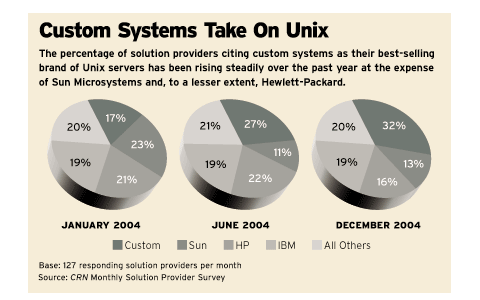
What he has seen with the rise of 64-bit chips from AMD and Intel is more customers who once used 64-bit products from Sun undergoing a change in loyalty—thanks to the lower cost of the Intel and AMD platforms and the progress the two chip makers have made in terms of hardware and software interoperability, Schaffer said.
“I think we are seeing more people coming down from that ultra-high-end Unix world and looking at 64-bit on Intel and AMD. More of them are putting Sun gear in the closet and moving to a more white-box-oriented scenario,” Schaffer said.
Many of the problems that plagued 64-bit processors during their introduction remain—including excessive heat, noise and vibration created by the fans needed to cool the chips. But this obstacle also is being overcome by motherboard vendors such as SuperMicro Computer, San Jose, Calif.
“A main concern the other manufactures of 64-bit systems have is the vibration that occurs when these machines are running. Many serial ATA drives are sensitive to excessive vibration, so we have reengineered our chassis to make them less sensitive to vibration,” Kalodrich said.
“Another one of the big challenges is the thermal properties of 64-bit computing, and we have done advanced cooling designs,” Kalodrich said. “Some feel power consumption is the issue since the memory for [32-bit] Xeon’s was 5 volts and now [the 64-bit chips] have 12-volt memory, so we upgraded our power supply.”