Databases: Microsoft, IBM
One solution provider suggested IBM’s cross-platform roots helped boost its standing. “As more people adopt Linux, plenty will go with DB2,” said Steve Chan, vice president of business development at Ziplip, a Santa Clara, Calif.-based solution provider. “We see a mixed bag of environments, and for the channel, it’s easier and less resource-intensive to deploy one database across operating systems.”

If there is any doubt databases remain a tightly contested category, this year’s Channel Champions survey should remove it.
Microsoft and IBM were in a dead heat, both earning an overall satisfaction rating of 75.4 from solution providers. Oracle was next with 73, closely followed by open-source favorite MySQL with 72.5.
On technical merit, Microsoft, Redmond, Wash., came out on top, pulling a slight four-tenths of a point ahead of IBM, Armonk, N.Y., while IBM squeezed past Microsoft on channel-program satisfaction.
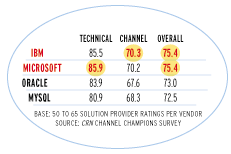
In technical areas, Microsoft received a boost from its price/performance score, where it bested IBM by a healthy margin, although it lagged far behind MySQL, the undisputed leader here. Microsoft’s greatest strength in the survey, though, was in application support. Here It led the pack and was a considerable 4.6 points ahead of IBM. Since most applications run on Windows, and Microsoft is touting the tight integration of its software stack, that win was probably a given.
IBM made up for the difference in scalability, a criterion on which it excelled, edging out Oracle by 1.6 points and clobbering Microsoft by 4.6 points.
| AD | |
|---|---|
| id | unit-1659132512259 |
| type | Sponsored post |
Microsoft has been targeting the enterprise with SQL Server, but the database’s popularity is rooted in departmental and SMB applications, solution providers said. Still, SQL Server is robust enough for most applications, said John Parkinson, chief technologist for Capgemini’s Americas region. “If you have 100 units of problem, SQL Server today covers 85 units,” he said. “There are a few things you might go to other databases for, but that number’s getting smaller.”
On channel criteria, IBM edged by Microsoft. IBM came up strong in the areas of vendor support, keeping solution providers informed and responsiveness to solution provider feedback. Solution providers said IBM has bent over backwards in the past year to attract and retain partners for its middleware products.
Microsoft made up for those weaknesses by besting IBM in the the areas of technical education and total ROI for customers.