The New HP Way?
HP executives have declined to reveal the channel organization and product road maps for the merged company, but last week channel sources familiar with the situation said the 900-member HP-Compaq integration team is leaning toward a dual channel infrastructure. Under that scenario, one executive would oversee higher-end "value" products,including enterprise storage and Unix servers,and another executive would manage lower-end products such as PCs, Wintel servers, printers and imaging, the sources said. No single channel czar would have responsibility for managing HP's entire channel.
\
Concerns about a dual channel structure have solution providers looking beyond the outcome of the Compaq merger vote.
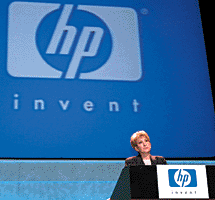
Talk of an HP channel realignment comes amid Chairman and CEO Carly Fiorina's declaration of victory in her five-month proxy battle with dissident board member Walter Hewlett, who claims the March 19 merger vote is undecided until the results are certified.
Fiorina hinted of a dual channel strategy,one for enterprise products and services and one for PCs,in an interview with CRN last month. "We have fixed our channel problems, and we don't want to go backward," she said. "We are going to keep Hard Deck. That program works." HP also would exploit Compaq's direct PC operation in the merged company, she said, citing increased inventory turns and inventory reduction as the impetus.
However, as solution providers await the outcome of the merger vote, some question the rationale for a dual channel approach. "A couple years ago at HP, we had a volume channel and a value channel, and there was very little crossover and understanding. I don't want them to take a bold step forward in merging with Compaq and then take several steps backward in the way they implement [channel strategy," said John Sheaffer, president and CEO of Sysix Technologies, Westmont, Ill.
A two-pronged HP channel might create an unnecessary dichotomy, said Guthrie Chamberlain, president of Venture Consulting Group, Marietta, Ohio. "I think this will be a mess and especially cause confusion in the SMB channel. Most SMB clients don't distinguish between volume and value. It is left up to the integrator to try to get the various machines to work together," he said.
HP and Compaq partners also are wondering about the merged company's channel leadership. The two likely candidates to lead a dual organization are current channel chiefs Kevin Gilroy, HP's vice president and general manager of North America commercial channels, and Dan Vertrees, Compaq's vice president of North America partner sales and marketing. Both executives declined to comment.
Channel executives note that the lack of a single channel czar could complicate the already monumental integration task that HP and Compaq face.
"My message to HP is, two channel managers is barely manageable," said Todd Barrett, networking sales manager at CPU Sales and Service, a Waltham, Mass.-based solution provider. "It could be a point of frustration if this doesn't work out. They will have to learn to work together as a team."
\
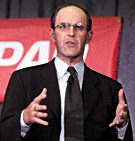
Compaq's Capellas acknowledged the challenges involved in a value-volume channel model.
Indeed, HP's channel strategy was in disarray until the company combined its North American operations under Gilroy as the channel czar. HP then implemented its Hard Deck strategy, in which it named 900 accounts it would target directly, with the rest being the exclusive domain of the channel.
"My business is up 37 percent over a year ago, and a lot of it is due to HP and the Hard Deck initiative," Sysix's Sheaffer said. "[With the merger I will have the ability to sell a more complete product line because a great deal of my customers have HP-Unix and Compaq NT desktops. Now I can address both sides with one vendor. But I will have two separate [channel strategies to sell through."
As HP and Compaq integrate, Hard Deck's dynamics could be upset, said Gary Melillo, vice president of business development at Melillo Consulting, Somerset, N.J. "I don't have a large relationship with Compaq," Melillo said. "HP seems to be behaving according to plan, which means below the Hard Deck [named accounts they let us handle as much as we can. If those accounts were to be defined as enterprise accounts because of the Compaq footprint, what does that do to the channel? We all like Hard Deck, but if it goes from 900 accounts to 2,000 accounts, what does that do to the channel?"
Though channel executives didn't rule out HP's ability to successfully meld value and volume channels into a single strategy, they said having one executive responsible for each segment complicates the task. And Compaq Chairman and CEO Michael Capellas has acknowledged that challenge.
"The real integration happens as you start to go down levels in the organization," Capellas said. "As we all know, it's a communications game."
Some solution providers see promise in separating HP's value channel from its volume business.
"I like it," said Carl Wolfston, director of Headlands Associates, a Pleasanton, Calif.-based storage solution provider. "One of the things Compaq screwed up with its Digital [Equipment acquisition was that Compaq did not understand margin. When Compaq brought in Digital, we lost 15 points of margin in a day. If someone says that [Compaq ProLiant servers and higher-end products get special treatment above and beyond what the vendor offers for PCs and printers, I'm all for it."
Other industry executives said the end of the proxy battle will only help the channel. "Both companies have been completely absorbed by this merger, causing some expected slowdown in the decision-making process. Now it's time to get back to work," said Steve Raymund, chairman and CEO of distributor Tech Data.
Some HP and Compaq partners say they're working with the companies to help shape post-merger channel strategy. "We are trying to give [HP and Compaq the best feedback as to what we think the best channel would look like," said Jerry Lumpkin, senior vice president of marketing at distributor Ingram Micro.
Meanwhile, Sun Microsystems, IBM and EMC aim to exploit any confusion arising from the HP-Compaq integration. Peter Rowley, IBM's general manager of global business partners, said IBM has added more than 200 new business partners in recent months, some of which teamed with IBM because of uncertainty surrounding the merger.
Sun also stands to benefit as the merger saga drags on, said Sun Vice President Gary Grimes, who oversees the vendor's solution provider channel. "With nine or 10 platforms and architectures between Compaq, Digital, Tandem and HP, as a solution provider you have to ask yourself where you should be investing your dollars and which of those architectures is going to survive post-merger and which is going to receive R and D dollars going forward," Grimes said. "You don't want to make the wrong bet because, if you do, it could cost you your company."
Don Swatik, vice president of alliances and information sciences at EMC, echoed Grimes. "There's a lot of overlap between products from the two companies," he said. "Look at StorageWorks and HP-VA [arrays. Both are aimed at the same market. It's hard to argue that both will continue."
No matter what channel structure emerges in the new HP, solution providers must brace for more direct competition, said Mike Mogavero, executive vice president at Data Systems Worldwide, a Woodland Hills, Calif., solution provider and MSP. "The message remains the same, which is don't expect that this [merger is going to improve your relationship with these companies or that it is going to hurt it," he said. "The writing is on the wall: Wall Street is pressuring these companies to gain more efficiencies and telling them they need to increase their share of direct business, whether it is PCs or services."
STEVEN BURKE, JOSEPH F. KOVAR, MIKE CRUZ, SCOTT CAMPBELL and AMY ROGERS contributed to this story.