Making It In The Mainstream
"A year ago in this market, nobody even wanted to talk about VoIP [voice-over-IP]. It was a voodoo word," said Leonard Nichols, integrated solutions sales manager at Tel-Data Communications, a solution provider in Cincinnati.
Now, with its promise of cost savings, ease of management and productivity improvements, IP telephony is the bright spot in an otherwise declining U.S. enterprise communications market, moving its way toward the mainstream spotlight, solution providers said.
Customers used to consider IP telephony cautiously as bleeding-edge technology, but now it's the accepted norm, said John Graven, COO of Computer Telephony Concepts, a solution provider in Mentor, Ohio.
"I had a person call me the other day and say, 'I need one of those IP phone systems.' He didn't even ask for a vendor. That makes it mainstream," Graven said. "We're doing double-digit growth in net new sales because of IP telephony, and the [legacy PBXes] are dying on the vine," he said.
Solution provider Lewan & Associates is seeing 50 percent growth now in its IP telephony sales compared with a year ago, said Fred Cannataro, president of the Denver-based company. He said the company expects to maintain that growth rate over the next several years.
"Customers today are more open to IP telephony, particularly as replacement PBXes," Cannataro said. In addition to savings in long-distance and maintenance fees, IP telephony sales are also driven by unified messaging capabilities and integration with applications such as Microsoft Exchange and Outlook, he said.
While IP-PBXes are not typically the sole telephone systems customers use, many more clients are installing them in branch offices or new buildings, said Greg Merritt, vice president of enterprise marketing at communications equipment vendor Nortel Networks, Brampton, Ontario.
"It's still early adoption in terms of full deployments, but it's definitely reaching mainstream in terms of people using it partially," Merritt said.
A recent market study by InfoTech confirms solution providers' recent experiences.
During the third quarter of 2002, U.S. IP-PBX line shipments (total wired station line ports) grew 40 percent from the same quarter in the previous year. At the same time, traditional PBX line shipments dropped 3.5 percent and key/hybrid station shipments declined 1.1 percent, according to InfoTech.
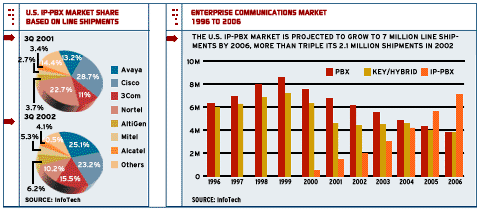
With IP-PBX growth offsetting declines in traditional systems, the overall enterprise communications market grew 2.5 percent during the quarter, InfoTech said.
The company expects the U.S. IP-PBX market to grow to 7 million line shipments by 2006, more than triple its 2.1 million line shipments in 2002.
A significant piece of the market's growth during the third quarter came as traditional PBX vendors put more emphasis on converged systems, which feature an IP-PBX platform but still offer support for legacy digital phones, the report said.
With promotions to convert legacy customers to its new IP Office and MultiVantage products, Avaya saw its line shipments grow by 169 percent to lead the market with a 25.1 percent share, up from a 13.2 percent share in the third quarter of 2001.
Cisco Systems, which formerly held the top spot, had a 23.2 percent share of the market, down from a 28.7 percent share for the same quarter in the previous year. The vendor increased its line shipments by 15 percent.
3Com's IP-PBX line shipments were up 100 percent during the quarter, earning the vendor a third-place finish with a 15.5 percent share, up from 11 percent a year ago.
Nortel Networks, the only top-five finisher to see line shipments decline during the quarter, dropped to a 10.2 percent share after shipments shrank by 36 percent. In the prior year, the vendor held 22.7 percent of the market for the quarter.
The end of promotional offers contributed to Nortel's line shipment decline, as did anticipation for new product launches in the following quarter, Merritt said.
AltiGen Communications, which primarily targets small and midsize businesses, increased line shipments by 71 percent to take a 6.2 percent share of the market, up from a 3.7 percent share in the third quarter of 2001.
In the short term, IP telephony vendors such as Avaya that can draw on an installed base of traditional PBX customers have an advantage over vendors such as Cisco and 3Com, which offer pure IP solutions and do not have traditional telephony offerings, said Frank Stinson, program director at InfoTech.
"You might have customers that are a little bit leery of making a commitment to go over [to] 100 percent IP. They can start with a small number of IP phones, and over time, if they want to play around with it in a year or two, they can do that," Stinson said.
However, companies such as Cisco and 3Com do have large installed bases of their networking gear to build on, solution providers said.
Customers are also taking notice of IP telephony for the improvements in cost savings, productivity and customer service it can offer to contact centers. Many customers use IP telephony to employ home-based agents for better time-zone coverage or integrate tracking of customer contact through calls, e-mail and Web-based chat, industry observers said.
AltiGen, for example, now ships about 47 percent of its IP-PBXes with its contact-center software, up from 5 percent when the software was first introduced, said Richard De Soto, senior vice president and chief marketing officer at AltiGen, Fremont, Calif.
Despite its current growth rate, IP telephony has been slower to catch on than originally anticipated, solution providers said.
The primary challenge now to the technology is the economy, Cannataro said. "The only impediment to IP telephony today is capital spending. It's not an issue of receptivity," Cannataro said. "We're all looking at it and saying it's the direction we see the market moving," he said.
Vendors also still face the challenge of mounting a properly trained channel that is equally comfortable with voice and data issues.
Several vendors said they plan to increase the amount of training available to solution providers over the coming year.