Ties That Bind?
The $3.5 billion deal "is not about combining two consulting businesses," Martino said. "This is about creating a powerful new capability to help clients solve business issues."
But for solution providers, the acquisition complicates another unsolved business question: Just what kind of partner is IBM?

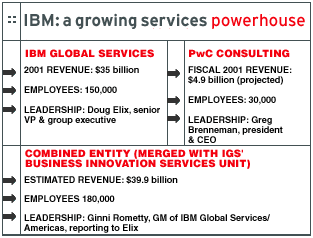
The vendor's IGS unit,by far the world's biggest IT services organization, with 2001 revenue of $35 billion and 150,000 employees,already competes with solution providers of all shapes and sizes with its long geographic reach, broad expertise and deep pockets, channel executives say. The PwC Consulting acquisition, expected to close at the end of the third quarter, stands to give IGS another 30,000 employees and nearly $5 billion of additional annual revenue. That has solution providers wondering about IGS' market ambitions,especially in the lucrative SMB space,and its willingness to subcontract work to channel partners.
"This certainly would make it a harder decision to sign with IBM," said Gary Melillo, vice president of business development at Melillo Consulting, a Somerset, N.J.-based solution provider that's currently being recruited as an IBM partner. Melillo summed up the attitude of many solution providers toward IGS: "They do seem to want it all."
Though IGS' absorption of PwC Consulting would mean one less competitor, IBM's continued evolution into "more of a services company" is impossible to ignore, said Gil Anderson, president and CEO of Caribou Lake, a Minneapolis-based solution provider. "I don't think [the deal will change the way we work with [IGS, because it's already been difficult," Anderson said.
IGS "has never been a real partner to begin with," and the PwC Consulting acquisition cements that stance, said Chris Pyle, president of Champion Computer, a Boca Raton, Fla., solution provider. "It's a one-way street with them," Pyle said. "We sell more IBM services than they subcontract back to us."
However, Martino said solution providers shouldn't fear that the acquisition of PwC Consulting, a unit of New York-based PricewaterhouseCoopers, will foster competition with IGS. Plans call for PwC Consulting to be combined with IGS' Business Innovation Services group to form a new unit that will be headed by Ginni Rometty, currently general manager of IGS Americas.
\
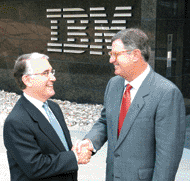
Samuel DiPiazza (l.), CEO of PricewaterhouseCoopers, and Samuel Palmisano, president and CEO of IBM, shake hands after the two companies announced that IBM agreed to buy PwC Consulting.
"I do not believe there is cause for concern here," Martino said, noting that as IBM communicates with partners about the deal, they'll be reassured that the company still wants to work with them.
IBM, for one, stands by its earlier pledge to pass leads involving customers with $100 million or less in annual revenue to channel partners, Martino said. The vendor also sees several areas in which solution providers and IGS can form valuable partnerships, he added.
"The first opportunity we have with our partners is a classic reseller arrangement, and [the PwC deal doesn't change that opportunity," Martino said. In another type of relationship, which he called "asset-based," IGS staff could provide software acumen, vertical-market expertise and other resources to partners. To that end, IBM's channel partners "should be delighted" with the PwC Consulting acquisition, which will add extensive Microsoft, PeopleSoft, SAP and Siebel technical know-how, Martino said.
Other partnership opportunities include "teaming agreements," in which solution providers with unique or specialized capabilities, such as in wireless application development, can work with IGS to augment its portfolio of skills, Martino said, citing IBM partners such as Sirius Computer Solutions. "Together, we can go farther than we can separately," he said.
Raymond Hawkins, a senior account executive at San Antonio-based Sirius, which generates more than $200 million in annual revenue, applauded the PwC Consulting acquisition and said subcontracting works both ways in the solution provider's relationship with IBM.
"What IGS gives us is lots of bodies, skill sets and abilities, and we do some specific things really well that they resell," including wireless applications, Hawkins said, adding that his company is IBM's largest partner for the iSeries (AS/400) product.
While channel executives mull the ramifications of IGS' growing size, Martino stressed that PwC Consulting's broad expertise in CRM, supply chain management and outsourcing was a linchpin of the acquisition.
Price was another enticing factor, say industry observers. Nearly two years ago, Hewlett-Packard sought to buy PwC Consulting for more than five times IBM's $3.5 billion purchase price but later decided to end the negotiations.
Recent pressure on consulting rates has led all IT services companies to enact discounts, which helped deflate the market value of PwC Consulting, said Tom Rodenhauser, president of Consulting Information Services, Keene, N.H. "I've heard [discounts of 40 percent and more," Rodenhauser said, adding that the consulting sector may start rising from its current doldrums by year-end. "IBM is betting as much by doing this acquisition now," he said.
As enterprises continue to keep a tight rein on IT spending, SMBs have emerged as a high-growth area for solution providers,some of which are concerned that the IGS-PwC Consulting combination could exploit its critical mass to cut in on that action.
"I think some competitors definitely do compete on being able to offer multiple types of services," said Nick Padgett, CFO of Inforte. "We're a consulting and systems integration firm, [but we don't do outsourcing. Some people who offer multiple services try to compete on that." Most of the Chicago-based solution provider's engagements are fixed-price, Padgett said.
The tough economic climate is pushing some services companies to cut their consulting fees to win business, said Mark Belles, senior vice president of global alliances at the Reston, Va., office of Dimension Data. "You have fewer large deals, and as a result you have some firms that are willing to be a little more aggressive in terms of their rate structure," he said.
At SBI and Co., SMB accounts are the sweet spot of business, said Bob Monio, director of strategic alliances at the Salt Lake City-based solution provider, which in the past 13 months has acquired some or all of the assets of e-services firms Scient, Lante, Emerald Solutions and marchFirst. Yet Monio said he hasn't seen IGS target many small-business deals, even though SBI is "very competitive to IGS" in the enterprise space.
"We do deals with IGS," Monio said. "They have programs where we are the go-to partner. [IGS routes business and leads to you." The arrangement works "as long you are willing to route business back to them," he noted. "It could be routed through the hosting business, or through [IBM's WebSphere or DB2 units. There are various facets of IBM you work with."
IGS won't target SMB clients because its consultants typically charge twice as much as its solution provider partners, said Steve Israel, executive vice president at solution provider AMC, New York. Israel estimated that IGS and PwC Consulting's hourly rates could run $300 to $450, compared with $175 to $225 per hour for an AMC consultant. AMC has won outsourcing contracts over IGS with bids that were 20 percent to 30 percent less, he said, adding that last year that range might have been 30 percent to 40 percent.
Other solution providers said they also don't expect an even-larger IGS to aggressively target SMBs. Stephen Allen, president of New York-based Integrated Technology Solutions, said IBM in the past hasn't worked effectively with those clients. When IBM launched its WebSphere line about three years ago, IGS often "wanted to work directly with clients to put together entire systems, along with consulting," Allen said. "Since the Internet bubble burst, I have not found them calling on the smaller customers."
Still, IGS has uncorked a strategy to sell managed services to smaller accounts and formed a unit devoted to winning that outsourcing business. Last month, IGS said it plans to target midmarket customers with Manage It For Me, an array of hosting, security and other managed services that IGS can sell directly or via channel partners.
One of those partners is Red Squared, a Manchester, England-based solution provider. Co-founder John McGuire said the firm was created in 2000 "exclusively with IGS to deliver managed services" such as Manage It For Me. And Red Squared has reaped benefits from its close relationship with IGS. "We've won two big contracts with them in the last six months," McGuire said. "IGS owns the contract, and they sub it back to us."
Other solution providers, however, said they expect the number of subcontracting engagements with IGS to taper off after the PwC Consulting deal closes.
"IBM used to go to tier-one resellers for resources they didn't have or didn't have enough of. But by buying PwC [Consulting, they're gaining a lot of resources so they won't have to go [to partners for them," said John Burke, CEO of JB Technologies, a New York-based solution provider.
Few high-tech executives would argue that IBM doesn't know which side its bread is buttered on. During last week's conference call announcing the merger, IBM CFO John Joyce said roughly 80 percent of the company's profits come from services and software sales. The PwC Consulting deal can only hike that percentage, say channel executives.
IBM recognized long ago that services are the main business driver in the IT sector, said Mike Grainger, president and COO of distributor Ingram Micro. "There is a huge transition in the industry of more and more focus on solutions and less on products," Grainger said. "That's one of the reasons they're leading the way right now."
STEVEN BURKE, SCOTT CAMPBELL, JENNIFER HAGENDORF FOLLETT, MARIE LINGBLOM, ELIZABETH MONTALBANO and CHRISTINA TORODE contributed to this story.