Brand Builders
"We have to differentiate ourselves, and we can't rely on the manufacturers to do it for us," said Brian Okun, vice president of marketing at CHIPS Computer Consulting, a solution provider in Lake Success, N.Y.

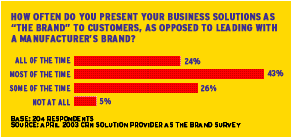
Faced with a tough economy, an increased focus on services, the growing complexity of IT solutions and hit-or-miss vendor product marketing campaigns, solution providers were bound to begin taking matters into their own hands. In an exclusive CRN Research survey of more than 200 solution providers, 65 percent said that over the past six months it has become more important for them to market their businesses as the brand. When asked how often they present their business solutions as the brand, as opposed to leading with a manufacturer's brand, 43 percent said most of the time, with 24 percent saying all of the time. About 79 percent said the strategy increased their sales and profits. In fact, CHIPS increased its business with new and existing customers by 25 percent since it began marketing efforts a few months ago, Okun said.
When asked what caused them to drive their companies as the brand, 46 percent of the survey's respondents cited the need to market multivendor solutions and 44 percent cited the need to concentrate more on marketing services rather than products. Almost 80 percent agreed they've decreased their focus on the product brand and increased their focus on choosing or becoming the brand.
"Customers don't call me looking for a product, they call me to satisfy a business need," said Angie Wong, CEO of Fremont, Calif.-based Network Designs and Ojo Technologies.
These moves by solution providers are catching the eye of others in the channel.
"We're seeing more solution providers promoting their businesses as the brand and moving away from billing themselves as a certified partner of Company X, Y or Z," said Jim Markisohn, vice president of business development at distributor Arrow Electronics, Melville, N.Y. "Solution providers want a differentiation. They need, and many have, some level of brand independence."
Solution provider brand independence is also creating a newfound sense of interdependence among channel players, forcing manufacturers and distributors to create marketing and sales programs better suited to solution provider needs. Many manufacturers and distributors are rolling out new programs or improving old ones with the hopes of gaining solution provider business. And, while solution providers have increased self-marketing efforts, most still look for additional help from their main vendors.
Manufacturers and distributors are keenly aware that to increase their market share among customers they must offer varied and targeted customized marketing campaigns, forge more solution provider relationships at distributors' VAR community events and other conferences, promote VAR partners to end users, and expand multiproduct demonstration centers.
"Marketing has to be much more oriented around solution sets and in identifying the role a particular product plays in a solution," said Pat Collins, Ingram Micro's senior vice president of sales. "It's a very healthy trend because it focuses a lot of energy and marketing efforts around demand creation."
On the manufacturer front, Intel this month changed its channel advertising program and will now pay for a portion of certified partners' own marketing materials, reimburse some of partners' cost of promoting their businesses at seminars or trade shows, and support certain types of solution provider-driven advertising campaigns, said Steve Dallman, Intel's director of North American channel sales and marketing.
"If vendors don't realize the influence solution providers have with their customers, they're making a big mistake," Dallman said. "For the guys who are pursuing their own marketing campaigns, we want to help them offset the costs of branding themselves. That strengthens their marketing push and, frankly, we hope that by helping them, they'll help us."
Hewlett-Packard, through its PartnerOne channel program, increased its co-branded marketing efforts for Platinum and Gold partners and introduced quarterly business agendas to help those partners develop marketing strategies and other initiatives. With last week's unveiling of its new PartnerOne SMB Network, HP is extending many of those marketing programs to smaller solution providers that don't meet Platinum and Gold requirements, said Kevin Gilroy, HP's vice president and general manager of commercial channels for the Americas. HP is also one of the main sponsors of the new Information Technology Solution Providers Alliance, an organization that was launched last week to help promote solution providers to small and midsize businesses.
"The more the solution providers present their perceived value, the better it is for the whole channel," Gilroy said.

\
'WE'RE SEEING MORE SOLUTION PROVIDERS PROMOTING THEIR BUSINESSES AS THE BRAND AND MOVING AWAY FROM BILLING THEMSELVES AS A CERTIFIED PARTNER OF COMPANY X, Y OR Z.' ,ARROW ELECTRONICS' JIM MARKISOHN
For its part, IBM this month is beginning to train solution providers on its ThinkVantage Technologies. Although the technologies, designed to improve customer ROI, are embedded within IBM's PCs and laptops, solution providers can brand them as their own services, said Frank Vitagliano, vice president of distribution channels management for IBM's Personal Computing Division. "Customers don't care because they think it's the VAR's technology and that lends itself to the VAR being the brand," he said.
Meanwhile, Cisco Systems last month launched its Collateral Builder program, a collection of Web-based marketing tools for VARs serving small and midsize businesses. Later this month, Cisco plans to introduce an end-user-based advertising campaign to promote those partners.
Distributors, on the other hand, have traditionally offered a variety of marketing programs, usually backed by manufacturers' market development funds, to help solution providers drive their businesses as the brand. But many of those programs, solution providers said, miss the mark because of their lack of focus and tendency to promote one-off products.
Arrow Electronics, through its North American Computer Products group, is migrating support services away from traditional programs such as lead generation and focusing more on providing custom-tailored marketing solutions, which roll out this month under Marketing Support Services. The new offerings, many of which were derived from Arrow Electronics' own marketing efforts, include strategic marketing consulting, event planning, public relations, corporate identity packages, print and video advertising, and database marketing.
To help solution providers develop high-margin niches, broadline distributors Ingram Micro and Tech Data have increased training, certification and consultative services in vertical markets, with a particular focus on leveraging new Health Insurance Portability and Accountability Act (HIPAA) regulations. They also have expanded their demo labs to include more multivendor solutions. Smaller distributors, such as D&H Distributing, have been longtime supporters of the trend. D&H recently launched a customized rebate plan for solution providers using its Right2U customized e-storefronts.
On the specialty distribution front, Westcon is sharing market intelligence on industry trends and region-specific end-user opportunities, developing business plans, and teaching solution providers how to participate in government buying lists and perform demand-generation seminars. Westcon's MarketVision service, launched last summer, also provides solution providers with branding, e-marketing and other marketing material. "Solution providers have to be consultative in how they go after end users," said Anthony Daley, senior vice president and general manager of Westcon Group North America. "They're technology enablers because the end user today is not buying new equipment like they used to; they're looking to maximize their investment."
These efforts by vendors and distributors are drawing a mixed response from solution providers.
"Most vendors that play in the channel still don't get it," said Bicky Singh, CEO of Future Computing Solutions (FCSi), a solution provider based in Yorba Linda, Calif. FCSi has increased customer retention and penetration, as well as revenue and profit, while differentiating its business through self-marketing efforts. "It's like a relay race," Singh added. "Manufacturers and distributors pass programs on to the channel, then they completely drop them and accuse someone else of fumbling the baton. They need to come up with packages that help VARs transition to, build and drive solutions, not one-off products."
And despite the input of vendors and distributors, solution providers more than ever are relying on their own creativity and customer knowledge to develop marketing strategies that highlight their individual solutions, not a vendor's particular product. Those efforts vary and include everything from running their own print and radio advertising campaigns, contributing "expert advice" columns to local newspapers and national trade magazines, sponsoring end-user-focused seminars and paying clients for additional leads. But the most successful strategies, solution providers said, are typically focused on a particular geography, customer set and well-defined solution.
"We bill ourselves as the brand by holding seminars, attending technology-specific trade shows, and interacting with clients through surveys," said Jennifer Wright, CEO of Wright Business Technologies, a Houston-based solution provider that changed its name earlier this year from The Wright Computer Company to better reflect its solutions focus. "Anytime we're out meeting with customers is beneficial. You don't reach the C-level through e-mail blasts."
John Sheaffer, president and CEO of Sysix Technologies, Westmont, Ill., had to broaden his vendor line about four years ago when two of his biggest customers switched from a Hewlett-Packard to a Sun Microsystems platform. HP now accounts for about 16 percent of Sysix's product business, with Sun and IBM accounting for the lion's share. About the same time, Sysix began marketing its own solutions and has experienced 20 percent year-over-year growth and predicts 30 percent growth by the end of the year.
"Customers used to care about the brand, but the [HP-Compaq] merger opened up customers' eyes that, if there continues to be convergence, they can move from one platform to the other," said Sheaffer, who still counts HP as an important partner. "If we didn't drive our business as the solution and diversify our offerings, we'd be done."