6 Channel Execs You Should Know

The past 12 months have brought seemingly unprecedented turnover in the ranks of the Channel Chiefs considered for this annual list. The highest-profile departures shook up companies from Microsoft to IBM to Hewlett-Packard, which is still seeking a North America executive for its solution provider program.
We could easily have written about any one of those individuals, but this New & Noteworthy list is about innovation and breakthroughs by companies that are emerging, not established, channel forces.

|
Channel Execs You Should Know |
|
|
RED HAT |
|
|
- WORKSHARE |
|
|
ASTARO |
|
|
WEBSENSE |
|
|
SUN |
|
|
PILLAR DATA |
RED HAT
- WORKSHARE
ASTARO
WEBSENSE
SUN
PILLAR DATA
RED HAT
- WORKSHARE
ASTARO
WEBSENSE
SUN
PILLAR DATA
Software is well-represented, from Mark Enzweiler, who is leading Red Hat's aggressive recruitment campaign, to Dave Roberts, who has revitalized Websense's channel program, to Joe Fantuzzi, who more than doubled Workshare's channel revenue in the past two years.
Astaro's Alex Quinonez is an innovator with MSP pricing and in helping security integrators generate demand in new vertical markets.
Storage rebel Pillar Data's Brenda Zawatski is a risk-taker who now pays her internal sales team more for taking a deal through the channel, while Tom Wagner is shaking things up at Sun Microsystems and winning new converts for a company that some had written off just a year ago.
We found the efforts of these Channel Chiefs. and their progress so far, noteworthy. Who else should we get to know? Solution providers are encouraged to send their suggestions via e-mail to CRN Editor Heather Clancy at hclancy@cmp.com.
Next: Mark Enzweiler, Red Hat

Red Hat has promised to deliver a unique channel program for two years but nothing has materialized—until now.
The Linux company's newly appointed U.S. partner chief, Mark Enzweiler, launched the Red Hat Certified Service Provider Program in late January and plans to announce a comprehensive channel strategy and more program details at the end of February.
The former Lenovo and IBM global channel sales executive, an open, affable industry veteran who has spent 19 years in the partner world, was appointed Red Hat's vice president of North American Channel Sales in October.
In that short time, the 50-year-old has been busy crafting a premium program for premium partners that have expertise in both the Linux operating system and open-source application stack. He's hired seven new partner executives, including Petra Heinrich, Novell SUSE's former channel chief, to lead Red Hat's European channel, bringing the total number of executives in the partner team to 13. He has been involved in the ongoing restructuring of Red Hat into a regional-based company with local offices that can better support customers and integrators in each district.
|
|
Channel Execs You Should Know |
|
|
RED HAT |
|
|
- WORKSHARE |
|
|
ASTARO |
|
|
WEBSENSE |
|
|
SUN |
|
|
PILLAR DATA |
RED HAT
- WORKSHARE
ASTARO
WEBSENSE
SUN
PILLAR DATA
RED HAT
- WORKSHARE
ASTARO
WEBSENSE
SUN
PILLAR DATA
Enzweiler's big challenge rests with finding the right set of "high-value" ISVs and system integrators that can deliver fully integrated open-source solutions that combine OS and applications, including Red Hat's JBoss stack. Red Hat also wants to push more license renewals through the channel. To encourage this, the Linux company is recruiting new partners and developing a set of fixed-price solutions with ISV partners and select systems integrators.
Ken Mclaurin, senior marketing manager at Akibia, Westborough, Mass., said he is impressed with Enzweiler's grasp of the evolving open-source channel and Akibia's business model, which combines Linux, open-source applications and virtualization services to deliver data center solutions.
"I have met with Mark several times and came away impressed both with his [knowledge] and his ability to be successful," Mclaurin said. "He is assembling a pretty good team to help him build the channel."
— Paula Rooney
Next: Joe Fantuzzi, Workshare

It speaks volumes when a company's CEO is also its channel chief.
"It's not that the channel reports to me, but everybody who has to work through the channel reports to me," said Workshare CEO Joe Fantuzzi, who also runs worldwide sales for the San Francisco-based software company. "I'm the steady voice."
Likewise, Workshare's channel growth has been steady. When former Autodesk bigwig Fantuzzi joined the document content security startup about two years ago, solution providers only generated about 24 percent of its annual sales. By the last quarter of 2006, however, the company's corps of approximately 200 security and content management VARs contributed 71 percent of revenue, up about 23 percent on the year. Workshare is privately held, so its numbers aren't public, but it just raised a $23 million secondary round of venture capital from investors including Intel Capital.
"The thing that made last year work was that there was much more of a team approach," said Nancy Walker, senior consultant with iEnvision Technology, a solution provider in Lafayette, Calif., with a large practice in law firms and corporate legal departments. "We were working with Workshare from the get-go in crafting a sales solution. ... We were so in tune with each other."
|
|
Channel Execs You Should Know |
|
|
RED HAT |
|
|
- WORKSHARE |
|
|
ASTARO |
|
|
WEBSENSE |
|
|
SUN |
|
|
PILLAR DATA |
RED HAT
- WORKSHARE
ASTARO
WEBSENSE
SUN
PILLAR DATA
RED HAT
- WORKSHARE
ASTARO
WEBSENSE
SUN
PILLAR DATA
One way in which Fantuzzi facilitated this shift was by creating an electronic store exclusively for the use of the channel through which VARs can handle and manage smaller transactions in a more automated fashion. That way, the Workshare channel and sales teams can spend more time on demand-generating activities while the actual transactions are automated. In the months to come, Workshare will add more functionality to this site, including renewal management, Fantuzzi said.
Other plans for 2007 include developing two-tier distribution relationships, starting outside the United States, and introducing a formal back-end rebate program, which will give solution providers incentives for meeting certain sales objectives.
— Heather Clancy
Next: Alex Quinonez, Astaro
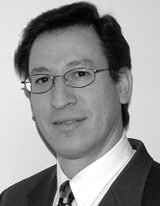
Security vendor Astaro touts a distribution agreement it penned with Synnex as its biggest accomplish-
ment of 2006. Not only is the partnership strategically targeted to broaden Astaro's reach into new markets and verticals, but according to Alex Quinonez, vice president of sales at the company, the overarching plan for 2007 is to double partner ranks along with doubling revenue for top partners.
That's great news for Astaro's biggest resellers—though not surprising. "Astaro seems to always be one of our leading product lines. As for revenue, with [Astaro's] margin programs, it's always been a great asset," said Scott Charles, security engineer at Roeing, an SMB- and education-focused solution provider based in Lafayette, Ind.
To meet this agenda, the Burlington, Mass., security vendor is taking advantage of marketing opportunities, offering technical support and improving distribution via a recently instituted two-tier system with Synnex. "We've put together a half-million-dollar [advertising] campaign, and we're working with Synnex to provide new mind-share and market-share programs," Quinonez said.
In the two years since Quinonez joined Astaro, he has converted the company's direct sales model into a channel model, and consequently, channel-specific revenue rose 50 percent from 2005 to 2006.
|
|
Channel Execs You Should Know |
|
|
RED HAT |
|
|
- WORKSHARE |
|
|
ASTARO |
|
|
WEBSENSE |
|
|
SUN |
|
|
PILLAR DATA |
RED HAT
- WORKSHARE
ASTARO
WEBSENSE
SUN
PILLAR DATA
RED HAT
- WORKSHARE
ASTARO
WEBSENSE
SUN
PILLAR DATA
In addition to Astaro's product line, Quinonez credits this overwhelming takeoff to its market demand generation programs, Web-based training as well as a dedicated team of channel managers. He also has made the product accessible to more MSPs due to pricing and contract commitments.
"We have special pricing for [partners] that gives them a per-month cost on a per-seat basis. Usually, your MSP will have to make a large capital investment and amortize that. ... We give the customer the capability to enter a contract and pay on a monthly basis," Quinonez said.
It's this business mentality that receives kudos from Astaro partners.
"[Quinonez] looks out for the customers that he deals with the whole time, making sure the resellers have the resources they need," Roeing's Charles said, adding that Astaro as a whole demonstrates a true commitment to the channel's wants and needs.
"[Astaro] is in constant contact with us and values the interest in resellers. They take that to the table, and it gets translated into the end product," Charles said. "That helps cater a great product to our customers."
— Elizabeth Dolski
Next: David Roberts, Websense
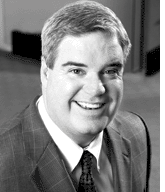
Before sitting down for a meeting with a channel partner, David Roberts, vice president of sales for the Americas at Websense, usually offers his guest a milk shake to break the ice. That simple pleasure may seem unremarkable, but for solution providers, it's an accurate reflection of the down-home friendliness Roberts brings to his job as Websense channel chief.
Since joining San Diego-based Websense in May 2006, Roberts has revitalized Websense's channel program and worked to boost partner profitability and eliminate channel conflict. Before Roberts came to Websense, however, it would have taken something stronger than a milkshake to pacify a channel partner. Websense's channel sales had dipped to around 85 percent when Roberts took the helm, and partners found themselves competing with the vendor's direct sales force. Many partners openly questioned whether it was worth their while to carry the vendor's products.
But in August, Roberts signaled Websense's intention to change its channel course with the launch of a three-tiered partner program that included improved sales and technical training, deal registration and better management of lead distribution. The idea, Roberts said, was for Websense to view the channel not only as an extension of the vendor's sales force, but also as a customer.
|
|
Channel Execs You Should Know |
|
|
RED HAT |
|
|
- WORKSHARE |
|
|
ASTARO |
|
|
WEBSENSE |
|
|
SUN |
|
|
PILLAR DATA |
RED HAT
- WORKSHARE
ASTARO
WEBSENSE
SUN
PILLAR DATA
RED HAT
- WORKSHARE
ASTARO
WEBSENSE
SUN
PILLAR DATA
Roberts has brought efficiencies of scale by moving channel staff to service resellers more efficiently, said Larry Dannemiller, president of security integrator BSSI, a Houston-based Websense Platinum partner. "We're now treated as valuable customers," he said.
Websense's moves to diversify its product portfolio have been another big part of showing its renewed commitment to the channel. In October, the vendor unveiled ThreatSeeker, a technology that scans the Web for threats and blocks them at the network gateway. And in December, Websense acquired data leak prevention startup PortAuthority.
"We've invested in the type of infrastructure to make our channel partners more competitive and to ensure the continued growth of the business," Roberts said.
— Kevin McLaughlin
Next: Tom Wagner, Sun Microsystems

Sun Microsystems, which every few years is written off as a basket case by the financial and press communities, this January reported its first quarterly profit in years and is coming off four straight quarters of revenue growth.
Tom Wagner couldn't have picked a better time to take the reins as Sun Microsystems' vice president of Americas region partner sales. Wagner, who was with Sun handling sales for its telecom vertical in the mid- to late '90s, left for a stint in a couple of dot-coms, then rejoined Sun's communications business in 2003, taking over the channel business when Greg Stroud retired in July.
And Sun couldn't have picked a better man for the job, solution providers said.
Tom Kuni, president of SSI hubcity, a Sun solution provider in Metuchen, N.J., said that while Wagner has not been at the job long enough to have had a major impact on Sun, that impact will be felt soon.
John Murphy, executive vice president of Advanced Systems Group, a solution provider in Denver, called his close personal friend Wagner the right guy at the right time for Sun. "He's a great advocate of the channel," he said.
|
|
Channel Execs You Should Know |
|
|
RED HAT |
|
|
- WORKSHARE |
|
|
ASTARO |
|
|
WEBSENSE |
|
|
SUN |
|
|
PILLAR DATA |
RED HAT
- WORKSHARE
ASTARO
WEBSENSE
SUN
PILLAR DATA
RED HAT
- WORKSHARE
ASTARO
WEBSENSE
SUN
PILLAR DATA
Sun in 2007 is more bullish and optimistic about the business than ever, Wagner said.
And as the vendor starts the long road to recovery, success can only come from aligning its channel strategy to its overall business, he said. But one thing Wagner said he isn't looking to do with the channel is make many changes.
For now, the only major change in discussion is whether to continue its series of mini channel road shows in various geographies or go back to a full-blown partner event, Wagner said.
"We need to let our programs settle in," he said. "Our partners are placing big bets with us. They are looking for us to be predictable and consistent. We owe that to them."
— Joseph F. Kovar
Next: Brenda Zawatski, Pillar Data

At was mid-2005, and Brenda Zawatski had left a job at StorageTek and was looking forward to spending more time with her family when she got the call. Mike Workman, president and CEO of Pillar Data and a colleague from her 20 years at IBM, wanted her to develop his company's channel.
It was an offer she couldn't refuse. So in January 2006, she started as Pillar Data's senior vice president of worldwide sales and marketing with responsibility for both direct and channel sales. Her marching orders? Build a channel program for this startup developer of highly scalable storage arrays that offer tiered storage in a single system for SAN and NAS environments.
On her watch, San Jose, Calif.-based Pillar Data has started a partner portal that ensures that the channel has access to the same tools as the company's own direct sales reps. And the company in September introduced a smaller, channel-specific version of its Axiom array. More recently, it changed compensation plans to give its direct sales reps a 10 percent bonus for taking a deal through the channel. "I hate to say this, but however you pay salespeople is what behavior you get," Zawatski said.
Of course, when your company is funded by Larry Ellison, as Pillar Data is, coming up with new compensation programs can be easier than for other companies. "Larry put the investment in place, so if I say I need a couple million dollars to build the channel, I can get it," she said.
|
|
Channel Execs You Should Know |
|
|
RED HAT |
|
|
- WORKSHARE |
|
|
ASTARO |
|
|
WEBSENSE |
|
|
SUN |
|
|
PILLAR DATA |
RED HAT
- WORKSHARE
ASTARO
WEBSENSE
SUN
PILLAR DATA
RED HAT
- WORKSHARE
ASTARO
WEBSENSE
SUN
PILLAR DATA
Victor Villegas, vice president of business development and alliances at Adeara, Sunnyvale, Calif., said Zawatski brought both a channel focus and several former colleagues with channel expertise. They have done a good job aligning Pillar Data and the channel, he said.
For instance, Zawatski eliminated a controversial $500 spif that partners could earn for simply setting up customer meetings and adopted a new one that pays solution providers $100 for setting up the meetings with new prospects and then another $500 for actually closing the deal.
"She's been able to come in and fine-tune the channel program in a way that's been felt all around," Villegas said.
— Joseph F. Kovar