Bloatware Not In Custom System Builders' Lexicon
In March, Sony decided to charge customers $50 to remove some of the free software on certain configurations. After an uproar, it decided to rescind the charge and offer a bloatware-free option at no cost.
Nearly every brand-name desktop and mobile PC vendor adds so-called "free" software -- bloatware -- which mainly includes trial software, utilities and games in exchange for a chance to share in the revenue should the user decide to purchase the full version of the software.
However, that free software, known as bloatware, can slow down system performance, according to custom system builders. The software is typically built into the system image, which is a collection of customized operating system and application files that are copied onto the hard drive of new systems before they're sold.
Users can remove bloatware in one of two ways. Either the end-user customer or his/her solution provider has to manually remove it once the system is delivered, or the vendor has to manually remove it after the system image has been installed but before the system is shipped.
San Diego-based Sony Electronics said in an e-mail response that it decided to offer "Fresh Start," a $50 option, to purchasers of its Vaio TZ2000 and TZ2500 ultra-mobile PCs in order to "maximize HDD space" in systems "aimed at the professional market where a clean image is more appreciated."
The $50 charge for Fresh Start was implemented thanks to "internal miscommunication between internal groups," but was removed "to maximize end user satisfaction despite the extra cost of creating an ad hoc image," Sony said.
The Fresh Start image is a separate one from the standard image, making it easy to make the change, Sony said.
Now that the Fresh Start charge has been eliminated, users have two choices with their TZ2000 and TZ2500 notebook PCs. Users who choose Microsoft Windows Vista Home Premium as their operating system get the image with the bloatware, including Microsoft Works, photo and video trial software, and a trial version of QuickBooks. Users who upgrade to Microsoft Windows Vista Business for $100 can click on Fresh Start to get the image without the bloatware.
Here's how Sony describes Fresh Start on its configure-to-order page:
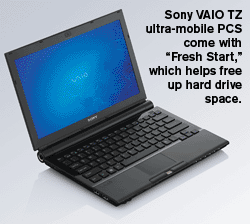
"Opt for a Fresh Start and your VAIO PC will undergo a system optimization service where specific VAIO applications, trial software and games are removed from your unit prior to shipment. Fresh Start safely scrubs your PC to free up valuable hard drive space and conserve memory and processing power while maximizing overall system performance right from the start."
Custom system builders typically do not add bloatware to their systems, with the exception of a trial version of Microsoft Word 2007.
"We want to enhance the performance of the system by not including any unneeded software," said James Huang, product marketing manager at Fremont, Calif.-based Amax Information Technologies Inc.
Hewlett-Packard Co., Palo Alto, Calif., is well-known for its bloatware, according to Joe Toste, vice president of marketing at Equus Computer Systems, a Minneapolis-based system builder.
However, Toste said, he is starting to see more channel interest in the new Vostro line of mobile PCs from Dell Inc., Round Rock, Texas, which are shipped without bloatware.
"Channel partners get suspicious about all this bloatware," Toste said. "They feel that HP or the other vendors are making money on it, but [the channel partners] aren't. This calls into question the integrity of the relationship, with the vendor taking margins out of the hands of the reseller."
In addition, Toste said, bloatwarecan be a hassle. "The channel partner might not want to support an application which customers just click todownload without knowing what it is," he said.
Todd Swank, vice president of marketing at Northern Computer Technologies, a Burnsville, Minn.-based custom system builder, said he sees manufacturers who ask his companies to add bloatware all the time. "It must be effective," he said. "Manufacturers pay to put it in there."
Some vendors are risking losing business by installing too much of the free software. "They like the revenue opportunities," he said. "But they don't care about the user experience. It doesn't show up on the bottom line."
But for custom system builders, bloatware is a welcomed "feature" on name-brand systems, Swank said. "One thing that differentiates systems builders is that we don't load it," he said.