No Wires Attached
Even the more enterprise-oriented vendors such as Trapeze, Pleasanton, Calif., are now angling WLAN products toward the booming small-business market, said Bruce Van Nice, vice president of marketing. “Yes, we have a low-end WLAN product—the MXR-2, which has an entry price of about $995. It’s targeted at both SMB and the branch offices of enterprise customers, he said. “Their thinking is, ‘Why do we want to spend the money to wire this building? Let’s just build a wireless network.’ ”

MB VARs say they’re feeling liberated these days, now that the foundation of a wireless network no longer has to be wired.
Quantum leaps in security and a field of ambitious vendors not content to wait for standardization of higher-speed wireless technology such as 802.11n are making it possible for VARs to deploy WLANs as the initial network infrastructure for small businesses. Companies that literally had no network other than an Internet connection—often used as a quasi-LAN to move data to a PC in the next room—now can be moved right into a WLAN, leapfrogging a wired LAN and its server and switch components altogether, VARs say.

But wait. Won’t VARs lose revenue by not first selling that server, that switch and maybe even a NAS box, all of which traditionally comprise the baby steps of an IT network? Not so, says Kristine Scott, vice president of sales and marketing at Computer Supply, a VAR and wireless infrastructure integrator in Tacoma, Wash.
“There’s a big upsell to wireless,” she said, “because most of our small-business customers think, understandably, kind of carefully at first, not realizing how mature the wireless stuff has become or how far they can extend a wireless network.”
With small-business wireless, solution providers also have the ability to “downsell” the wired network, Scott said. “You sell them the wireless LAN, then you’ll be there when they need a wired LAN, higher-speed connections, things to help them grow, ways to connect to storage,” she said.
| AD | |
|---|---|
| id | unit-1659132512259 |
| type | Sponsored post |
And it’s not a hard sell, she said. The current inflection point of advanced wireless technology and demystified customers conditioned by the pervasiveness of cell phones means that small businesses moving right to WLANs aren’t held back by “early adopter syndrome,” Scott said. With WLANs, small-business customers don’t see themselves taking the same kind of risk that companies issuing PDAs in the late 1990s did, she said. Today, three-seat law offices, small accounting firms, family-owned motels and even the satellite offices of larger, already wired businesses can reap the benefit of deploying a WLAN from scratch.
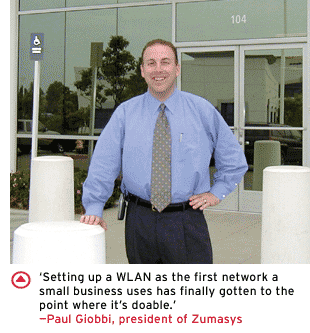
“Setting up a WLAN as the first network a small business uses has finally gotten to the point where it’s doable,” agreed Paul Giobbi, president of Zumasys, a Trapeze Networks partner in Lake Forest, Calif.
Giobbi said that very often in today’s business environment, large distributed businesses sprout small-business environments that can be networked without the need for a fixed LAN to be deployed first. These opportunities include franchised retail and food-service locations such as Starbucks and Arby’s, and small outdoor businesses such as plant nurseries and garden supply stores. Small-business environments such as these typically don’t require the level of bandwidth associated with data-intensive networks supporting fleets of clients or a heavy wireless transaction area such as a stock trading floor, Giobbi said.
And if a small business’s upstart wireless network requires a more powerful WAN back end to support the wireless router, firewall and a few access points, then Giobbi has the answer for that, too. “We can put it all on one small server in the data center and then, using Citrix, all the satellite office needs is a wireless network and a browser back to the main office,” he said.
More often than not, Scott said, a small business primed to catapult right to a wireless network is not a savvy corporation’s satellite office, but that classic small business without an IT staff that’s probably already halfway down a circuitous route toward setting up their wireless network.
Scott said she can pick out these types of small businesses just by driving down Tacoma’s main drag and scanning for WLAN signals still operating on their unsecured, default settings, she said, jokingly refusing to call the practice “lead generation.”
“You can go through downtown and find networks that haven’t changed the default setting, like a lot of hackers who know these unprotected networks are easy to piggyback onto and get online,” Scott said.
Most of these unprotected networks began their lives on the shelf of a Best Buy or CompUSA. But the fact that many small businesses are self-starters when it comes to deploying a WLAN is not a bad thing for VARs, Scott said. The job of selling these businesses into wireless is done, and the more lucrative job of improving and securing the WLAN can begin.
VENDOR ROLE The wireless-first trend is being helped along by recent offerings from Linksys, Belkin, Netgear and D-Link Systems. This group, along with other vendors and application developers, is delivering wireless performance today that can mimic the speedy 108-Mbps transmission rate that larger enterprises will begin to adopt when the IEEE standardizes 802.11n within the next two years.
These vendors are working to increase partner awareness of the opportunity “pre-n” technology presents to small businesses. For example, Linksys has distributed a flurry of Multiple Input, Multiple Output (MIMO)-related educational and promotional material through its reseller channel, and it has made demo units available to its Partner Connection members. With MIMO, multiple antennas are used to send simultaneous data streams, which can double the data rate and improve the range of wireless connectivity.
Irvine, Calif.-based Linksys also is motivating its tier-two distributors such as Ingram Micro and Tech Data to communicate the value of its pre-n products to small-business resellers.
Channel-oriented pre-n promotional efforts from Belkin are also paying dividends, said Mark Reynoso, senior vice president of sales and marketing at the Compton, Calif.-based vendor. “Third-party testing of our pre-n products has also helped VARs effectively sell the product into the SMB market,” he said.
Slowing the arrival of the 802.11n standard is a drama unfolding between two wireless standards advocates: the WorldWide Spectrum Efficiency Group (WWiSE) and the Task Group N (TGn).
The WWiSE guys, who wish the n-standard would remain in the same band and channel range as 802.11b and 802.11g for compatibility’s sake, were recently outvoted by the TGn, which prefers to see a higher band and boosted channel range. But the vote was nowhere near a landslide (56 votes to 44), and a struggle continues for the required two-thirds majority for ratification of a new standard.
In the meantime, Belkin and Linksys are offering high-speed wireless gear that employs the MIMO technique used in the n-standard.
Others, such as Netgear, incorporate hot-rod antenna technology from third-party vendors including Video54. The Mountain View, Calif.-based company’s BeamFlex technology enables the Netgear wireless antennas to make adjustments that compensate for weak or distorted signals. The resulting performance boost delivers 45 percent more range and up to 20 percent more speed than MIMO, said Vivek Pathela, senior director of product marketing for consumer products at Santa Clara, Calif.-based Netgear.
WHERE THE ACTION IS Vendors say they’re pushing pre-n wireless technology toward home and SOHO integrators right now because it’s where the action is for pre-n wireless performance tools. Large businesses with formal IT organizations must explain their decision-making based on rigid ROI, and most will wait for 802.11n to become official before recommending broad investments in higher-speed WLAN technology.
“Most of the activity [with pre-n] is down at the SOHO and even the consumer level,” said Rocky Rosas, technical marketing engineer at D-Link, Fountain Valley, Calif. Unlike larger companies, small businesses have the agility to “look for what it takes to get the immediate job done: better performance at a greater range.”
Strong vendor partnerships help VARs such as Computer Supply stay competitive in the small-business market, Scott said. A typical WLAN deployment in a small business, depending on environment and building structure, costs between $1,000 and $1,500, she said. But from vendors, “you can get good back-door spifs [to help compete] against other resellers and retail chains. … And you’ve got to have those partnerships because the hardware has no margin,” Scott said.
“There has to be service behind it, and that’s what differentiates us—the IT service we can provide,” she added.
Vendors themselves are surprisingly candid about the positives and negatives of their pre-n standard high-speed WLAN products, mostly because they’ve pretty much covered all the bases as far as being able to provide security and manageability.
“Let’s face it, with a wireless network you are not going to get the speed of a wired network,” said Kevin Allan, director of product management at Netgear. “But the technology is there to forge a solid wireless network from scratch.”
Netgear offers small-business integrators pre-n WLAN products such as the new WG302 Business Class Access Point, which brings a load-balancing tool to small-business WLANs.
“What’s cool with the WG302 is something called AutoCell,” Allan said. “It’s essentially RF management. If you use a number of these APs [access points], instead of letting them sit on the same default channel, like Channel 6, it employs a cognitive RF capability and automatically moves an AP to another channel, which improves bandwidth because you don’t have all the APs stepping on the same channel.”
For a small business whose security policy requires that all access points run on the same channel, the WG302 can be set to automatically power up and down APs that are the most in use at any given moment, again preserving bandwidth for the airwaves being used, Allan said. And graphical interfaces that display signal range, along with advanced user authentication, give even more manageability to small-business users, Allan said.
For resellers, Netgear’s pricing can position a VAR to deck out a 10-seat office with three APs and an eight-port Power-over-Ethernet switch for less than $800. “We want to support all the VARs who are touching the mom-and-pop shops,” Allan said.