Getting Right With The Channel
Just two years ago, McAfee was in trouble. Then called Network Associates, the company was suffering from stagnant sales of its Sniffer network management and Magic help-desk offerings. Its channel was a mess, with partners shying away from the vendor as its habit of cherry-picking deals and taking them direct became more prevalent. And the security side of its business continued to lose share to market leader Symantec.
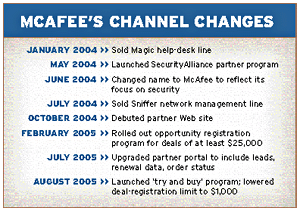
After shedding Sniffer and Magic in 2004, the pure-play security vendor now known as McAfee decided to turn over a new leaf and embrace the channel with a zeal rarely seen in the technology industry. Over the past nine months, the company has restructured its sales department and IT systems to optimize them for partners, doubled its staff dedicated to supporting the channel, reduced its direct-sales force by 90 percent, and cut the number of direct accounts from the hundreds to just 10.
And the channel is taking notice. The Santa Clara, Calif.-based company has added nearly 1,000 new partners since October and issued more than 5,000 sales and technical certifications. Channel sales have moved from about 60 percent in 2002 to more than 90 percent today.
“They have really turned themselves around,” said Jim Hindy, CEO of Entre BTG, a Norcross, Ga., solution provider. “They have taken themselves from a company with a very mixed message and strategy to a singular force in the security industry. The change has been dramatic.”
The result? The company has posted strong sales growth in the past three quarters and profits are on the rise. Indeed, finding channel religion may have saved McAfee&'s soul.
“We changed the relationship with our partners, and it&'s proven to be a tremendous help for our business,” said George Samenuk, McAfee chairman and CEO. “It was a fundamental shift from a 60 percent channel company to a nearly 100 percent channel company, and it is working.”
Samenuk said the company posted growth of 28 percent in the fourth quarter of 2004, its first quarter as a pure security player focused on the channel. That was followed by 36 percent growth in the first quarter and 32 percent in the second quarter of this year. “The channel was critically important to achieving those growth rates and profitability,” he said.
The change from a direct company to a channel company “was not an easy task,” said Kevin Weiss, McAfee executive vice president of worldwide sales, services and support. “It was beyond a struggle. It was a religious war.”
Despite an uptick in growth after the sale of its Sniffer and Magic units, even 2004 “was an absolute disaster for us,” Weiss said. “In the SMB space, we lost share quarter after quarter. We were struggling to make our numbers in North America, so we weren&'t doing something right,” he said. “But by the fourth quarter, we knew we had the programs in place and were developing the systems that would help us come out of it. We knew we were on the right path.”
That path, said McAfee President Gene Hodges, was a full-scale change in how the company does business. “We had to change our internal systems to make it easier for partners to do business with us,” Hodges said. To deal with the legacy of a company that would take partner-initiated deals direct, the company changed its internal systems so that salespeople cannot sell except through a partner. “Our sales force simply cannot produce a direct quote,” he said. “That stops them from making direct sales.”
The company had some 120 telesales reps calling on SMB customers, which “irritated both the partners and the end customers,” Weiss added. That number has been reduced to 10, and the reps currently work in conjunction with partners instead of around them, he said.
In addition to changing its sales force, McAfee also had to change its channel program and products, Hodges said. McAfee knew the key to growth and success in today&'s environment was the channel, especially with industry heavyweights like Cisco Systems and Microsoft entering the field, he said. “It would be impossible for McAfee to compete effectively with Microsoft or Cisco. It would be impossible for us to outsell them—a fool&'s errand,” he said. “But it is possible for us to build better products and a better channel program, and that&'s what we&'re doing.”
A linchpin of McAfee&'s effort is the SecurityAlliance channel program and its MAX partner portal, launched in October 2004 and significantly enhanced in July, Hodges said. “We knew that the best way to build trust with our partners is to let them know everything that we know.”
The upgraded partner Web portal, which gives partners access to prequalified leads, renewal data and order status information, also serves as a platform for partners to communicate directly with McAfee channel and sales teams.
David Roberts, senior vice president of North American channels at McAfee, said the new version of the portal is proof of the company&'s yearlong effort to transition from a direct sales-focused company to a channel-focused company. “It&'s one thing to say you want to be a channel-friendly company, but it&'s a different step to look at all of your back-end systems and optimize them for dealing with the channel.”
With the new portal, “the concept of partner relationship management and customer relationship management goes away at McAfee,” Roberts said. “Our partners and our field sales people now use the same system.”
Robb MacMillan, security practice lead for Intermountain Technology Group, a solution provider and McAfee partner in Boise, Idaho, said the changes to the partner portal are significant. “This really puts us on the same page with McAfee,” he said. “I can go in there and see the deals we&'ve been working on with McAfee reps, the deals we&'ve registered and which customers are coming up for renewals, all in one place.”
Continuing its push to drive channel sales, the company also last month rolled out McAfee Rewards, a sales incentive program targeted at employees of solution providers in McAfee&'s SecurityAlliance partner program.
Under the program, partner sales managers, sales reps and sales engineers earn points for sales of McAfee products that can later be redeemed for merchandise, Roberts said. The program is slated to run through December 2006, Roberts said.
And this week, the company is launching its “try and buy” program, which lets partners get demos of McAfee&'s high-end equipment into the hands of customers at no cost. “We know when we do trials, the customer usually buys the product,” Roberts said. “So we are moving the trial process out to partners.” Under the program, partners bring the opportunity to McAfee and the company will configure the product and ship it to the customer, he explained. Because the VAR never takes title of the product, it puts the cost of the deal on McAfee instead of the partner, he said.
The company this week also is restructuring its deal-registration program to make it more accessible for SMB deals by lowering the deal limit from $25,000 to $1,000, Roberts said.
On the product side, McAfee is retooling its lineup with the channel in mind as well. Next month, the company will enter the unified threat management arena with a secure content management appliance targeted at the SMB space. The new product was the driving force behind lowering the deal-registration limit, Roberts said.
In July, the company launched a 21-day free trial offer for its Foundstone On-Demand Service, a hosted version of its Foundstone vulnerability management technology. The service is typically sold on an annual subscription basis.
McAfee&'s SecurityAlliance partners will be able to take the free trial offer to customers, Roberts said. In addition, partners will receive support from assigned technical account managers during the trial.
The service provides automated vulnerability assessment via scans of Internet-facing devices, and delivers threat alerts, threat correlation and compliance assessments, Roberts said.
Sean Stoutmeyer, director of professional services at Software Medium, a Dallas-based McAfee partner, said the free trial could sway customers who are initially worried about the cost of such a service.
“The cost can be ‘over and above&' for customers unless they see what it can do for them,” Stoutmeyer said. “The free trial helps seal the deal.”
Hodges said the offerings are part of a strategy at McAfee that will turn its partners into managed service providers in the SMB space. “We think security in the small-business space is going to be a service because it&'s so complicated,” he said. “So we are developing our products so that they can be managed by the partner.”
All of McAfee&'s hard work is paying off, as evidenced by a new stable of VAR converts.
Entre BTG&'s Hindy said his company has increased its involvement with McAfee since its new channel focus. “They have been very focused on partnering with us,” he said. ”They have improved dramatically in the last year, and you can see that in our numbers. In all of last year, we bought $750,000 worth of product from McAfee. This year, through June 30 we were at $2 million.”
Bob Roddewig, sales manager at Prosys Information Systems, Norcross, said his company too has increased its McAfee business. “We don&'t work well with companies that are half-direct and half-indirect. It&'s like being half-pregnant,” he said. “So we sold McAfee before, but it was more reactive. If a customer asked for it, we would sell it to them.”
But since McAfee&'s channel makeover, “It is much more proactive,” Roddewig said. “We&'ve gotten a lot more training, more collaboration with the McAfee sales team, and that just naturally leads to more sales.” Will the channel propel McAfee to the top of the security heap? Time will tell. But if the company keeps its promise of continuing to roll out channel-friendly products and programs, it will no doubt have a faithful flock of partners.