Making Virtualization Real
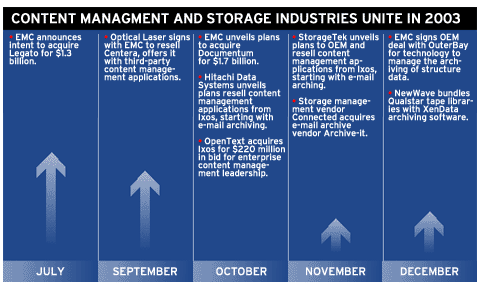
Tucci, for his part, is doing his best to create change. In the past year, he has spent more than $3.5 billion in cash and stock to acquire four software companies.
"Storage will change more in the next three years than it has in the last decade," Tucci said after EMC's stunning $635 million acquisition of VMware in December. "I am totally committed to that. You've got to pick what kind of company you want to be. EMC is going to be a leader."
EMC's acquisitions point toward where Tucci plans to lead: the open systems software market. In particular, EMC's latest acquisitions give the company its first midrange and entry-level storage management technology thanks to Astrum and Legato Systems, as well as e-mail archiving via Legato, content management with technology from Documentum, and leading server virtualization capabilities from VMware.

Tucci said the acquisitions, combined with EMC's own technology, can create a "game-changing" shift that opens the door to the "Holy Grail of virtualization" in the storage and server world. As part of EMC's information life-cycle management (ILM) and content management strategies, EMC software has already been virtualizing storage devices from a common pool of storage resources. With VMware, servers also can be virtualized, allowing both server and storage resources to be provisioned as needed. Virtualization makes storage more nimble and adaptable, enabling customers to utilize all of their investment and thereby boosting ROI.
These actions come as EMC, Hopkinton, Mass., looks for new ways to compete in a quick-moving storage environment. While the company's storage hardware business has pretty much bounced back after the dot-com bust, EMC still faces a sea of change in the storage software space as key competitors, including Hewlett-Packard, IBM and Veritas Software, make gains toward embracing the utility computing model, under which storage and server management and provisioning become increasingly automated. Such moves threaten to commoditize the storage hardware business, on which EMC originally built its fortunes.
Furthermore, HP, IBM and Sun Microsystems are beefing up their storage software capabilities to protect their market positions and piggyback storage sales on their server sales. EMC, without a server platform, needs the software to differentiate itself and continue to be in customers' data centers regardless of server platform.
EMC executives said now that the company has made its necessary purchases, the primary tasks are to integrate the newly acquired technologies into complete customer solutions while making sure that each of the acquired companies continues to partner on its own with solution providers and platform vendors, some of which are among EMC's most bitter rivals.
Solution providers generally appear to view the acquisitions as smart moves.
In a departure from the usual concerns about the effects on the channel from changes at EMC, none of the several solution providers contacted for this story, including those who do not partner with EMC, said they see the acquisitions as anything but positive. They expect EMC's consolidation of the various technologies to mean more opportunities and to make it easier to tie non-EMC hardware and software into EMC products.
Marc Duvoisin, national practice director for enterprise servers and storage at Dimension Data, an Atlanta-based solution provider and partner of EMC, Legato, Documentum and VMware, said the acquisitions are good news for his company and the channel. Duvoisin said that after EMC purchased Legato, for instance, it said it would combine both companies' data replication software and asked solution providers what they needed. "What they don't want is to make people think [Legato] NetWorker only works with EMC disk," he said. "They are very careful to become a heterogeneous storage company. This is moving them into the heterogeneous space."
Phillip Hice, director of technical services at Computer Configuration Services, an Irvine, Calif.-based partner of IBM and VMware, said he is excited by the VMware buyout, even though his company competes fiercely with EMC. "EMC, for as much as they sell storage hardware, is still a software vendor," Hice said. "I'm looking forward to see what EMC will do to optimize their storage to run better with VMware. If they can do it, it is a win for me from the customer standpoint."
In fact, one solution provider said the integration of at least one of the acquisitions was so smooth as to go almost unnoticed. Kevin Reith, manager of strategic technology at Wilmington, Del.-based Info Systems, said it was six months after the fact before he knew EMC had bought Astrum, even though Info Systems partners with both vendors.
That transparency is just what EMC wants as it sets out to prove it is an open systems software vendor and not looking to build proprietary technology.
Howard Elias, executive vice president of corporate marketing in the office of technology and new ventures at EMC, said the company's goal is to remain open and heterogeneous across the storage, server, network and application layers. "We continue to partner with others and are even more open than in the past," Elias said. Legato, Documentum and VMware are separate divisions within EMC, he said, adding that they are becoming part of the integrated solutions it offers while also being stand-alone solutions. "We will work with others, including IBM, HP, Sun and Network Appliance, to give customers choice and let them buy the solutions they want," Elias said.
David Goulden, executive vice president of customer solutions and new business development at EMC, said that this approach enables the company to make its acquisitions very channel-friendly. EMC direct-sales reps can get credit against their quotas for Legato and Documentum sales into their enterprise accounts, Goulden said.
However, that will not be the case for VMware in order to make sure server vendors are convinced there is no channel conflict, he said. For all three technologies, EMC's direct reps are incented to use indirect channels as additional sales resources, he said.
However, the sales organizations of the acquired companies will not be incented to bring EMC into their accounts, said Goulden. "They are incented to use any channels they need," he said.
So, while working hard to integrate its new software offerings into complete customer solutions, EMC must also work to assure the partners of those acquired companies that it is committed to their channels, company executives said.
For example, at Legato's annual solution provider conference in Phoenix last week, a record crowd of more than 500 attendees from 230 companies, many of which were new to EMC, heard presentations from Tucci and David Dewalt, president of Documentum, on how partners are a vital part of EMC's future growth, said Nick van Wyk, vice president of sales and operations at Legato.
And so far, EMC has managed to convince many of its storage rivals that it is sincere in continuing the technology alliances it inherited with the acquisitions.
Agreements signed by Network Appliance to extend its Documentum alliance and IBM to resell Legato software after EMC announced their acquisitions were cited by Tucci as proof of his company's commitment to open systems software. "[They show] how committed we are to remaining open in this part of our business," he said.
HP's relationship with VMware is expected to continue as before, despite the EMC connection, said Nick Van Der Zweep, director of virtualization and utility computing at HP.
-- Phillip Hice, Computer Configuration Services
Van der Zweep said Diane Greene, president of VMware, assured HP it will continue to improve its software's capabilities and will release its software developer kit as originally expected. "She told us she is looking to add more ties to both HP and EMC storage," he said.
IBM Tivoli plans to continue reselling Legato and VMware software, said Theresa O'Neil, director of storage strategy for the company. "We don't see a change in the way we work with the two," she said.
Even so, EMC has much work to do before convincing the industry it can keep its new acquisitions completely independent from its legacy business.
Frank Orlando, manager of HP's ILM partner program, said his company has yet to see changes in how it partners with Legato, but it is waiting for the other shoe to drop.
"Legato said it is not going to change," Orlando said. "But if it doesn't change, customers will wonder how EMC expects to get their investment back. If they don't change, how can they justify their investments to their stockholders?"
A Veritas spokesperson said Network Appliance recently signed new agreements with the company for backup and recovery storage software in an effort to distance itself from its traditional partner, Legato.
Industry observers are waiting to see what is next for EMC in its quest to dominate open systems software.
Tucci, who told CRN in June that he was "purposely hunting" software vendors, sang a different tune in December after the VMware acquisition. "There's nothing else I am looking at with any substance or size," he said. "Our focus is on chewing what we have put in our mouth."
STEVEN BURKE and JOHN LONGWELL contributed to this story.