Jensen Huang Uses Computex 2026 To Showcase Nvidia’s Next AI
Nvidia CEO Jensen Huang once again grabbed the spotlight at Computex 2026, outlining his company’s next phase of AI infrastructure and computing.
Nvidia stole the show again at Computex 2026 with Jensen Huang delivering his keynote on GTC Taipei on the sidelines of the premier tech summit. The two-hour GTC Taipei keynote saw the Taiwanese CEO reveal several innovations as well as updates to its supply chain on its new chips.
“Useful has arrived. From an industry perspective, tokens are now in extraordinary demand. Tokens are now profitable units of revenues. Because it is now profitable, the AI companies want to build a lot more tokens, generate a lot more tokens and build more AI factories. This is the reason why compute demand here in Taiwan has skyrocketed,” said Huang, founder and CEO of Nvidia.
“The compute pattern has changed. Everything has changed. So, the first idea is that useful AI has arrived. AI is now a profit generator. AI is now a GDP generator. Behind it is a whole new kind of computing pattern. Not just a large language model, but an agent. Today, almost everything we’re going to talk about is going to be based on this,” he said.
Here are three key takeaways from Huang’s keynote at Nvidia GTC Taipei.
Vera Rubin Is In Production
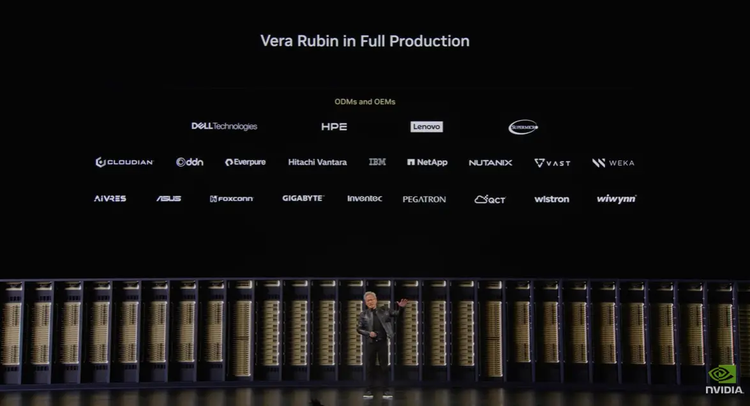
According to Huang, Vera Rubin is the most ambitious endeavor in the history of the company. Despite global supply chain concerns, Huang said that the Nvidia Vera Rubin platform is ramping into full production to power agentic AI factories worldwide.
“Vera Rubin is in full production. The supply chain we created for Vera Rubin is twice as large as Grace Blackwell. What used to take two hours to assemble one Grace Blackwell rack now only takes 5 minutes. Not only is the capacity higher, but the throughput is also a lot faster. And we need it all to support the demand. This ecosystem is extraordinary. Millions of square feet have been put online to support Grace Blackwell and preparing now and ramping up Vera Rubin. Vera Rubin is in full production,” he said.
Capable of delivering Nvidia’s most extensive POD-scale platform, Vera Rubin’s five purpose-built racks operate as one massive AI supercomputer for agentic workloads. The platform unifies Nvidia Vera Rubin NVL72 systems, Nvidia Vera CPU, Nvidia Groq 3 LPX, Nvidia Vera BlueField-4 STX storage and Nvidia Spectrum-6 SPX Ethernet racks into a fully integrated system.
“Agentic AI is a new kind of workload. One prompt can launch a thousand-step journey of reasoning, retrieval, tool use and response generation. Vera Rubin was built for this moment—an AI factory engine that delivers intelligence at scale, with the performance, efficiency and security needed to power the next industrial revolution,” he added.
Nvidia RTX Spark
Nvidia also unveiled a new superchip for the Windows PC for the era of personal AI agents. The Nvidia RTX Spark is designed for AI, creating and gaming in collaboration with MediaTek.
The RTX Spark superchip features an Nvidia Blackwell RTX GPU with 6,144 CUDA cores and fifth-generation Tensor Cores with FP4 precision, connected via the Nvidia NVLink-C2C chip-to-chip interconnect to a high-performance, 20-core Nvidia Grace CPU.
“The PC is being reinvented,” said Huang. “For 40 years, you launched apps. Click. Type. With RTX Spark and Microsoft Windows, you ask—and the PC does the work. RTX Spark brings everything Nvidia has built—CUDA, RTX, our AI platform—into a single superchip. Local agents. Frontier models. Creative workflows. RTX games. All on a laptop. This is the new PC. The personal AI computer.”
Huang is expected to share more on this with Microsoft Chair and CEO Satya Nadella. RTX Spark laptops and compact desktops will be available this fall from leading manufacturers including Asus, Dell Technologies, HP Inc., Lenovo, Microsoft Surface and MSI, with models from Acer and Gigabyte to follow.
Nvidia Vera CPU
Huang also announced Nvidia Vera, a CPU built for AI agents. Nvidia Vera is a new class of processor enabling 1.8X faster task completion compared with x86 CPUs to drive diverse workloads across industries, including agentic AI, reinforcement learning and data processing, generating more data center token revenue.
“The economics of the AI factory is tokens, and the tokens are created here. Of course, you want to manufacture and generate as many tokens as possible. This is where you put all of your economics, and this has to not be in the way. Vera CPU has great pressure on the CPU architecture, which is the reason why we built a brand-new architecture from the ground up, a CPU the world has never seen before. We call it Vera. This is CPU for agents. All the CPUs of the past we built for humans. This CPU is built for agents,” Huang said.
According to Huang, Vera takes CPU performance and energy efficiency to new levels for the most demanding AI workloads in modern data centers.
“AI agents will be the largest users of computing,” said Huang. “Vera is the first CPU designed for that future—built to run agentic AI at hyperscale with extraordinary performance, efficiency and programmability.”
The Vera CPU can also be deployed across the full AI factory—from the stand-alone CPU infrastructure to tightly coupled accelerated systems. Vera helps AI factories deliver higher end-to-end throughput and faster time to solution for users, improving responsiveness and efficiency across training, inference and agentic execution.
Other Nvidia Announcements
Apart from the three big announcements, Huang also announced several other innovations including Nvidia Cosmos 3, an open world foundation model for physical AI built on a breakthrough mixture-of-transformers architecture that combines vision reasoning, world generation and action prediction in a single system.
As the world’s first fully open omnimodel, Cosmos 3 can natively understand and generate text, images, video, ambient sound and actions with leading physics accuracy, reducing physical AI training and evaluation cycles from months to days.
Also announced was an open-source collection of physical AI agent skills and tools spanning Nvidia Omniverse, Cosmos, Alpamayo and Metropolis for robotics, autonomous vehicles, vision AI and industrial digital twins. These new physical AI skills turn complex physical AI training, evaluation and deployment workflows into repeatable, optimized and agent-executable instructions.
This article originally appeared on CRN sister website CRN Asia.