Midmarket IT Leaders Optimistic For 2026, Make Plans To Spend Big On Solution Providers
MES Computing’s IT Leaders Spending Intent survey results show IT leaders are ready to spend on value-added resellers, MSPs and cloud service providers in 2026.

Despite turmoil in the geopolitical arena, midmarket tech leaders are optimistic going into 2026 and are poised to make heavy investments in partner relationships with value-added resellers, MSPs and cloud service providers this year.
While many leaders did not spend big bucks on AI projects in 2025, they said that their focus this year is on using AI to help with two critical operations: cybersecurity and incident response as well as business process automation.
Over 100 senior midmarket leaders were polled at the end of 2025 for MES Computing’s IT Leaders Spending Intent survey. The majority of respondents hold senior technology and procurement roles at organizations with 100 to 499 employees. The respondents represented a wide range of verticals including manufacturing, energy, banking, retail and the public sector.
A majority (30.5 percent) said their IT budgets increased 5 percent from 2024 to 2025, while 29.3 percent said there was no change in their budgets.
Where The IT Money Is Going
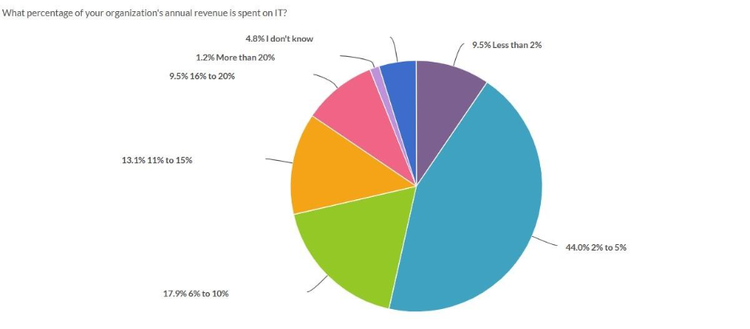
Forty-four percent of midmarket IT leaders surveyed said that 2 percent to 5 percent of their organization’s revenue is spent on IT.
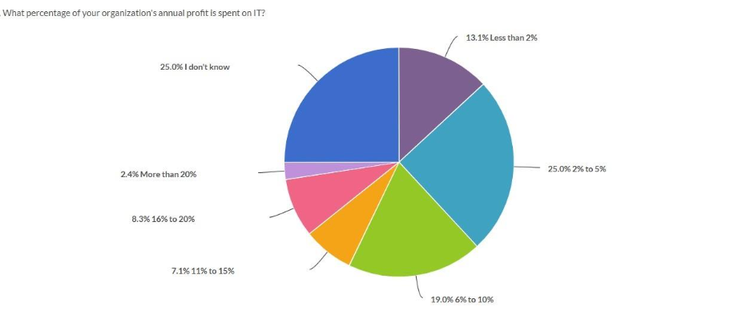
Twenty-five percent said their organization’s annual profit spend on IT was also 2 percent to 5 percent, although an equal percentage said they did not know how much of their organization’s profit was spent on IT operations.
The majority (27.7 percent) said that 21 percent to 50 percent of their organization’s IT budget was spent on cloud services.
Most said that their IT budget was also spent on resellers, MSPs and systems integrators (26.5 percent of respondents).
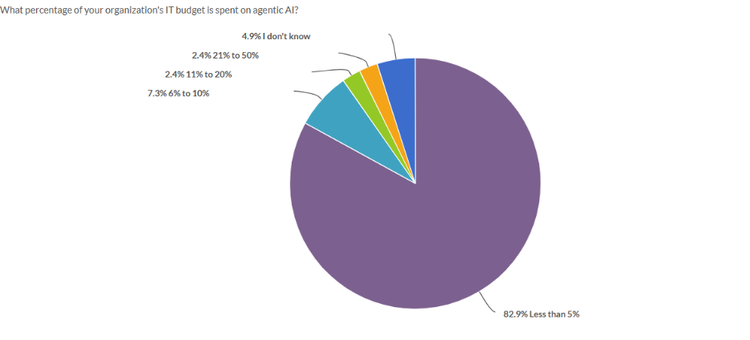
Despite a lot of noise about AI in 2025, over 75 percent of IT leaders said that less than 5 percent of their IT budget was spent on GenAI. And over 80 percent said that they spent less than 5 percent of their budget on agentic AI.
Cybersecurity was a significant investment for midmarket IT and will continue to be so in 2026.
Among those surveyed, 36.5 percent said 11 percent to 20 percent of their IT budget was spent on cybersecurity.
Security was the biggest reason for increased IT budgets.
“Fourth generation of leadership sees value in IT. Hired a CIO and has been allowing us to build out our technology stack,” one IT leader commented in the survey.
Another respondent said that the company was dedicating more resources to securing data as well as various AI projects. Infrastructure resiliency was cited as another spending focus this year.
Most said (30.4 percent) that IT work was mostly focused on internal projects (75 percent) versus customer-facing projects (25 percent).
There were two big investment areas IT leaders were focused on in 2025: cybersecurity and incident management (48.1 percent) and business process automation (35.4 percent).
Overwhelmingly, midmarket IT leaders said they are allocating budgets for VARs and solution providers (57.1 percent), MSPs (55.8 percent) and cloud service providers (53.2 percent).
ROI
Over the past three years, most respondents said they either were on budget as far as their IT expenditure matching budget forecasts or they were 10 percent over budget.
Most also said that ROI for major IT projects was achieved as expected or “somewhat achieved.”
Those who said achieving ROI was less successful cited various reasons, including challenges with adoption. “Using technology is very new to our industry. Our sales force barely uses email. ... Even our current leadership is technology-challenged,” one respondent commented.
Other reasons for underperforming ROI included lack of IT involvement in major projects including system implementations, poor planning, project creep, and vendor hyperbole versus implementation reality
According to one leader: “Achieving ROI is always in view and is typically accomplished, but clearer guidelines and numbers would help enhance ROI achievement.”
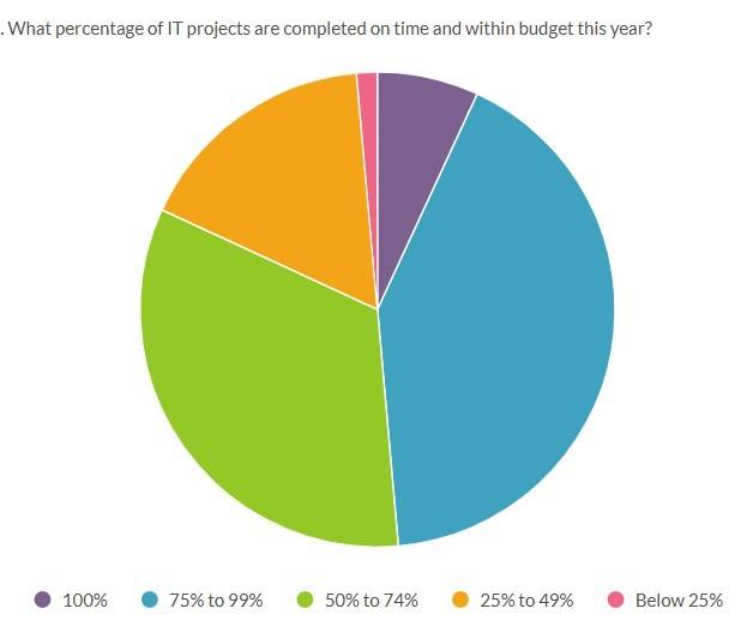
Overall, most said their IT projects were completed on time and within budget.
An Optimistic Outlook For 2026
Almost half (47.2 percent) said they felt more optimistic about their business in 2025 than they did in 2024 and some even more so in 2026.
“2026 is planned to be a transformative year for IT under my leadership. There have been several key achievements with measurable impact in 2025 that positions us nicely for launching some large organizational changes and solutions,” one IT leader offered.
“For the 2nd year in a row our Executive Management and Board of Directors have recognized the amount of Technical Debt we have erased (network infra refresh, rigorous vendor management and change management, PC fleet modernization, replacement of unhealthy DFS file server with new NTFS file servers and migration user directory content to OneDrive). GenAI is unlocking significant competitive advantage,” another commented.
Recruiting And Retaining IT Talent
IT leaders said some of the biggest challenges in recruiting have to do with the industry they are in and their location. However, the majority saw no difference in hiring challenges from 2024 into 2025.
Hardest IT roles to recruit? A vast majority said help desk and support. “Help desk turnover is very difficult,” one leader said.
Software developer/lead developer/and DevOps engineer roles were cited as the next most challenging jobs for recruitment.
Tech Challenges In 2026
The biggest tech challenges midmarket IT leaders predict within the next 12 to 18 months: cybersecurity (cited by 75 percent) and rolling out AI (62.5 percent).
This article originally appeared on CRN sister website MES Computing.